Why Ganga Paused Before Maa Mahagauri: The Extraordinary Moment of Purification
By Pt. Suvrat Sharma
When Divinity and Purity Flow Meet in Silence
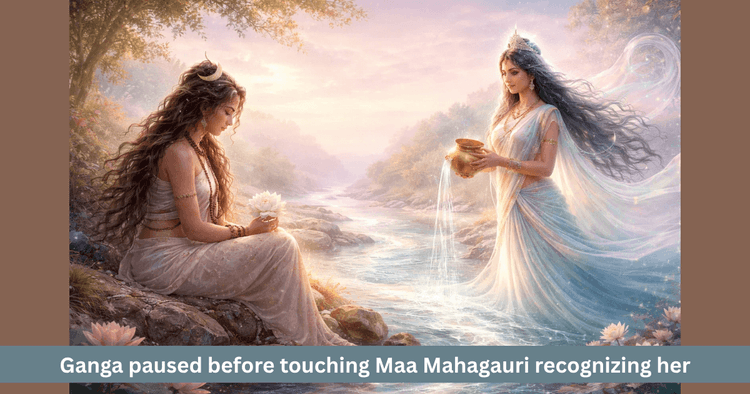
Table of Contents
Some divine episodes speak more through silence than through action. The transformation of Maa Parvati into Maa Mahagauri is one such episode. This is not merely the story of ritual ablution, nor only the description of outer purification. It is the story of a moment in which an ascetic power and a sacred flow stood before each other. On one side stood Maa Parvati, whose body had become covered with dust, austerity, resolve and inner fire. On the other side was Ganga, revered as the embodiment of purity, compassion and divine flow. When these two were about to unite, a brief pause arose and that pause became the deepest truth of the story.
That pause matters because it reveals that all purification is not external. Some souls have already ripened so completely in the fire of tapasya that they need to be recognized more than changed. The emergence of Maa Mahagauri was the result of that profound recognition.
That Form Filled with Austerity Was Not Mere Darkness
Long and severe penance had transformed Maa Parvati’s body. Her complexion had turned dark, dust covered her and the force of her tapasya had given her an intensity that ordinary vision might mistake for only an outer change. But that darkness was not merely physical. It was the visible mark of her resolve, austerity, patience and inner fire.
When a seeker completely surrenders to a sacred goal, the form itself ceases to remain ordinary. It begins to carry the heat of tapasya, the traces of struggle and the power of what is burning within. Maa Parvati’s state was a sign of this truth. She was not merely a goddess performing penance. She had become the very embodiment of tapasya itself.
That is why her purification should never be understood as a simple bath or a story of enhanced beauty. It was a process in which a great spiritual discipline was about to enter its next divine stage.
Ganga’s Pause Was Not Fear but Recognition
When Lord Shiva invited Ganga for the sacred purification of Maa Parvati, the moment was far more than a divine ritual. Two immense powers stood facing one another. One had become complete through tapasya, while the other had purified worlds for ages. In such a moment, Ganga pausing for an instant is both natural and deeply meaningful.
This pause was not a sign of fear. Ganga was not afraid. She was recognizing what stood before her. She experienced that the one upon whom she was to flow was no ordinary body. This was a being already purified through the fire of austerity itself. Here, merely flowing as water would not be enough. The tapasya itself had to be honored.
That is why a subtle stillness arose at that moment. It was as though Ganga herself acknowledged that this purification would not be imposed from outside. It would become the revelation of a perfection already attained within. This is what makes the episode extraordinary.
The Unusual Peace That Spread Across Kailash
With Ganga’s pause, an uncommon peace descended upon Kailash. The gods who witnessed this scene also felt that pause. This was not ordinary silence. It was the silence that descends before a great transformation. There was no haste there, no agitation and no urgency. Everything seemed to be waiting for its right rhythm.
This peace teaches that divine processes do not unfold in haste. They unfold in fullness. When tapasya and grace meet, a profound harmony is born. That very harmony was present in this moment.
For the gods this became a moment of learning. They understood that purity is not merely an outer state. Sometimes a soul has already become so refined through tapasya that even the forces of nature pause before it in reverence.
When Ganga Moved Forward
Then the moment came when Ganga resumed her flow. This was no longer only the movement of water. It was acceptance. It was as if one pure force, having recognized another, was revealing it through her touch. It was as though Ganga were saying that what had become complete within would now shine visibly without.
As her waters flowed over Maa Parvati’s body, a wondrous transformation began. It was not sudden and violent. It unfolded like light spreading gradually. The dust, the outer darkness of austerity, the marks of harsh penance, all slowly began to wash away. In their place there emerged a bright, peaceful and radiant white aura.
This was the divine moment in which Maa Parvati manifested as Maa Mahagauri. This was not merely a change of complexion. It was the journey from austerity to peace, from struggle to balance and from severity to compassion becoming visible.
This Was the Consecration of Tapasya, Not Merely of the Body
The deepest aspect of this episode is that Ganga did not touch only a body. She accepted the tapasya that Maa Parvati had endured. It was a kind of divine offering. One pure force did not bow in defeat before another. It honored and received it.
At this point the story rises to a very high spiritual plane. The purity of Ganga and the austerity of Parvati were not in opposition. They completed one another. Tapasya had purified the inner being. Ganga revealed that purity to the world. This transformation was not imposed from outside. It was the divine unveiling of an inner attainment.
That is why no conflict is seen in this episode. What appears instead is a deep gentleness. There is no victory here, only fulfillment. No defeat, only revelation.
What the Emergence of Maa Mahagauri Signifies
When Maa Mahagauri’s form fully appeared, she was not merely the embodiment of whiteness. She held within herself both the fire of tapasya and the peace of Ganga. This is what makes her form unique. She is not only gentle. She is gentleness born through discipline. She is not only radiant. She is light emerging from struggle. She is not only peaceful. She is the goddess of the peace that comes after crossing storms within.
The form of Maa Mahagauri teaches that true purity does not come from outer ornamentation. It comes from crossing inner difficulty. When one moves through one’s limitations, weariness, darkness and burden, the light that then emerges from within is the principle of Mahagauri.
What Did Lord Shiva See
Lord Shiva witnessed the entire scene in silence. His silence here is deeply meaningful. He knew that this was not only an abhisheka. It was the culminating point of a transformation. He saw that Parvati’s tapasya had now become luminous compassion and divine balance. He saw that struggle had entered fulfillment.
His silence reveals that some truths are not explained. They are experienced. The emergence of Maa Mahagauri was one such truth. It held beauty but even more, it held spiritual attainment. It held radiance but even more, it held the ripened fruit of austerity. It held peace but even more, it held completeness.
Shiva’s silence deepens the story further. For when even a deity like Shiva accepts a transformation in silence, one must understand that what occurred was not ordinary. It was a divine attainment.
How the Gods and Asuras Saw This Scene
The gods saw this moment as a teaching. They realized that purity does not come through outer means alone. If no inner change has occurred, no sacred water can produce lasting purification. But when the inner tapasya is complete, divine grace can reveal it in full. Maa Mahagauri became the living embodiment of that truth.
The asuras, however saw this only as a transformation of form. They could not understand the union of balance, austerity and peace hidden within it. That was their mistake. They failed to see that the power now standing before them was more balanced, more refined and more effective than before. In that very moment, the foundation of their defeat had already been laid.
What Ganga’s Pause Teaches Human Life
This episode is deeply significant for human life as well. People often want every change to happen immediately or they want every process to be completed through outer means alone. But Ganga’s pause teaches that to pause is sometimes necessary. Not every purification is instant. Not every transformation can be completed externally.
Sometimes life covers us with dust, struggle and exhaustion. In such moments we feel that our brightness has been lost. But in truth that period may be the inner preparation itself. When that preparation is complete, a single moment of grace, a single touch of clarity, a single descent of divine compassion can reveal the radiance already born within.
The story of Maa Mahagauri teaches exactly this. True purity comes from within. Outer means only help reveal that truth completely.
That Strange, Beautiful and Deep Moment of Purification
In the end it becomes clear that Ganga’s pause was no accident. It was a divine recognition. It was the acknowledgment that Maa Parvati was not simply a seeker waiting to be purified. She had already reached a new state through the fire of tapasya. Ganga recognized her before she touched her and then through her sacred flow she revealed that fullness to the world.
This is the deepest truth of the story. When inner tapasya becomes complete, outer grace illuminates it. Maa Mahagauri is the name of that illuminated completeness.
Frequently Asked Questions
Why did Ganga pause before touching Maa Parvati
Because this was not merely a moment of outer purification. Ganga recognized the depth of tapasya and divine energy already awakened within Maa Parvati.
Is the form of Maa Mahagauri only a symbol of outer beauty
No. It is a symbol of inner purity, the fulfillment of austerity, peace and balance.
What is the spiritual meaning of Ganga’s abhisheka
It symbolizes the divine revelation of a spiritual discipline that had already become complete within.
Why did Lord Shiva remain silent in this episode
Because he was witnessing the depth of a transformation. It was not only ablution but the emergence of a new state of divine power.
What does this story teach human life
It teaches that true purification comes from within. Outer grace and sacred means help reveal that inner purity in its fullest form.
Get your accurate Kundali
Generate KundaliDid you like it?
Author
Pt. Suvrat Sharma (63)
Experience: 20
Consults About: Family Planning, Career
Clients In: Punjab, Haryana, Delhi
Share this article with friends and family
About ZODIAQ
ZODIAQ is an online Vedic Astrology platform. It connects clients seeking astrological advice to experienced astrologers with deep knowledge. Our users also generate kundali and perform kundali milan for free. ZODIAQ also offers services to the Astrologers. Astrologers utilize various offerings by ZODIAQ to serve their clients effectively.
If you are a User
Consult with experienced astrologers and seek their guidance. You can also order handwritten Janm Patrika report with life prediction prepared by experienced astrologers. Generate accurate Kundali, perform Kundali Matching and check horoscope and muhurat. Utilize our online library for all the necessary astrological and spiritual information.
If you are an Astrologer
Create accurate kundali for your clients and perform Kundali Matching for up to 5 people at a time. Write comprehensive Janm Patrika report for your clients with ZODIAQ. Check client details anytime by saving it in client directory. Become more productive by tracking how many clients you guide every day.
WELCOME TO
ZODIAQ
Right Decisions at the right time with ZODIAQ
