The Asura Who Tried to Steal Maa Kushmanda’s Energy and Vanished Forever
By Pt. Nilesh Sharma
Maa Kushmanda’s Energy and the Asura’s Forbidden Desire
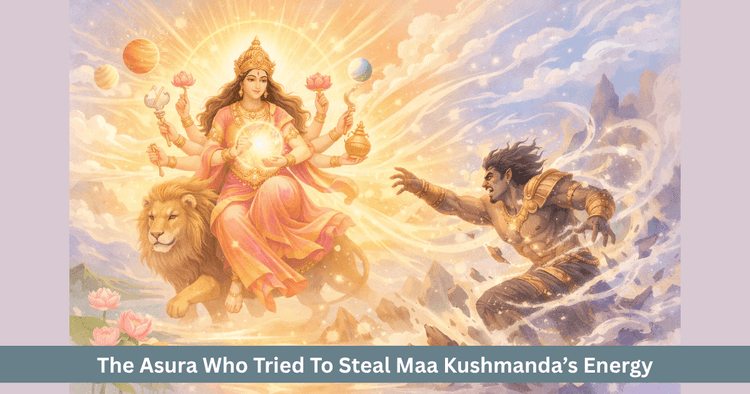
Table of Contents
In the story of Maa Kushmanda, creation, light, balance and primordial Shakti come together in a profound way. Yet this is not only a tale of divine glory. It is also the story of a deep principle, that there are certain forces in existence which are not meant to be possessed but to be understood, honored and lived in harmony with. Within this tradition there appears a rare and mysterious episode, the story of an asura who tried to seize the living energy of Maa Kushmanda and then disappeared so completely that no clear trace of him remained.
This is not merely the story of an asura being destroyed. It is the story of the error that arises when conscious power is treated like an object. At the beginning of creation, while the energy of Maa Kushmanda was spreading across the universe, it was not only the gods who were perceiving this force. Some asuras were also sensing it. This energy was no ordinary radiance. It was the power through which life, light, balance and creation itself were being established. Where light appears, the desire to possess it can also arise and in one asura this desire awakened intensely.
Who Was This Asura And Why Did Such A Thought Arise In Him
The narrative hints that this asura was not merely strong in the ordinary sense. He possessed intelligence, patience and the ability to observe subtle things. He was not one of those beings who believed only in direct warfare. He realized that the energy of Maa Kushmanda was not spreading light alone. It was also creating the flow of life, order and balance wherever it moved.
At that point a dangerous idea was born within him. If such energy could come under his control, he would no longer remain only a powerful asura. He could become one who might influence even the movement of creation itself. This was the seed of his fall. His desire was not only to receive power. His desire was to own power. That is the central truth of the story.
Why Did He Not Choose Direct Battle
The asura understood that facing Maa Kushmanda openly would not be possible. Her radiance could not be overcome by raw force alone. So he chose another path, the path of hidden approach. This decision reflected his intelligence, yet it also became his mistake. He believed that if he could reach the source of the energy without direct confrontation, he could absorb it without having to withstand the resistance of the Goddess.
That is why he made no declaration, raised no war cry and revealed nothing of his intention. Quietly and patiently he moved toward that level where the power of Maa Kushmanda was most concentrated, most subtle and most alive. This was no ordinary field. To reach it required more than force. It demanded inner concentration and a capacity to move upon subtle levels. Through cunning and patience, he reached near it.
What Might That Field Of Energy Have Been Like
The place where Maa Kushmanda’s power was most condensed would not have been merely a field of brightness. It would have been a realm where the original vibration of creation remained active, where light was not only visible but felt as consciousness. It was a level one could enter but not dwell within unless one could also accept the laws of that energy.
At first he believed he had succeeded. He touched the force and it seemed to him that he was drawing it inward. For him, this was the long awaited moment. It appeared as though the energy he desired was at last moving into his being.
What Happened The Moment He Tried To Take The Energy
Here the story takes its most mysterious turn. In the first instant, he felt triumph. It seemed that the power of Maa Kushmanda was beginning to come under his influence. But in the very next moment everything changed. He realized that what he had touched was not inactive energy. It was living consciousness. It did not move according to his will. It moved according to its own eternal law.
The force entered him but not in submission. It entered with its own self governed nature. That was the first moment of fear for the asura. He understood that he was not drawing in a dead light. He had reached a power that knew how, when and where it wished to manifest. His entire plan began to collapse in that realization.
How Did Maa Kushmanda Perceive This Attempt
The story says that Maa Kushmanda sensed all of this through her conscious awareness. She showed no outward anger. She did not raise any weapon. She did not even announce resistance. This is what makes the episode so extraordinary. Her response was not outer opposition. She simply deepened her own energy into a more original, more intense and more truthful state.
When conscious force settles more fully into its own essence, whatever is not aligned with it cannot remain stable. Maa Kushmanda did exactly this. She did not withdraw the energy. She did not merely intensify it in violence. She established it more fully in its true form and that became unbearable for the asura.
What Then Happened To The Asura
As the force of the Goddess deepened into its essential state, the asura’s own consciousness began to fragment. His mind, his strength, his structure and even his sense of self could not remain whole before that power. He had gone to seize energy, not to receive it in reverence. For this reason, he had no inner balance. And without balance, such an immense consciousness cannot be contained.
He felt his own existence begin to dissolve into that force. This was not defeat in an ordinary war. He was not struck down by a weapon, nor overthrown in visible battle. He began to disintegrate through the consequences of his own attempt. His body, his subtle identity and his separate consciousness seemed to merge into the very radiance he had wanted to possess.
Why Is He Said To Have Vanished Forever
This is the most mysterious part of the tale. After that moment, there was no clear trace of him. No body remained. No ordinary story of defeat survived. No final weapon, no visible evidence, no last proclamation. He simply vanished. That is why even for the gods this became a profound mystery.
This disappearance may be understood in two ways. One is that he was completely destroyed because he could not withstand a force beyond his nature. The second, more subtle understanding is that he lost his separate identity and became absorbed into the very energy he wanted to control. That is why some traditions say that he was neither slain in the usual sense nor victorious. He was dissolved.
Was He Truly Destroyed Or Did He Become Part Of That Energy
This question deepens the story even further. When a force is not dead but conscious, one who comes into contact with it may not simply break. One may also be transformed. Some traditions suggest that the asura was not utterly erased but that his separate asuric identity was ended. He became so completely absorbed into that force that no distinct self remained.
This is a very deep idea. It means that the energy of Maa Kushmanda is not merely punishing. It breaks the tendency of appropriation and returns everything to its proper law. What can exist in alignment with that law remains. What tries to dominate it loses its separate form.
What Is The Deepest Spiritual Meaning Of This Story
The greatest message of this story is that some powers can never be controlled. They can only be understood, received and honored. The energy of Maa Kushmanda is one such power. It gives life, spreads light and creates balance, yet it can never become the possession of anyone.
This truth applies in human life as well. Love, light, consciousness, life force, creativity and time itself are not things that can be owned. One who tries to seize them moves away from them. One who approaches them in reverence is nourished by them. This was the essential error of the asura. His deepest mistake was not desire alone. It was his way of seeing. He treated consciousness as though it were an object.
How Does This Story Relate To Our Lives
In our own lives, we often try to control forces that can only be lived in harmony with. Some try to possess relationships. Some try to turn knowledge into pride. Some try to seize spiritual experience and claim it. Yet the more one tries to grasp, the more imbalance may arise within.
The story of Maa Kushmanda teaches that true power lies not in possession but in experience. Light is not grasped. One stands in it. Consciousness is not imprisoned. One aligns with it. Energy is not captured. One enters into rhythm with it. This is one of the subtle laws of life.
The Final Illumination Of This Secret
In the end, it becomes clear that the disappearance of that asura is not merely the ending of a punishment tale. It is the revelation of a divine principle. What is conscious can never be reduced to property. Maa Kushmanda proves that there is no path to conquering primordial power. There is only the path of harmony with it. One who understands this is nourished. One who tries to seize it loses even the self that wished to possess it.
That is the final secret of the story. True power is never an object. It is experienced, like light, like breath and like the Goddess herself.
Frequently Asked Questions
Why did the asura want to steal Maa Kushmanda’s energy
Because he believed that if he gained control over that force, he could influence even the movement of creation itself.
Why did he not choose direct battle
He knew that confronting the Goddess openly would be impossible, so he chose a subtle and hidden path instead.
How did he vanish
In trying to control living divine consciousness, his own balance collapsed and he began dissolving into that energy itself.
Was he completely destroyed
Some traditions suggest that his separate asuric identity ended and he became absorbed into the very force he wanted to control.
What is the greatest message of this story
That some powers are never meant to be possessed. They are to be honored, understood and experienced with reverence.
Get your accurate Kundali
Generate KundaliDid you like it?
Author

Pt. Nilesh Sharma (63)
Experience: 20
Consults About: Family Planning, Career
Clients In: Punjab, Haryana, Delhi
Share this article with friends and family
About ZODIAQ
ZODIAQ is an online Vedic Astrology platform. It connects clients seeking astrological advice to experienced astrologers with deep knowledge. Our users also generate kundali and perform kundali milan for free. ZODIAQ also offers services to the Astrologers. Astrologers utilize various offerings by ZODIAQ to serve their clients effectively.
If you are a User
Consult with experienced astrologers and seek their guidance. You can also order handwritten Janm Patrika report with life prediction prepared by experienced astrologers. Generate accurate Kundali, perform Kundali Matching and check horoscope and muhurat. Utilize our online library for all the necessary astrological and spiritual information.
If you are an Astrologer
Create accurate kundali for your clients and perform Kundali Matching for up to 5 people at a time. Write comprehensive Janm Patrika report for your clients with ZODIAQ. Check client details anytime by saving it in client directory. Become more productive by tracking how many clients you guide every day.
WELCOME TO
ZODIAQ
Right Decisions at the right time with ZODIAQ
