Why Did Lord Shiva Remain Silent When Maa Kushmanda Appeared?
By Pt. Sanjeev Sharma
Shiva’s Silence and Maa Kushmanda’s Divine Emergence at Creation’s Dawn
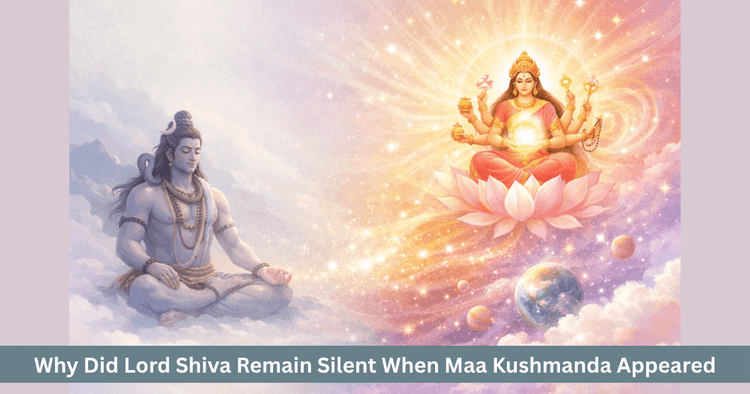
Table of Contents
The beginning of creation was an extraordinarily subtle moment. Time was not yet clearly flowing, direction was not yet established and no visible order had fully emerged. In that immense and mysterious void, when the consciousness of Maa Kushmanda appeared, another profound presence was already there and that presence was Lord Shiva. He was silent, still and aware of everything, yet outwardly he was doing nothing. This silence becomes the deepest mystery of the entire story.
It is said that when Maa Kushmanda began to expand her energy, a vibration arose throughout the void. That vibration slowly turned into light and the seed of creation began to take form. This was a moment in which every power could have become active, every divine force could have intervened and every cosmic presence could have shaped the unfolding. Yet Shiva did not intervene.
Why Is Shiva’s Silence So Mysterious
For the gods, it was difficult to understand why, at the very moment when creation was beginning, a power as immense as Lord Shiva would remain silent. If he had wished, he could have influenced the process. If he had wished, he could have added his own force to the unfolding of creation. But he did not. This question gives the story its depth. Was it indifference. Was it distance. Was it only witness consciousness. Or was there a deeper reason that only one who fully understood the law of creation could recognize.
Over time it becomes clear that Shiva’s silence was not passivity. It was a conscious decision. He knew that every power has its proper time and every cosmic process has its own sacred sequence. If he had intervened at that moment, the natural rhythm of creation might have been altered. The energy of Maa Kushmanda needed both space and time to unfold in its complete form and Shiva gave her that space.
Did Shiva Remain Silent While Knowing Everything
Yes and this is one of the most important layers of the story. Shiva’s silence did not come from unawareness. It came from total inner knowledge. He was feeling every shift taking place within the void. He recognized the vibration from which light was being born. He understood that the energy of Maa Kushmanda was not merely the force of a goddess in a limited sense but the very primordial movement of creation itself. That is why his silence was not helplessness. It was acceptance.
This is where the deeper wisdom of the story emerges. Not every divine force has the same role at every moment. Some powers begin, some preserve, some dissolve and some hold the balance necessary for each phase to unfold. At that moment, the dharma of Maa Kushmanda was creation. Shiva understood this and allowed that energy to reveal itself without interruption. His silence was therefore an act of reverence toward creation itself.
How Does Shiva’s Connection With The Void Explain This Secret
In many traditions, Lord Shiva is associated with the void, stillness, detachment and the unformed foundation of all that can exist. He represents that state in which everything is possible, yet nothing has been bound into form. If Maa Kushmanda is the active radiance of creation, then Shiva is the infinite stillness that exists before form takes birth. When creation arises within the void, the void itself must remain steady. If the ground of silence were to become active too early, the natural rhythm of creation might be disturbed.
That is why Shiva’s silence was not only a personal choice. It was also part of his essential nature. He knew that at that moment his role was not to act but to hold the field. He was the stable ground within which the energy of Maa Kushmanda could expand naturally. Seen in this way, his silence becomes not withdrawal but the necessary foundation of creation.
How Might Maa Kushmanda Have Understood This Silence
One of the most beautiful layers of the story is that Maa Kushmanda did not read Shiva’s silence as distance, weakness or indifference. She understood it as support. It was a support without words, without gesture and without visible action, yet one divine power was offering another the freedom to unfold her work in completeness.
This points to a highly mature divine relationship. In ordinary life, people often understand support only as visible involvement. But here support appears in the form of silent allowance. Maa Kushmanda knew that her work could become complete only if it were left free from unnecessary interference. Shiva’s silence was giving her exactly that freedom. Thus his silence was not distance. It was a form of profound harmony.
When Did The Gods Understand The Meaning Of This Silence
At first, the gods found the scene difficult to understand. They could see the energy of Maa Kushmanda expanding and they could also see that Lord Shiva remained still and silent. But as creation gradually took order, they began to understand the meaning of that silence. They realized that not every power needs to become active at every moment. Sometimes the greatest power is the one that knows how to restrain itself at the right time.
This is one of the profound spiritual teachings of the story. People often think that power is proved through action. But through this event, the gods learned that non action can also be power, when it arises from awareness. Shiva showed that when creation is already unfolding according to its own truth, remaining silent may be just as necessary as acting in another moment.
Is Intervention Necessary In Every Situation
This question is not important only for this story. It is deeply important for life itself. Human beings often assume that if something is happening, they must immediately intervene. But not every unfolding requires our direct involvement. Some processes need to be allowed to take their own course and complete themselves in their own order. If we interfere too early, twist them according to impatience or impose our will upon them, they may remain incomplete.
The silence of Shiva teaches that the recognition of right timing is itself a form of wisdom. Act where action is truly needed. But where a process is already unfolding according to its own inner truth, patience may be the greater strength. Such patience is not weakness. It is a higher form of balance and understanding.
What Does This Story Teach In Human Life
In human life too, there are many moments when something new is being born, a thought, a relationship, a creative vision, an inner transformation or a spiritual experience. In such moments, many people become impatient. They want to direct it, shape it, explain it or interfere with it too quickly. But not every new beginning should be immediately touched. Some things need the protection of silent space.
The story of Shiva and Maa Kushmanda teaches that when a deep process is being born in life, one does not always need to act outwardly. Sometimes it is enough to remain present, to witness, to understand and to allow it to take its natural expansion. This silent support can become more powerful than any spoken guidance.
Was Shiva’s Silence Also Part Of Creation
Yes and this is a very important insight. If creation is understood only as the birth of light, then the story remains incomplete. For light to spread, there must also be a stable field in which it can unfold. Maa Kushmanda gave the force of creation but Shiva’s silence gave that creation its space. In this sense, Shiva’s silence was also an essential part of the creative process.
Creation never happens in isolation. Many subtle dimensions work together. One force acts and gives birth, while another remains still and makes that birth possible. The silence of Shiva is the divine example of this second principle. He proved that sometimes stepping back is itself the highest participation.
What Is The Final Meaning Of This Secret
In the end, it becomes clear that the silence of Lord Shiva was not passivity. It was the form of balanced awareness, right timing and respect for the law of creation. He did not feel the need to act simply because he had the power to do so. He recognized that in that moment the greatest action was to remain silent and allow the energy of Maa Kushmanda to unfold in full.
This is the deepest light of the story. True power lies not only in action but also in knowing when to remain silent. It lies in knowing when to stop oneself, when to offer another force the space to complete its work and when stillness becomes the highest form of support. Lord Shiva stands here as the symbol of that divine wisdom.
Frequently Asked Questions
Why did Lord Shiva remain silent when Maa Kushmanda appeared
Because he understood that the process of creation needed to unfold in its own complete form without interference.
Was Shiva’s silence a sign of indifference
No. It arose from complete awareness and deep respect for the sacred law of creation.
Was Shiva aware of everything happening in creation
Yes. He was inwardly fully awake and was feeling every change taking place.
How did Maa Kushmanda understand this silence
She saw it not as distance but as a silent support that allowed her work to unfold completely.
What is the greatest message of this story
That not every moment requires action. Sometimes the greatest strength and deepest wisdom lie in remaining silent at the right time.
Get your accurate Kundali
Generate KundaliDid you like it?
Author

Pt. Sanjeev Sharma (63)
Experience: 20
Consults About: Family Planning, Career
Clients In: Punjab, Haryana, Delhi
Share this article with friends and family
About ZODIAQ
ZODIAQ is an online Vedic Astrology platform. It connects clients seeking astrological advice to experienced astrologers with deep knowledge. Our users also generate kundali and perform kundali milan for free. ZODIAQ also offers services to the Astrologers. Astrologers utilize various offerings by ZODIAQ to serve their clients effectively.
If you are a User
Consult with experienced astrologers and seek their guidance. You can also order handwritten Janm Patrika report with life prediction prepared by experienced astrologers. Generate accurate Kundali, perform Kundali Matching and check horoscope and muhurat. Utilize our online library for all the necessary astrological and spiritual information.
If you are an Astrologer
Create accurate kundali for your clients and perform Kundali Matching for up to 5 people at a time. Write comprehensive Janm Patrika report for your clients with ZODIAQ. Check client details anytime by saving it in client directory. Become more productive by tracking how many clients you guide every day.
WELCOME TO
ZODIAQ
Right Decisions at the right time with ZODIAQ
