Was Maa Brahmacharini Actually Testing Shiva? The Hidden Secret Behind Love
By Pt. Amitabh Sharma
Brahmacharini’s Tapas, Patience, and Consciousness Leading to Deeper Understanding of Love
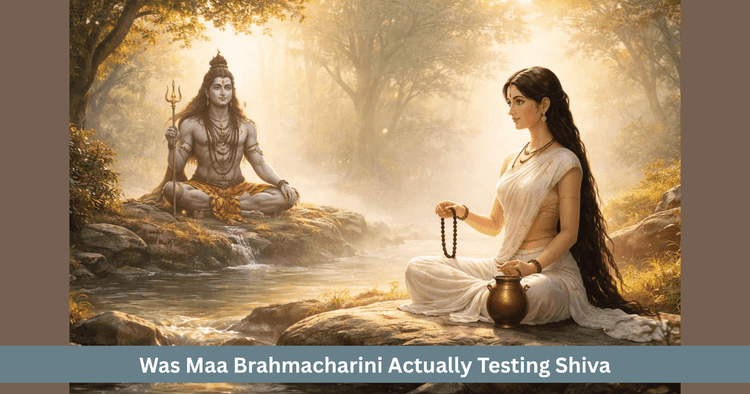
Table of Contents
If the story of Maa Brahmacharini is seen only as austerity, devotion or a deep longing to attain Shiva, then only its outer layer is understood. The true depth of this narrative lies in the silent dialogue that unfolds not through words but through resolve, tapas, patience and the maturation of consciousness. At first glance, it appears that Brahmacharini is simply engaged in severe spiritual discipline in order to attain Shiva. Yet when the episode is viewed more subtly, another question arises. Was this only the journey of one side or was it also a process in which Shiva himself was being tested.
This is not an ordinary question. Shiva is not someone to be attained in a simple human sense. He is the form of supreme consciousness itself. He is detached, beyond binding, complete within himself and not easily drawn into relationship. Therefore if divine power wishes to unite with him, it cannot happen through longing alone. It must rise to such a height that love is no longer desire but becomes a state of existential equality. This is the point where the tapas of Maa Brahmacharini asks for a deeper interpretation.
Was Her Tapasya Only To Attain Shiva
On the surface, it certainly appears that Brahmacharini’s tapas is directed toward obtaining Shiva as her divine consort. That is true but it is not the complete truth. Her tapas held devotion, surrender and an unwavering orientation toward Shiva. Yet within it there was a deeper process unfolding. She was not merely trying to reach Shiva. She was transforming herself to such a degree that Shiva’s acceptance could become natural.
This distinction is essential. The desire to attain and the discipline to become worthy are not the same thing. Ordinary love seeks to obtain. Divine love transforms the self. The tapas of Maa Brahmacharini belonged to this second category. She did not attempt to change Shiva. She raised herself into such purity, steadiness and vastness that no inequality would remain between them. Seen in this light, her austerity was not only a request. It was the process of becoming worthy of divine union.
Can Love Contain A Hidden Test Within It
Here it becomes important to understand the relationship between love and testing. In ordinary language, a test is associated with challenge, suspicion or conflict. But in spiritual relationships, a test carries a very different meaning. It is not meant to defeat anyone. It serves to reveal whether both sides have reached the truth where their union can become not merely emotional but a symbol of cosmic balance.
The tapas of Maa Brahmacharini appears to function in this way. She crossed every limitation within herself. She disciplined desire, refined the body through austerity, gathered the mind into one point and made patience her greatest strength. This was not merely self demonstration. It also became a silent question placed before Shiva. That question was not spoken aloud, yet Shiva had to answer it. The question was whether he would recognize the power hidden in this tapas, the truth hidden in this love and the equality hidden in this devotion.
What Does It Mean To Say That Shiva Was Being Tested
It would not be correct to say that Maa Brahmacharini was challenging Shiva in a confrontational sense. Yet it is profoundly meaningful to say that her tapas placed before Shiva a silent spiritual test. This was not an outer test. It was not about victory or defeat. It was a test of whether Shiva would recognize the force that was no longer merely devoted to him but had itself become consciousness refined through tapas.
Shiva has always been depicted as detached. He stands beyond the attractions of the world. Pleasure, splendor, emotional insistence and social bonds do not easily move him. That is why any ordinary affection would never have been enough for him. The tapas of Maa Brahmacharini demonstrated that her love was not ordinary. It had transformed into tapas. The question then became whether Shiva would recognize this transformation, whether he would accept this silent radiance and whether he would see that this was not merely attraction toward him but the call of a power that had risen to equal depth.
Was Maa Brahmacharini Making Herself Equal To Shiva
This is one of the deepest sides of the narrative. Brahmacharini was not merely drawing closer to Shiva. She was awakening within herself the same stillness, the same detachment, the same centered awareness and the same force of tapas that are seen in Shiva. For this reason, her tapas was not only external discipline. It was a transformation of being.
If Shiva represents supreme detachment, Brahmacharini was awakening that detachment within herself. If Shiva is silent consciousness, Brahmacharini was embodying that same silence through tapas. If Shiva stands beyond worldly entanglement, Brahmacharini was rising beyond inner desire, emotional dependence and limitation. In this way, she was not only approaching Shiva. She was rising to the level at which their union could become not a joining of unequal sides but the meeting of two balanced and equal powers.
Tapasya Not To Possess Love But To Become Worthy Of It
This narrative offers an extremely elevated understanding of true love. Ordinary love seeks to possess the other. Divine love refines the self until receiving becomes natural. Maa Brahmacharini did not attempt to make Shiva change. She did not demand that he abandon his detachment, alter his form or become suited to her expectations. She lifted herself, refined herself, entered tapas and made her consciousness so steady that Shiva’s acceptance could become not a gift of pity but the natural result of her own attainment.
This is the beauty of the story. It separates love from dependence and links it with self transformation. It teaches that true love does not weaken a person. It makes them inwardly clearer, steadier and more worthy. The tapas of Brahmacharini is therefore a living example of divine love.
How Was The Silent Dialogue Taking Place
The most extraordinary aspect of this process is that there was no direct spoken exchange. Shiva did not come repeatedly to give explanations and Brahmacharini did not express her tapas through words. Yet a profound silent dialogue continued between them. Every vow, every austerity, every act of restraint, every moment of patience was carrying a message toward Shiva. It was a communication not of language but of consciousness.
At the same time, Shiva was not merely observing. He was understanding. He was recognizing that this was not the emotional insistence of a goddess seeking him. This was the awakening of a power that had already proved itself. That is why his acceptance was neither sudden nor superficial. It was the response to a long inner dialogue that had already ripened.
Could This Union Happen Only When Both Reached The Same Level
From a spiritual perspective, yes. If Shiva had accepted Parvati without this tapas, that acceptance would have signified love but it would not have carried the same depth. But when Maa Brahmacharini stood before him after awakening within herself the same steadiness, the same self mastery, the same detachment and the same luminous resolve, their union rose beyond ordinary marriage and became a balanced divine conjunction.
This union is special because one side is not merely giving while the other is receiving. Both are complete in themselves and accept one another from that fullness. That is why it would be inadequate to call this only a love story. It is the story of a union in which equality, maturity and cosmic balance are hidden at the deepest level.
What Does This Secret Of Maa Brahmacharini Teach Today
This story is not only about a goddess and a god. It is equally true in human life. Every deep relationship contains an inner process. Both sides are shaped, refined and matured by it. The love that inspires a person to rise inwardly is the love that endures. The love that only seeks possession soon becomes restless. Maa Brahmacharini’s hidden teaching is that the highest form of love inspires tapas, patience, steadiness and self awakening.
The love that merely wants to capture the other is not divine. Divine love first makes itself luminous. That is why her story remains relevant. It teaches that every meaningful union requires more than attraction. It requires inward preparation.
The Impartial Meaning Of This Story
In the end, it becomes clear that Maa Brahmacharini was not practicing tapas merely to attain Shiva. She was creating a condition in which their union could become the symbol of a new balance for creation itself. If this is called a test, then it was not a test meant to defeat anyone. It was the test of worthiness, where love, tapas, patience, awareness and equality come together and make union divine.
That is why the story is so profound. There is love here but not demand. There is tapas but not harshness. There is testing but not rivalry. There is union but not ordinary relationship. This is the secret hidden in the form of Maa Brahmacharini.
Frequently Asked Questions
Was Maa Brahmacharini really testing Shiva
Not directly but her tapas functioned like a silent spiritual test through which it became clear whether Shiva would recognize this divine equality.
Was her tapas only to attain Shiva
No. Along with the desire to unite with Shiva, it was also the discipline of making herself worthy of that divine union.
What is the spiritual meaning of Shiva being tested
It does not mean challenge. It means whether Shiva would accept the power of tapas and the maturity of divine love standing before him.
What is the greatest message of this story
That true love makes a person more steady, more refined and more awakened. It is not only the desire to attain but the process of becoming worthy.
How does this story apply in life
It teaches that every deep relationship is strengthened not merely by attraction but by inner maturity, patience and self transformation.
Get your accurate Kundali
Generate KundaliDid you like it?
Author

Pt. Amitabh Sharma (56 Years)
Experience: 20
Consults About: Family Planning, Career
Clients In: Punjab, Haryana, Delhi
Share this article with friends and family
About ZODIAQ
ZODIAQ is an online Vedic Astrology platform. It connects clients seeking astrological advice to experienced astrologers with deep knowledge. Our users also generate kundali and perform kundali milan for free. ZODIAQ also offers services to the Astrologers. Astrologers utilize various offerings by ZODIAQ to serve their clients effectively.
If you are a User
Consult with experienced astrologers and seek their guidance. You can also order handwritten Janm Patrika report with life prediction prepared by experienced astrologers. Generate accurate Kundali, perform Kundali Matching and check horoscope and muhurat. Utilize our online library for all the necessary astrological and spiritual information.
If you are an Astrologer
Create accurate kundali for your clients and perform Kundali Matching for up to 5 people at a time. Write comprehensive Janm Patrika report for your clients with ZODIAQ. Check client details anytime by saving it in client directory. Become more productive by tracking how many clients you guide every day.
WELCOME TO
ZODIAQ
Right Decisions at the right time with ZODIAQ
