The Moment When Maa Brahmacharini Recognized Her True Power And Everything Changed
By Pt. Sanjeev Sharma
Brahmacharini’s Inner Awakening and Realization of Her True Self
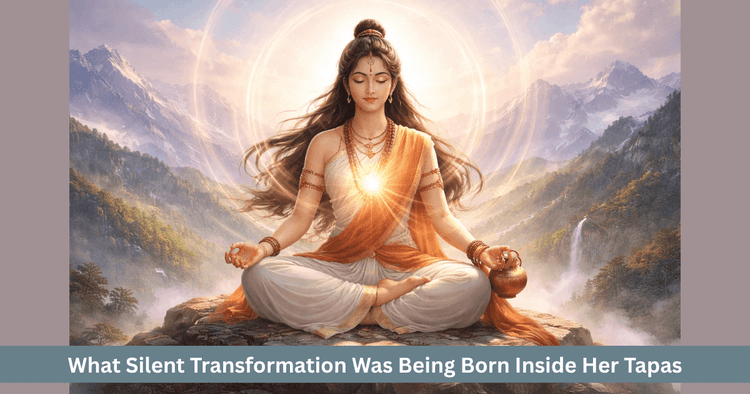
Table of Contents
In the story of Maa Brahmacharini, there comes a point that is not merely the continuation of austerity but the moment of inner awakening. From the outside, it may appear like the natural progression of spiritual discipline, yet inwardly it is far deeper than that. It is the moment when her journey stops being only a movement toward a goal and becomes the realization of her own being. That is why it is not enough to describe this episode as the result of tapas alone. It is the arising of an inner light that was always present but had not yet been fully recognized in experience.
In the beginning, her path was marked by clear intention. There was resolve, patience, devotion and a seriousness of purpose that was not ordinary. She was practicing tapas, steadying her mind, disciplining the body and slowly refining every layer of her own being. Yet there comes a stage in tapas when the seeker is no longer merely practicing. The seeker begins to meet the depth of the self beyond effort. Maa Brahmacharini had reached that point.
What Silent Transformation Was Being Born Inside Her Tapas
Tapasya often begins with outer discipline. One fasts, restrains the senses, holds patience and learns to keep the mind fixed upon a goal. Yet when practice deepens, the transformation begins to move from behavior into consciousness itself. Something similar was unfolding within Maa Brahmacharini. At first it may have appeared as patience, then it may have matured into steadiness and gradually it became that peace in which outer disturbance begins to lose its grip.
This is the subtle stage where the seeker first realizes that the practice is no longer only something being done. Something real is changing within. One is no longer governed by circumstances but begins to be guided by inner consciousness. This inward shift is what makes the story of Maa Brahmacharini so profound. It is the point where her tapas rises beyond outer austerity and enters the realm of self awareness.
Did She Gain Her Power From Outside Or Recognize It Within
This is the central truth of the narrative. Maa Brahmacharini did not receive her power from outside. She recognized it within. This difference is immense. Many forms of power in the world appear to be gathered from the outside through position, influence, recognition, wealth, knowledge or support. But the power that awakens from within does not depend upon external things. It becomes part of one’s very being.
That moment in her life was the moment of this inner recognition. She saw that she was not merely a seeker engaged in tapas. She was already connected to the source of power from which tapas gains meaning, patience gains foundation and spiritual effort receives direction. This realization did not come as a dramatic declaration. It came as a deep silent knowing, as though some inner veil had fallen away and she had glimpsed her own real nature.
What Might That Moment Of Recognition Have Been Like
Such an experience is difficult to capture in words because it belongs more to realization than to thought. Yet the story suggests that it must have been extraordinary. A different stillness seems to have entered the atmosphere. Even the air may have felt quieter. Time itself may have seemed to slow. Maa Brahmacharini remained absorbed in meditation but now this was no longer only concentration. It was awakening.
This awakening did not come like an explosion. It spread like a gentle radiance. Not a radiance that startles the eyes but one that transforms consciousness. It would have spread gradually around her and with it her very presence would have begun to feel different. This is the point where the seeker and the practice are no longer separate. The seeker becomes the living expression of the discipline.
Why Did The Gods Sense This Change
Whenever such an awakening happens within a great being, its effect does not remain limited to that one presence alone. The subtle worlds register it. That is why it is said that the gods immediately sensed this transformation. They understood that this was not an ordinary attainment through tapas. It was a moment in which power was becoming aware of itself and when power knows itself, its influence reaches the level of cosmic balance.
The response of the gods is important here. It does not mean they feared this power. Rather, they recognized its seriousness. They knew that something far greater than personal attainment had happened. A consciousness had awakened that could influence the wider order of existence. Maa Brahmacharini was no longer only the goddess engaged in austerity. She was becoming the embodiment of awakened power.
What Is The Fundamental Difference Between Inner Power And Outer Power
The story of Maa Brahmacharini offers an especially beautiful answer to this question. Outer power changes. It may depend on time, people, circumstances and resources. It may appear strong today and diminish tomorrow. But once inner power awakens, its source is no longer outside. It remains rooted within. For this reason, it is deeper, more enduring and more luminous.
Maa Brahmacharini recognized precisely this second form of power. She realized that what was awakening within her was not merely the result of achievement but the emergence of her own true nature. This awakening is what lifts her beyond the image of an ascetic practitioner and turns her into a symbol of power itself. She is no longer only practicing tapas. She is becoming the very form of शक्ति born through tapas.
Was This Experience Only Personal To Her
No and that is one of the most beautiful teachings of this episode. Although the awakening occurred within her, its significance is not limited to the personal level. It carries a universal lesson. That lesson is that every being already holds within a power that is often searched for outside. Human beings imagine that strength will come from outer accomplishment, direction from outside guidance and meaning from external recognition. The story of Maa Brahmacharini reveals that the real beginning happens within.
Her experience teaches that until a person journeys inward and meets the depth of their own being, they cannot know the fullness of their strength. That is why this is not only a divine story. It is an invitation to every seeker, every human being and every questioning soul to turn toward the source within.
How Did This Awakening Change The World Around Her
When the inner center changes, the outer field begins to change as well. As this recognition awakened within Maa Brahmacharini, its effect began to spread into the space around her. The atmosphere became more still, her presence became more powerful and those who came near her field of tapas felt an unspoken force. This change did not appear as an outer miracle. It appeared as the depth of energy itself.
This reveals another essential truth. Transformation does not always begin outside. It begins in the consciousness within. Once there is clarity within, the direction of the outer world also starts to shift. Once inner power awakens, outer circumstances begin to take on new meaning. The story of Maa Brahmacharini is a divine example of this subtle law.
What Does This Episode Teach About Inner Strength
This narrative makes it clear that inner strength is not built by outer proof. It is formed slowly within through patience, discipline, solitude, austerity and the courage to meet oneself honestly. Maa Brahmacharini recognized exactly this strength within herself. That recognition became the turning point of her journey. She was no longer simply a seeker moving toward a goal. She had become the very form of the power worthy of that goal.
This is what inner strength truly means. It means to be rooted within. It means to move not by outer approval but by inner clarity. It means that decisions arise from understanding rather than fear. Maa Brahmacharini stands as the highest inspiration for such strength. She shows that the awakening of inner power does not arise through noise but through deep discipline and silent realization.
Why Does This Story Matter So Much Today
In the present age, people often measure power through outer success, visibility, social approval and comparison. That is why the story of Maa Brahmacharini becomes especially important. It teaches that the greatest power a person can have is the center within. If that center is awake, outer difficulties may disturb but they cannot destroy. If that center is asleep, even outward success may leave an inner emptiness.
For this reason, this story is not only meant for worship. It is also meant for life. It asks whether we have the courage to go inward. It asks whether we truly want to know our real strength or whether we remain satisfied with its outer symbols. Maa Brahmacharini gives a clear answer. One who recognizes the power within is the one who truly changes and such a person can also transform the world around them.
What Was That Moment In Its Deepest Sense
In the end, it becomes clear that this was not merely a spiritual experience. It was a new birth. At that point Maa Brahmacharini ceased to remain only in the role of a seeker. She became the symbol of the very power that sustains creation, gives it direction and illumines it from within. That is why it is not enough to call this only an episode of tapas. It is the moment of recognizing one’s own inner power and from that point, everything changes.
She teaches that such a moment is never found outside. It is born within. When practice deepens, when the mind becomes still and when one stops fleeing from the truth within, then one day the moment arrives when the self is recognized. That recognition changes the direction of life itself.
Frequently Asked Questions
What was the moment in which Maa Brahmacharini recognized her true power
It was the point where her tapas ceased to be only effort and became the realization of the real source of power within her.
Did she receive this power from outside
No. She did not obtain it from outside. She recognized it within.
Why did the gods sense this transformation
Because it was not merely personal. The awakening was so deep that its effect reached the subtle worlds.
What is the main message of this story
That our greatest power is not outside but hidden within and it can be recognized only by turning inward.
How is this episode useful in life today
It teaches that inner clarity, steadiness and self strength matter more than outer achievement alone.
Get your accurate Kundali
Generate KundaliDid you like it?
Author

Pt. Sanjeev Sharma (63)
Experience: 20
Consults About: Family Planning, Career
Clients In: Punjab, Haryana, Delhi
Share this article with friends and family
About ZODIAQ
ZODIAQ is an online Vedic Astrology platform. It connects clients seeking astrological advice to experienced astrologers with deep knowledge. Our users also generate kundali and perform kundali milan for free. ZODIAQ also offers services to the Astrologers. Astrologers utilize various offerings by ZODIAQ to serve their clients effectively.
If you are a User
Consult with experienced astrologers and seek their guidance. You can also order handwritten Janm Patrika report with life prediction prepared by experienced astrologers. Generate accurate Kundali, perform Kundali Matching and check horoscope and muhurat. Utilize our online library for all the necessary astrological and spiritual information.
If you are an Astrologer
Create accurate kundali for your clients and perform Kundali Matching for up to 5 people at a time. Write comprehensive Janm Patrika report for your clients with ZODIAQ. Check client details anytime by saving it in client directory. Become more productive by tracking how many clients you guide every day.
WELCOME TO
ZODIAQ
Right Decisions at the right time with ZODIAQ
