Why Maa Brahmacharini Chose To Walk Alone And Why This Is More Than A Story Of Devotion
By Pt. Narendra Sharma
Brahmacharini’s Solitary Journey: Deep Message of Inner Strength and Purpose
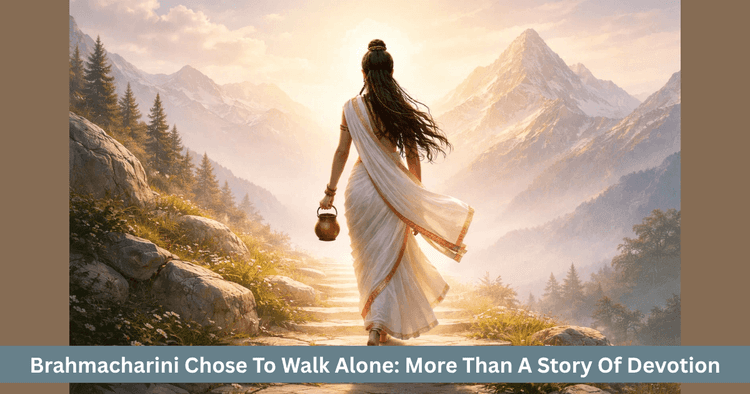
Table of Contents
The story of Maa Brahmacharini is often understood only as a tale of devotion, austerity and the desire to attain Shiva. That view is not wrong, yet it is incomplete. If her journey is seen only as the longing of a goddess for her chosen Lord, then the deeper truth hidden within her path remains unseen. Her story is not merely about devotion. It is also about a form of power that chooses to walk alone in order to know itself completely. That is why her solitude does not symbolize weakness. It becomes the sign of awakened inner strength.
It is important to understand that her walking alone was not the result of rejection, defeat, helplessness or emotional collapse. She had family, affection, protection, dignity and the kind of secure life that most beings would consider sufficient for happiness. Yet she chose a path where external support was minimal and inner confrontation was profound. This itself is the first great sign in her story. A person chooses difficulty over comfort only when the purpose within has become greater than the pleasure outside. In Maa Brahmacharini, that purpose had already awakened.
Why Was Solitude For Her Not Renunciation But Awakening
Very often solitude is associated with loss, distance or emptiness. But the solitude of Maa Brahmacharini is different from all of these. She did not choose to be alone because she wanted to run away from others. She chose solitude because she wished to come closer to her inner truth. This distinction is essential. To move away from the world is not the same as to move toward oneself. Many remain outwardly alone and yet inwardly scattered. The solitude of Maa Brahmacharini was the solitude of inner concentration.
When a person steps back from outer dependence, they are compelled to meet their own mind. That meeting is often the most difficult and yet the most fruitful. That is why her solitude is not an empty condition. It is a living discipline. There is silence but not emptiness. There is distance but also depth. There is little outer companionship but much greater inner presence.
Did She Not Have The Option Of Living An Easy Life
Certainly she did. That is precisely what makes her story even more powerful. If no option had been available, then choosing the difficult path would not appear as extraordinary. But when everything is available and one still chooses austerity, solitude and self discipline, it becomes clear that the decision is not ordinary. Maa Brahmacharini did not reject a simple life merely for the sake of hardship. She chose deep fulfillment over surface comfort.
She had everything that could have given a royal daughter a protected and respected life. Yet she did not mistake comfort for truth. This decision shows how strong the inner call had become within her. She knew that outer security can make life easier for a while but it cannot make the soul truly steady. That steadiness must be earned within and such earning often happens in solitude. That is why her walking alone was actually proof of trust in the power within herself.
What Does A Person Encounter First When Walking Alone
When someone truly walks alone, the first encounter is with their own inner layers. Fear appears, doubt appears, unresolved questions arise and hidden illusions stand exposed. This is the deeper side of Maa Brahmacharini’s journey. She did not merely give up outer pleasures. She agreed to face every inner conflict.
This is what makes her great. The ordinary human tendency is to avoid fear, run away from discomfort and cover inner noise through outer activity. Maa Brahmacharini did the opposite. She saw every fear, recognized every weakness and instead of suppressing them, she transformed them through tapas. That is why her solitude slowly stopped being a field of weakness and became a field of power.
How Did Walking Alone Become A Means Of Building Power
When a person walks alone, decisions must be taken alone, doubt must be faced alone, patience must be held alone and direction must be found from within. This is where outer support begins to fall away and an inner foundation begins to form. The story of Maa Brahmacharini gives living form to this truth. For her, solitude was not emptiness. It was the ground upon which self reliant power was built.
It is often easier to walk in company because direction is shared. But walking alone forces a person to stand upon their own center. That is why her decision was not only a decision for austerity. It was a decision for self dependent consciousness. She lived in such a way that her resolve no longer depended on outer confirmation. This is one of the clearest signs of real power.
Is This Story Limited Only To Personal Spiritual Practice
No and that is one of its greatest strengths. The form of Maa Brahmacharini is not merely the account of a private spiritual life. It is a living teaching for seekers in every age. In life, there are times when one must walk alone in order to grow inwardly. At such times, outer support may be absent, others may not understand, the path may appear difficult and the mind may tremble. In such moments, her story reminds us that walking alone is not always the sign of loss. Often it is the sign of deep inner preparation.
Her decision teaches that the greatest growth often begins when a person learns to hear the voice within above the noise outside. This lesson is not limited to spiritual life. It applies equally to relationships, work, knowledge, discipline and self decision.
Is Power Always Built Through Companionship
The common belief is that power is built through support, recognition, community and collective movement. All of these certainly have value but Maa Brahmacharini reveals another kind of power, one that is forged in solitude. It is this power that makes a being inwardly unshakable. Until a person learns to stand alone inwardly, even outer power remains dependent upon circumstances.
Maa Brahmacharini does not teach that companionship has no worth. She teaches that unless one can stand within oneself in solitude, even companionship cannot create lasting strength. Real power is first born inwardly and only then does it shape the outer life. That is why her solitude becomes the first school of strength.
How Did Her Solitude Become A Dialogue With Nature
Another deeply beautiful side of her story is that when she stepped away from human support, she did not enter emptiness. Her solitude became a silent relationship with nature. Forest, wind, trees, sky and water all seemed to become witnesses to her tapas. This is not merely poetic imagination. Spiritual tradition often holds that when a seeker becomes deeply steady within, nature begins to enter into subtle harmony with that consciousness.
For this reason, her solitude was not barren. It was the solitude of a wider silent companionship. There were no spoken words, yet there was communion. There was no human support, yet there was the witnessing presence of nature. That is why her aloneness was not emptiness. It was filled with a profound sense of living connection.
Why Is This Story More Than A Story Of Devotion
Because the heart of this narrative is not merely the desire to attain the beloved. Its center is the process of becoming worthy of divine union. One may see devotion here and that is true. But if one looks deeper, one sees self transformation. Maa Brahmacharini was not only practicing to attain Shiva. She was awakening within herself such power that she could remain steady in truth without dependence on any external support.
That is what takes this story beyond devotion and makes it a story of power. There is love here but not dependence. There is surrender but not weakness. There is solitude but not loneliness. There is tapas but not harshness. There is the presence of a woman who is becoming so inwardly complete that her path itself becomes proof of her strength.
What Does This Story Teach For Life Today
Many people in modern life are afraid of being alone because solitude places them face to face with themselves. The form of Maa Brahmacharini teaches that if solitude is embraced rightly, it can become the greatest source of strength. She teaches that descending inward, seeing one’s limitations, choosing one’s path consciously and facing fear instead of escaping from it are all part of building inner power.
This story also teaches that no outer support is permanent. At times life takes away visible supports only to teach a person how to stand upon their own being. In those moments, the story of Maa Brahmacharini becomes like a lamp. It reminds us that the one who recognizes the power within does not collapse even when outer supports grow few. Instead, such a being becomes more free.
The Final Life Teaching Of Maa Brahmacharini
In the end, it becomes clear that Maa Brahmacharini’s decision to walk alone is not a story of loss but a story of reaching oneself. She did not choose solitude because she was defeated by the world. She chose it because she wished to reach that power within which is greater than any outer condition. That is why her form is not only the form of an ascetic but also of self knowledge, inner strength and deep freedom.
She teaches that once a person recognizes the power within, external support is no longer needed at every step. That is the moment of real freedom. That is the moment when fear begins to loosen its grip. And that is the moment when an ordinary life begins to move in a divine direction.
Frequently Asked Questions
Why did Maa Brahmacharini choose to walk alone
Because she wished to come closer to her inner truth, strength and steadiness. Her solitude was the path of self awakening.
Was her solitude a compulsion
No. It was a fully conscious and voluntary choice. She chose self discipline over comfort.
Why is this story more about power than devotion
Because it is not only about surrender but also about self mastery, self reliance and the deep building of power within.
Is walking alone always a sign of weakness
No. Very often it is the beginning of inner strength, clarity and spiritual maturity.
What is the greatest message of this story
That true power is built within and the one who learns to walk alone in truth becomes truly free.
Get your accurate Kundali
Generate KundaliDid you like it?
Author

Pt. Narendra Sharma (63)
Experience: 20
Consults About: Family Planning, Career
Clients In: Punjab, Haryana, Delhi
Share this article with friends and family
About ZODIAQ
ZODIAQ is an online Vedic Astrology platform. It connects clients seeking astrological advice to experienced astrologers with deep knowledge. Our users also generate kundali and perform kundali milan for free. ZODIAQ also offers services to the Astrologers. Astrologers utilize various offerings by ZODIAQ to serve their clients effectively.
If you are a User
Consult with experienced astrologers and seek their guidance. You can also order handwritten Janm Patrika report with life prediction prepared by experienced astrologers. Generate accurate Kundali, perform Kundali Matching and check horoscope and muhurat. Utilize our online library for all the necessary astrological and spiritual information.
If you are an Astrologer
Create accurate kundali for your clients and perform Kundali Matching for up to 5 people at a time. Write comprehensive Janm Patrika report for your clients with ZODIAQ. Check client details anytime by saving it in client directory. Become more productive by tracking how many clients you guide every day.
WELCOME TO
ZODIAQ
Right Decisions at the right time with ZODIAQ
