Was Maa Chandraghanta’s Anger Only An Illusion Or A Real Cosmic Power
By Pt. Sanjeev Sharma
Mystery of Chandraghanta’s Anger: Difference Between Human Emotion and Divine Power
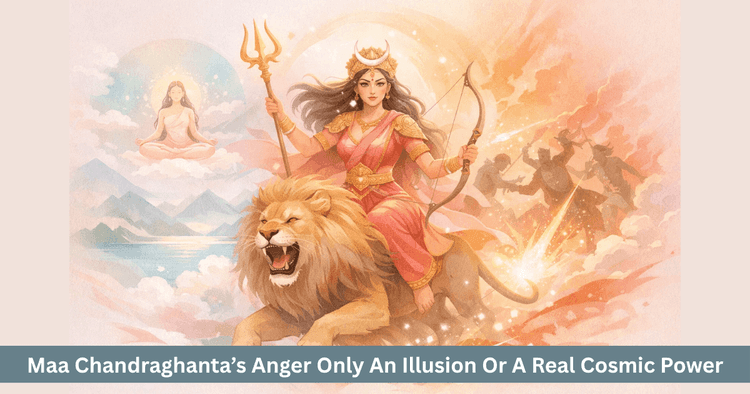
Table of Contents
When one beholds the fierce form of Maa Chandraghanta, the first question that arises is whether this anger was truly real or whether it was only an appearance created to terrify the asuras. Her face remains calm, yet in her eyes there is an intensity capable of changing everything in a single moment. This very contrast gives the story its depth. It asks us to understand the difference between human anger and divine force.
Ordinary human anger usually arises from reaction. It is born from hurt ego, insult, fear, insecurity or the loss of inner balance. But the fierce form of the Goddess is not anger in that same sense. There is no blindness in it, no confusion and no uncontrolled agitation. The fierce presence of Maa Chandraghanta appears when the balance of creation is endangered and when gentleness alone is no longer enough to restore order. For this reason, her anger is not personal. It is the manifestation of a power that protects dharma.
Is Divine Anger The Same As Human Anger
This is where the central meaning of the story begins to unfold. Human anger often weakens the person who experiences it because it carries loss of control. But Maa Chandraghanta’s fierce form is not a loss of control. It is the sign of perfect control. Every glance is purposeful, every movement is measured and every action is guided toward restoring balance.
Her form teaches that not all intensity is negative. Some intensity is necessary to stop injustice. Just as a difficult surgery may appear harsh but is meant for healing, in the same way the fierce form of Maa Chandraghanta is not meant for destruction as an end in itself. It is a cosmic intervention required when harmony has been disturbed.
Why Did The Asuras Mistake This Form For An Illusion
The greatest mistake of the asuras was that they measured power only through outward appearance. They assumed that the fierce form of Maa Chandraghanta was a terrifying image meant only to shake their confidence, a divine display created to produce psychological fear. They thought that if they ignored the intensity of her form, they could still fight as in any ordinary battle.
But as they drew closer, they began to feel that this was not merely a visual effect. There was an energy present that was challenging not only their bodies but their ego, their false confidence and their dark resolve from within. At that moment they began to understand that they were standing not before a merely angry goddess but before a cosmic consciousness that could destroy the very foundation of their unrighteous strength.
Why Was This Not An Illusion But A Real Power
If a form were only an illusion, it could create fear for a short time but it could not hold lasting influence. It would disturb only the surface. But the fierce form of Maa Chandraghanta did not stop at the surface. It shook the minds of the asuras, broke their confidence and awakened hidden fear within them. Such an effect is possible only when the force before them is real, conscious and active on the level of inner existence.
This is the secret hidden in the story. Her fierceness was not performance, not deception and not illusion. It was the real manifestation of a power that usually remains calm but when balance begins to collapse, emerges in its protective aspect. Therefore her fierce form was not meant merely to frighten. It was meant to end adharma.
Was Her Anger For Destruction Or For Balance
This is perhaps the deepest truth in the narrative. The wrath of Maa Chandraghanta did not arise from personal enmity. It held no revenge. It carried no blindness of emotion. It was entirely directed toward the restoration of balance. That is what makes it divine. It may appear destructive from the outside, yet inwardly it is joined with compassion because it exists to protect sacred order.
If her anger had been merely emotional, it would have become uncontrolled and excessive. But every step she took, every gaze she cast and every act she performed was measured and purposeful. That is why her form must not be understood as destructive rage. It is creative severity. Like a storm that clears what has become stagnant so that purity can return, her fierceness removes what has disturbed the balance of existence.
What Did The Gods Recognize In This Form
When the gods beheld the fierce form of Maa Chandraghanta, they understood at once that this was no illusion. The gods know the difference between visible force and true divine manifestation. They felt that this power had not appeared randomly but at the exact moment of need. This made the form even more powerful. Divine energy does not remain fierce at all times. It remains calm as long as calmness can sustain balance. But when the order of existence is seriously threatened, that same energy descends in a more intense form.
For the gods, therefore Maa Chandraghanta’s fierceness was not only fearsome. It was also deeply reassuring. They knew that when this power rises, adharma cannot endure for long. Her fierce form is a promise that peace in the universe is not passive. It will rise in its protective radiance whenever necessary.
What Does This Story Reveal About Our Inner Emotions
This story is not only about the Goddess. It is also about understanding the intense forces within ourselves. People often treat anger as entirely negative and either fear it or suppress it. Maa Chandraghanta’s form teaches something more subtle. Not every intense feeling is wrong. The true question is not whether intensity exists. The true question is toward what end it is moving.
If anger arises from ego, it becomes destructive. But if that same force is purified into courage against injustice, the defense of truth and the setting of proper boundaries, then it becomes transformative power. Maa Chandraghanta teaches that emotions are not to be blindly rejected. They are to be purified, disciplined and directed.
Was Her Fierce Form Permanent
No and this is one of the most beautiful aspects of the story. The fierce form of Maa Chandraghanta was not permanent. The moment balance was restored, her presence returned once more to peace, steadiness and compassion. This gives an important spiritual lesson. True power is that power which can change according to time and then return to its original stillness after its work is complete.
A force that becomes fixed only in fierceness is not complete. A force that remains only in softness may also fail when adharma rises. Complete power is the power that knows when to be gentle, when to be firm and when to be terrible. Maa Chandraghanta is the embodiment of that completeness.
Is It Right To Call This A Cosmic Power
Yes, because her fierce form moves far beyond the personal level. It is not a reaction to one insult, one event or one emotional disturbance. It is the expression of an energy tied to cosmic order itself. When adharma increases, when injustice crosses its limit and when softness becomes insufficient to preserve truth, this force appears. It is not merely the mood of a deity. It is the divine answer of creation itself.
That is why her anger cannot be dismissed as illusion. It is real but not in the ordinary worldly sense. It is real because its purpose is real, its effect is real and its relationship to the deeper moral balance of the universe is real.
What Does This Story Teach In Life
This story teaches that one should not fear the intense force within but neither should one unleash it blindly. Within every person there is a power that can rise at the right time to oppose injustice, establish boundaries and take clear decisions in service of truth. If that power is suppressed entirely, one may become weak. If it is released without wisdom, it becomes destructive.
Maa Chandraghanta teaches that the true path is to join inner fire with discernment. Then intensity becomes protection, direction and the source of true strength. This is why the story is not merely about divine wrath. It is about disciplined sacred intensity.
What Is The Final Revelation Of This Secret
In the end, it becomes clear that Maa Chandraghanta’s anger was neither mere illusion nor only an emotional feeling. It was a real cosmic power, one that appeared at the right time, fulfilled its purpose and then dissolved again into peace. That is what makes it divine. A power that is only fury is not sacred. A power that becomes fierce and yet restores balance is truly divine.
Maa Chandraghanta teaches that peace and fierceness are not opposites when both are governed by dharma. Together they form complete power. This is the deepest truth of the story.
Frequently Asked Questions
Was Maa Chandraghanta’s anger truly real
Yes. It was real but not like ordinary human anger. It was a divine force that appeared to restore balance.
Was her fierce form only meant to frighten the asuras
No. Its purpose was not merely fear but to break the root of adharma and protect dharma.
How is divine anger different from human anger
Human anger usually arises from reaction, while the fierce form of the Goddess arises from awakened decision and cosmic balance.
Is every intense emotion negative
No. When guided by discernment, dharma and balance, intensity itself can become power.
What is the greatest message of this story
That true power knows how to reveal peace and fierceness at the right time and for the right purpose.
Get your accurate Kundali
Generate KundaliDid you like it?
Author

Pt. Sanjeev Sharma (63)
Experience: 20
Consults About: Family Planning, Career
Clients In: Punjab, Haryana, Delhi
Share this article with friends and family
About ZODIAQ
ZODIAQ is an online Vedic Astrology platform. It connects clients seeking astrological advice to experienced astrologers with deep knowledge. Our users also generate kundali and perform kundali milan for free. ZODIAQ also offers services to the Astrologers. Astrologers utilize various offerings by ZODIAQ to serve their clients effectively.
If you are a User
Consult with experienced astrologers and seek their guidance. You can also order handwritten Janm Patrika report with life prediction prepared by experienced astrologers. Generate accurate Kundali, perform Kundali Matching and check horoscope and muhurat. Utilize our online library for all the necessary astrological and spiritual information.
If you are an Astrologer
Create accurate kundali for your clients and perform Kundali Matching for up to 5 people at a time. Write comprehensive Janm Patrika report for your clients with ZODIAQ. Check client details anytime by saving it in client directory. Become more productive by tracking how many clients you guide every day.
WELCOME TO
ZODIAQ
Right Decisions at the right time with ZODIAQ
