The Invisible War No One Saw And The Secret Of Maa Chandraghanta’s Hidden Power
By Pt. Suvrat Sharma
Chandraghanta’s Subtle Power: Protection of Consciousness, Thought, and Inner Balance
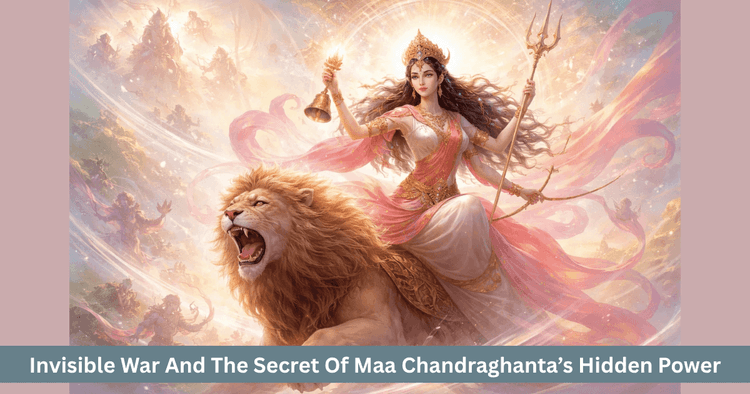
Table of Contents
Whenever the wars between the Goddess and the asuras are remembered, the mind usually imagines clashing weapons, roaring force and fierce open battle. Yet within the story of Maa Chandraghanta there is also another war, one that no one saw and yet whose effect was the deepest of all. This was the war fought not outside but within and on an invisible level. It is here that Maa Chandraghanta rises beyond the image of an outer warrior and appears as the presiding power of consciousness, subtle force and silent victory.
It is important to understand that not every battle takes place on a visible battlefield. Some battles are born in the mind. Some in thought. Some in fear. Some in the disturbance of energy where ordinary weapons cannot even reach. The strength of the asuras was also not limited to outer force. They were gradually beginning to influence thought, consciousness and inner balance itself. That is why the efforts of the gods, though noble, kept proving insufficient. They were fighting what appeared outside, while the true spread of the enemy was happening within.
What Was This Invisible War In Reality
The invisible war does not merely mean something mysterious in a vague sense. It means the struggle that happens on the subtle plane. There, swords do not strike but intentions collide. No blood is shed, yet consciousness trembles. No army is seen, yet the direction of thought changes. It is on that level that fear begins, confusion grows, courage weakens and adharma quietly roots itself.
Maa Chandraghanta understood exactly this. She knew that if the battle were fought only outwardly, the result would remain incomplete. The real strength of the asuras lay not merely in weapons but in their capacity to disturb the inner balance of beings. This recognition was the first sign of her hidden power. She saw the enemy at the level where others had not yet even reached.
Why Were The Efforts Of The Gods Failing Again And Again
The gods had power, sacred rites, mantras and divine resources. Yet complete victory was not coming. The reason was not only the outer might of the asuras. The true reason was that the gods were not yet fighting on the level where the enemy had become strongest. They were confronting the effect but not the root. They were trying to stop the visible aggression, while the unrighteous influence that fed it from within continued to remain active.
This is precisely where Maa Chandraghanta’s role becomes unique. She did not view the problem merely as an event. She saw it as a distortion in energy. She understood that unless the subtle influence of the asuras was weakened, outer conflict would keep rising again and again. That is why her war differed from all others. She was not only resisting force. She was reaching the source itself.
How Did Maa Chandraghanta Recognize This Secret
Maa Chandraghanta is not merely the goddess who fights. She is the goddess of awakened awareness. Her bell, her lion, her radiance and her gaze all suggest that she is rooted in the highest form of alert consciousness. She perceived the vibration that had not yet become fully visible. She recognized the darkness that was slowly entering thought and energy.
This was her hidden power. It was not only the power to strike. It was the power to perceive. To recognize where the real war is being fought is itself a great victory. Many beings remain trapped in outer problems without seeing the root beneath them. Maa Chandraghanta saw the root and for this reason she was able to enter the invisible war that no one else could truly see.
Why Was Her Meditation Not Ordinary Meditation
The story says that she entered meditation but this was not a passive stillness. It was a focused divine resolve. Outwardly she was still, inwardly all her force was moving in one direction. This is the state in which consciousness rises beyond ordinary limits and enters the levels inaccessible to the common mind.
She gathered her entire power inward and entered that subtle realm in which the asuras were exercising their real strength. Her eyes were closed, yet her awareness was completely awake. Her body was motionless, yet the current of force within her was fully active. Her outer form remained silent but inwardly the divine battle had already begun. That is what makes this episode so profound. The greatest struggles often occur in complete silence.
What Might Have Happened In That Subtle Battle
Such a battle cannot easily be described in visible language, yet its signs are clear. There were no weapons, yet there was collision. There were no words, yet there was opposition. There was no noise, yet waves of force were striking against one another. The struggle was unfolding between resolve and distortion, between light and darkness, between steadiness and corruption.
When the asuras realized that someone had entered the invisible realm in which they held their true strength, their greatest safety was broken. They may have been prepared for outer war but not for resistance at this inner level. This became their weakness. Maa Chandraghanta touched their field of thought, unsettled their energetic balance and began weakening the fear and confusion hidden within them. The war remained unseen but its intensity was deeper than any visible clash.
How Was Victory Possible Without Weapons
This is the deepest secret of Maa Chandraghanta’s power. She proved that not every victory requires visible weapons. If one can recognize the inner foundation of the enemy, then it is possible to weaken their strength without direct outward attack. The outer force of the asuras was being fed by inward distortion. Once that subtle support began to weaken, their visible power also began to decline.
In this sense, she did not fight only with their bodies. She fought with the source of their force. Outer war can be won only after the inner victory has already begun. This was her true strategy. She understood that if the war of consciousness were won, then the battle of weapons would become secondary.
What Did The Gods See And What Did They Not See
The gods did not directly witness this battle. They saw no visible collision, no great assault, no dramatic spectacle. Yet they saw the result. They felt the strength of the asuras suddenly decline. Their force seemed weakened. Their aggression no longer felt as whole or as organized. This change was so sudden that even the gods were astonished.
Only gradually did they begin to understand that something had happened beyond their ordinary sight. They realized that Maa Chandraghanta had fought on a level that cannot be seen with external vision. That is why this story becomes the story of a silent victory. The greatest act was the least visible. This is the subtle splendor of divine power.
What Does This Story Mean For Human Life
This episode applies deeply to human life as well. Many of our struggles are also invisible. The problem may appear outside but its root often lies within. Outer failure may arise from inward fear. Broken relationships may be fed by hidden ego and insecurity. Restlessness outside may grow from confusion and imbalance within. If a person fights only the outer symptoms, the solution will remain incomplete.
Maa Chandraghanta teaches that one must also go inward. True power is the power that can identify the subtle cause of suffering. Until we understand the invisible wars within us, no outer victory can become lasting. For this reason, her story is not only about divine glory. It is also a profound lesson in life and self understanding.
What Was The Real Secret Of Her Hidden Power
Her hidden power was not merely her radiance or her battle skill. Its real secret was her capacity to act on the subtle level. She knew where energy had become distorted, where thought had become corrupted, where balance was breaking and where light needed to enter. This was her divine strategy. It is what sets her apart from the image of an ordinary warrior goddess.
Many powers are visible and impress immediately. But the power of Maa Chandraghanta belongs to that higher kind which, while unseen, proves to be the most decisive. She teaches that the deepest victories do not always come with the loudest noise. They often come through full silence, full concentration and full inner clarity.
Why Was This Invisible War The Most Important Of All
Because it was the real one. The outer war was only its consequence. If the subtle influence of the asuras had not been weakened, they could have risen again in another visible form. But once Maa Chandraghanta struck at the invisible root of their force, the base of their power was cut. That is why this unseen battle was the most decisive of all.
This teaches another truth as well. What is unseen is not unimportant. Many times it is the most powerful of all. Thoughts cannot be seen, yet they change the direction of life. Fear cannot be seen, yet it stops action. Faith cannot be seen, yet it makes the impossible possible. In the same way, the invisible war of Maa Chandraghanta was far deeper than the visible battle.
The Final Meaning Of This Story
In the end, it becomes clear that Maa Chandraghanta did not win only on the battlefield. She won first on the subtle plane where war itself takes birth. That is the secret of her hidden power. She teaches that the greatest victory comes not from weapons alone but from clarity of consciousness, purification of energy and inner steadiness.
She also teaches that to recognize the invisible conflicts of one’s own life is already half the victory. Once a person sees fear, imbalance, confusion and distortion within, they can begin to work upon them consciously. That is the path to lasting victory.
Frequently Asked Questions
What was Maa Chandraghanta’s invisible war
It was the subtle battle fought at the level of consciousness, thought and energy, not merely on the visible battlefield.
Why were the efforts of the gods failing
Because they were fighting the outer effect while the real force of the asuras was active on an invisible inner level.
What was Maa Chandraghanta’s hidden power
Her hidden power was the ability to recognize the root of the enemy on the subtle plane and weaken it through consciousness itself.
What does this story mean in life
It teaches that many of life’s deepest battles are inward and until they are understood, outer solutions remain incomplete.
What is the greatest message of this episode
That true and lasting victory comes by winning the invisible war within.
Get your accurate Kundali
Generate KundaliDid you like it?
Author

Pt. Suvrat Sharma (63)
Experience: 20
Consults About: Family Planning, Career
Clients In: Punjab, Haryana, Delhi
Share this article with friends and family
About ZODIAQ
ZODIAQ is an online Vedic Astrology platform. It connects clients seeking astrological advice to experienced astrologers with deep knowledge. Our users also generate kundali and perform kundali milan for free. ZODIAQ also offers services to the Astrologers. Astrologers utilize various offerings by ZODIAQ to serve their clients effectively.
If you are a User
Consult with experienced astrologers and seek their guidance. You can also order handwritten Janm Patrika report with life prediction prepared by experienced astrologers. Generate accurate Kundali, perform Kundali Matching and check horoscope and muhurat. Utilize our online library for all the necessary astrological and spiritual information.
If you are an Astrologer
Create accurate kundali for your clients and perform Kundali Matching for up to 5 people at a time. Write comprehensive Janm Patrika report for your clients with ZODIAQ. Check client details anytime by saving it in client directory. Become more productive by tracking how many clients you guide every day.
WELCOME TO
ZODIAQ
Right Decisions at the right time with ZODIAQ
