Why Maa Chandraghanta Rides A Lion And What Deep Meaning Is Hidden Behind It
By Pt. Nilesh Sharma
Chandraghanta’s Lion Vehicle: Symbol of Courage, Balance, and Self-Control
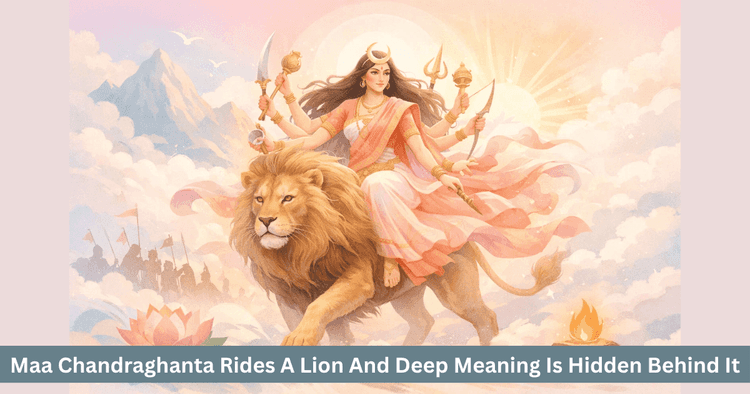
Table of Contents
The form of Maa Chandraghanta naturally raises a question in the mind. Why does she ride a lion. Is it only a traditional image or does it carry a deeper spiritual truth. The answer does not lie merely in the outer symbol. It lies in the energy, the meaning and the inner message this form holds within itself.
Maa Chandraghanta should not be understood only as a goddess of battle. She is a form of power that holds courage but not blindness. She is fierce but not unbalanced. She is intense but never without purpose. That is why her being seated upon a lion is not just a display of force. It is the declaration of a truth that power becomes complete only when it knows how to govern its own intensity.
Why Was The Lion Chosen
In spiritual symbolism, the lion is not seen merely as a strong animal. It is regarded as the sign of courage, confidence, royal authority, fearlessness and natural command. Its roar is not only a sound. It is a statement of presence. Yet an important thing must be noticed. The lion does not display its strength every moment. It can remain still, restrained and only strike when truly necessary.
These same qualities are visible in the form of Maa Chandraghanta. She is not in constant warfare, yet when dharma is threatened, her form becomes active. In this way, the lion is not only her vehicle. It is an outer expression of her own nature. The lion is a powerful force in itself but under the Goddess it becomes balanced power.
What Does It Mean That The Goddess Rides The Lion
When a goddess is shown seated upon a lion, it does not merely mean that she is powerful. It also means that she knows how to direct power. The lion represents intense and raw energy. Left uncontrolled, such force can become destructive. But when the same lion comes under the command of the Goddess, it becomes a force of sacred protection.
This is the deepest meaning of the symbol. Maa Chandraghanta is not only power. She is mastery over power. She is not only courage. She is the direction of courage. She is not only aggression. She is the wisdom of necessary force. That is why her lion teaches that greatness does not lie merely in being strong. It lies in remaining controlled even while being powerful.
Does A Lion Also Exist Within Us
This is one of the most beautiful aspects of the story. Its meaning is not limited to the divine form alone. A lion also lives within every human being. It appears in many forms. Sometimes it is inner strength, sometimes willpower, sometimes anger, sometimes ego, sometimes fear and sometimes the fierce urge to struggle against life and move forward. This inner force, if left unbalanced, can wound the person from within. But if it is mastered, it can become the source of greatness.
Maa Chandraghanta teaches exactly this truth. The lion within is not to be killed and not to be feared. It is to be recognized and disciplined. She shows that the intense force within us should not be suppressed but guided. That is why her form appears both awe inspiring and reassuring at once.
What Is The Relation Of This Symbol With Anger Ego And Fear
In human life there are three forces that can create great imbalance, anger, ego and fear. These three may be understood as distorted expressions of the inner lion. When anger loses direction, it destroys relationships. When ego loses measure, it destroys wisdom. When fear loses balance, it paralyzes strength. The fact that Maa Chandraghanta rides the lion shows that she has attained victory over all of these.
It is important to notice that she does not suppress these forces. She gives them direction. Her anger becomes the force to protect dharma. Her radiance becomes not arrogance but divine confidence. Her alertness becomes not fear but awakened awareness. This is why even her fierce form feels sacred. It contains intensity but not disorder.
What Does The Connection Between The Lion And The Sun Reveal
In deeper symbolism, the lion is also connected with the Sun and the Sun is associated with the soul, light, direction and life force. When Maa Chandraghanta sits upon the lion, it suggests that she also presides over that inner solar power which gives direction to life itself. This means that her symbolism is not limited to outer battle. It also points toward inner victory.
It reminds us that when the light of the soul is steady and disciplined, a human being moves in the right direction. But the same force, if lost in confusion or ego, can distort judgment. That is why her lion is not only the sign of valor. It is also the sign of self mastery.
What Did The Gods Recognize In This Form
When the gods beheld the form of Maa Chandraghanta, they would have understood that this was not merely preparation for battle. It was a divine message for the whole universe. That message is that power becomes truly beneficial only when it is disciplined. Strength alone is not enough. Strength must be joined with discernment, control and purpose.
This is why the form also gave assurance to the gods. They knew that power had not merely appeared but had appeared in a form that knew how to govern its own force. Only such power can truly protect dharma.
What Does Her Lion Teach Us In Life
This symbol remains just as relevant today. Every person faces situations in life that awaken the fierce inner force. One sees injustice and feels anger. One suffers insult and feels inner fire. One faces fear and loses confidence. One senses inner strength but does not know how to direct it. At such times, the lion of Maa Chandraghanta teaches that the greatest victory lies in bringing inner force under peaceful command.
One who learns to ride the lion within no longer finds outer challenges overwhelming. The one who can guide anger, transform fear into courage and restrain ego into self respect is the one who truly advances. That is the practical teaching hidden in this symbol.
Is The Lion Only A Symbol Of War
No and this is one of its deepest layers. The lion is not only a symbol of war, force or attack. It is also the symbol of steady presence. It shows that true power does not need to prove itself every moment. It can remain still within itself, understand the right time and act with total force only when necessary. Maa Chandraghanta is the goddess of this balance.
For this reason, her lion teaches that being constantly fierce is not power. Remaining always passive is also not complete power. The fullest power is that which can take the right form at the right time. This is her message.
The Final Meaning Of This Secret
In the end, it becomes clear that the lion of Maa Chandraghanta is not merely a vehicle. It is a living message. It teaches that true power is the power that can bring even inner intensity under the rule of peace, control and dharma. It also teaches that before one can win the outer battle, one must first master the forces within.
Maa Chandraghanta reminds us that if the lion within remains unbalanced, life becomes difficult. But when that same lion comes under the command of the Goddess, it becomes protector, guide and the basis of victory. This is the deepest meaning of the story.
Frequently Asked Questions
Why does Maa Chandraghanta ride a lion
Because the lion symbolizes courage, control, awakened force and balanced intensity, all of which remain fully governed by the Goddess.
Is the lion only a symbol of power
No. It also represents disciplined force, confidence, patience, alertness and decisive action at the right time.
What does this symbol mean for our lives
Each of us also carries a lion within, appearing as anger, fear, willpower and strength and it must be rightly directed.
Does the Goddess suppress emotions
No. She does not suppress anger, fear or intensity. She directs them toward balance and dharma.
What is the greatest message of this story
That true power is the power that can keep even its fiercest inner energy calm, controlled and sacred.
Get your accurate Kundali
Generate KundaliDid you like it?
Author

Pt. Nilesh Sharma (63)
Experience: 20
Consults About: Family Planning, Career
Clients In: Punjab, Haryana, Delhi
Share this article with friends and family
About ZODIAQ
ZODIAQ is an online Vedic Astrology platform. It connects clients seeking astrological advice to experienced astrologers with deep knowledge. Our users also generate kundali and perform kundali milan for free. ZODIAQ also offers services to the Astrologers. Astrologers utilize various offerings by ZODIAQ to serve their clients effectively.
If you are a User
Consult with experienced astrologers and seek their guidance. You can also order handwritten Janm Patrika report with life prediction prepared by experienced astrologers. Generate accurate Kundali, perform Kundali Matching and check horoscope and muhurat. Utilize our online library for all the necessary astrological and spiritual information.
If you are an Astrologer
Create accurate kundali for your clients and perform Kundali Matching for up to 5 people at a time. Write comprehensive Janm Patrika report for your clients with ZODIAQ. Check client details anytime by saving it in client directory. Become more productive by tracking how many clients you guide every day.
WELCOME TO
ZODIAQ
Right Decisions at the right time with ZODIAQ
