The Night When Even The Gods Remained Silent And Waited For Maa Chandraghanta To Strike
By Pt. Narendra Sharma
Awakening of Chandraghanta’s Power and the Mystery of Divine Waiting
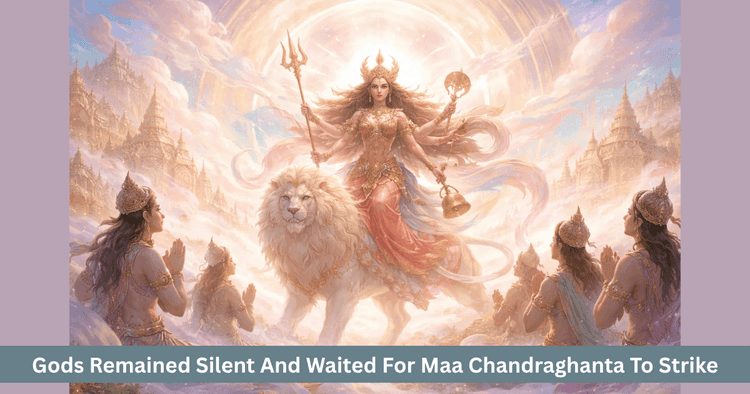
Table of Contents
It was not an ordinary night. The sky carried an unusual stillness, as though time itself had paused. The gods, who would usually gather in times of danger to discuss, plan and act together, were strangely silent that night. Their faces held concern but even more than concern, there was waiting. This was not the waiting for a strategy. It was the waiting for an awakening of power and that power was Maa Chandraghanta.
At that time, the force of the asuras had grown so immense that all efforts of the gods had begun to fail. Every battle, every sacred rite and every attempt at restoring order seemed to fall short. This was not only outward defeat. It was a condition in which even the confidence of the gods had begun to tremble. They knew that the conflict had passed beyond their ordinary control. That is why they made no fresh plan that night and declared no new strategy. They waited.
Why Was That Night So Heavy With Silence
The heaviness of that night did not arise only from the growing force of the asuras. It also came from the uncertainty of what was about to happen. Everyone knew that something was near but no one knew when it would unfold or how. Uncertainty often weighs more heavily than visible fear. In the assembly of the gods, words had become fewer and fewer. They still looked at one another but they did not speak much. Thought had reached its limit. What was to come belonged not to calculation but to divine resolve.
This silence also held an inner acceptance. The gods had understood that they would now have to wait. Not every crisis is resolved by immediate effort. Some grow to such a point that only the direct emergence of awakened power can restore balance. That is why their silence was not hopelessness. It was restrained trust. They knew that when the balance of creation is shaken too deeply, divine power appears in the form required by the moment.
Why Did The Gods Make No Plan That Night
This question is important because the gods are generally associated with activity, guidance and collective effort. Yet that night they remained silent. The reason was that they had understood the struggle had moved beyond their ordinary reach. When a crisis crosses a certain limit, constant activity does not always create a solution. Sometimes it only deepens confusion.
Their silence was not defeat. It was humility. It was the recognition that they would now have to step back and allow a greater power to take its place. This is one of the deepest spiritual teachings hidden in the story. Strength does not always mean moving forward. Sometimes strength also means knowing when to pause, when to remain silent and when to make room for a force greater than one’s own.
Where Was Maa Chandraghanta At That Time
The story says that during this same night, Maa Chandraghanta was absorbed in deep meditation. Her outer form was calm but within her a tremendous force was flowing. This is one of the most extraordinary aspects of the story. Outside there was stillness. Inside there was resolve. Outside there was silence. Inside a decisive turning point was taking shape.
Her meditation was not passivity. It was preparation. It was the moment in which the battle was being decided in consciousness before any weapon was raised. She spoke no word, yet her silence itself was her vow. She knew this was not merely about defeating the asuras. It was about the restoration of sacred balance.
How Did The Gods Sense Her Awakening
In the divine realm, much is understood not through speech but through vibration. The gods slowly began to feel a change in the atmosphere. First there was a subtle shift, then the weight of the air seemed to alter and then a quiet presence of resolve spread in all directions. This was not a loud sign. It was a deep inner indication that power had begun to awaken.
This was the moment their silence deepened even further. It was no longer only the silence of waiting. It became the silence of reverence. They felt that what was about to happen lay beyond their own effort. They could only remain witness. This gives great dignity to the story. That night, the gods were less warriors and more witnesses. For when great divine power rises, even the highest role of the gods may become the role of sacred witnessing.
What Was The Subtle Vibration That Broke The Stillness
The story suggests that the stillness was first broken not by thunder but by a subtle vibration. This is deeply meaningful. True transformation often does not begin with noise. It begins with vibration. First the atmosphere changes, then consciousness shifts and only then does the event become visible. The awakening of Maa Chandraghanta followed this very order. The resolve that had matured within her began to radiate outward.
This was the emergence of energy before the sound itself. Just as a wave in the ocean is born within before it appears on the surface, in the same way her strike had already begun inwardly before it became outwardly visible. In this sense, the real battle had already begun that night as a silent vibration before any weapon moved.
How Did The Asuras Feel This Change
The asuras could not understand what was happening, yet they felt it. They sensed that something in the atmosphere had shifted. The confidence that until then had seemed solid began to feel strangely uncertain. They could not give it a clear name but they felt that something was approaching which was not ordinary. This is the moment when darkness first begins to recognize the nearness of light.
Their unease itself was a sign that war is not won only through outer force. Many times the enemy first begins to weaken inwardly before the outer battle changes. The presence of Maa Chandraghanta did exactly this. She began to alter the direction of the outcome even before open battle had fully started.
Why Was Her First Strike So Decisive
When Maa Chandraghanta finally made her first strike, it was not merely a physical attack. It was a declaration that dharma would no longer remain passive. It was the answer to the silence that had deepened throughout the night. It was not only the movement of a weapon but the return of balance to its rightful place. This is why its effect was immediate and far reaching.
The strength of the asuras, which until then had seemed difficult to overcome, began to loosen. This does not mean their force disappeared all at once. It means that the inner support behind that force had begun to crack. Whenever adharma stands not only on outer power but on inner arrogance, the divine strike first breaks that inner center. This is why the first strike of Maa Chandraghanta was so decisive. It contained not only strength but also perfect timing.
Why Did The Gods Remain Silent Even Then
By that point, their silence was no longer the silence of fear. It had become the silence of reverence. They knew that the moment they had waited for had arrived. No speech was needed now. No advice, no intervention and no plan had meaning any longer. Divine action had begun. This is why they remained silent but the nature of their silence had changed. Concern had given way to trust.
This too is a profound teaching. Some events are so sacred that they can only be fully witnessed through silence. If the gods had remained restless, they may not have perceived the fullness of this divine manifestation. Their silence became a form of worship. They were not merely waiting. They were honoring divine timing.
What Is The Deeper Spiritual Meaning Of This Story
This story reveals that not every struggle requires immediate reaction. Sometimes silence, patience, waiting and the recognition of the right moment become the highest response. Maa Chandraghanta teaches that power does not always mean striking at once. Power also means knowing when to arise, when to remain inwardly still and when one single act can alter the direction of everything.
In life too, human beings often feel compelled to react immediately. Waiting is mistaken for weakness. But this story shows that conscious waiting can itself be power. Silence, when filled with awareness, can become the deepest answer. The night of Maa Chandraghanta is a divine example of this truth.
What Does This Story Teach In Human Life
Within us as well, many struggles do not demand instant action. They demand depth, stillness and the right inner timing. Sometimes the mind makes noise, yet the true answer is born in silence. Sometimes a decision is not formed through many words but through a deep and quiet certainty within. The story of Maa Chandraghanta teaches precisely this. In every battle of life, not every moment calls for outward action. At times, silence itself is preparation and the right action at the right moment can resolve what years of confusion could not.
For this reason, the story is not only divine praise. It is also a serious lesson for life. It teaches that until the inner decision ripens, outer action remains incomplete. But once the inner decision becomes whole, even a single step can bring immense transformation.
What Was The Final Truth Of That Night
In the end, it becomes clear that the night was not merely the beginning of war. It was the experience of power being born in silence. The gods remained silent because they knew something beyond speech had begun to act. Maa Chandraghanta proved that true power does not need noise. It rises when the time is complete and when it rises, everything changes.
That night teaches that not every answer comes immediately. Some answers ripen in silence. Some decisions are born in reverence. Some strikes happen only when dharma itself calls upon time. Maa Chandraghanta is the presiding force of such awakened moments.
Frequently Asked Questions
Why did the gods remain silent that night
Because they understood that ordinary efforts were no longer enough and they had to wait for the intervention of greater divine power.
Had Maa Chandraghanta already taken her decision
Her silence itself was her resolve. In meditation she was inwardly preparing completely for the protection of dharma.
How was her awakening first sensed
Through subtle vibration, changing energy in the atmosphere and the feeling of divine presence becoming active.
Why was her first strike so decisive
Because it was not merely an attack but a perfectly timed divine intervention for the restoration of balance.
What is the greatest message of this story
That sometimes the deepest answer lies not in noise but in aware silence, patience and action taken at the right moment.
Get your accurate Kundali
Generate KundaliDid you like it?
Author

Pt. Narendra Sharma (63)
Experience: 20
Consults About: Family Planning, Career
Clients In: Punjab, Haryana, Delhi
Share this article with friends and family
About ZODIAQ
ZODIAQ is an online Vedic Astrology platform. It connects clients seeking astrological advice to experienced astrologers with deep knowledge. Our users also generate kundali and perform kundali milan for free. ZODIAQ also offers services to the Astrologers. Astrologers utilize various offerings by ZODIAQ to serve their clients effectively.
If you are a User
Consult with experienced astrologers and seek their guidance. You can also order handwritten Janm Patrika report with life prediction prepared by experienced astrologers. Generate accurate Kundali, perform Kundali Matching and check horoscope and muhurat. Utilize our online library for all the necessary astrological and spiritual information.
If you are an Astrologer
Create accurate kundali for your clients and perform Kundali Matching for up to 5 people at a time. Write comprehensive Janm Patrika report for your clients with ZODIAQ. Check client details anytime by saving it in client directory. Become more productive by tracking how many clients you guide every day.
WELCOME TO
ZODIAQ
Right Decisions at the right time with ZODIAQ
