How Did Maa Chandraghanta Transform So Suddenly From A Peaceful Goddess Into A Fierce Warrior
By Pt. Abhishek Sharma
Chandraghanta’s Transformation: Awakening from Peace to Fierce Power
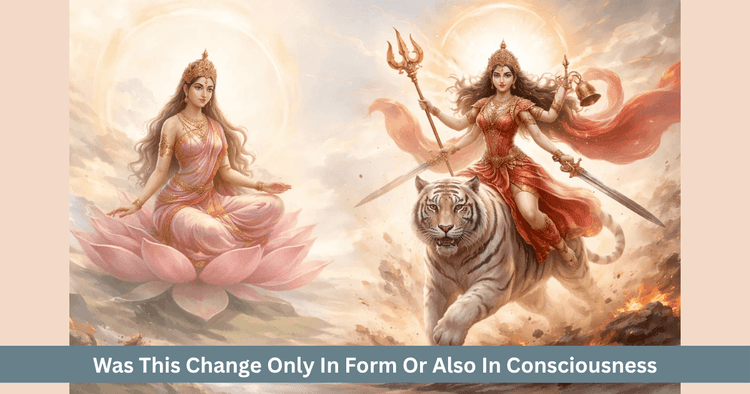
Table of Contents
The form of Maa Chandraghanta raises an immediate and profound question. How could the same goddess who had so recently appeared gentle, serene, loving and deeply graceful suddenly stand forth as a fierce warrior of astonishing force. This is not merely a story of outer transformation. It is the story of a change in consciousness. It is the moment when divine power recognizes another side of itself and allows it to emerge when the time demands it. That is why this narrative is not only about battle. It is about awakened responsibility, the protection of sacred balance and the necessity of transformation.
As long as the world remains balanced, power does not need to appear in its fierce form. It can work through peace, compassion, beauty and quiet protection. But the moment disorder begins to cross its limits, the same power rises in another form. The story of Maa Chandraghanta is the living proof of this truth. Her transformation appears sudden from the outside but inwardly it had been preparing for a long time.
Was This Change Only In Form Or Also In Consciousness
This is the most important dimension of the story. The transformation was not only about adornment, expression or outer presence. It was a change in consciousness. The same force that had earlier expressed itself through love, surrender, patience and tapas later revealed itself through protection, decisiveness and warrior readiness. This does not mean that her earlier form was incomplete. It means that divine power holds many layers and each layer comes forth according to the need of time.
There is power in peace but it remains concealed. There is compassion in fierceness but it becomes disciplined for the sake of dharma. The form of Maa Chandraghanta reveals this deep truth that power is not static. It is living, aware and capable of reshaping itself according to circumstance.
Why Did This Form Appear After Her Marriage
The emergence of Maa Chandraghanta after her marriage to Shiva is not merely a mythic detail. It is deeply symbolic. Marriage here does not only indicate companionship. It signifies the balanced union of Shiva and Shakti. Once power became established at this new level alongside Shiva, its field of action also expanded. She was no longer only the goddess of personal tapas, devotion and inward love. She became the active guardian of cosmic balance.
The crescent moon upon her forehead appearing in the form of a bell carries the same meaning. It is not merely beautiful. It signals awakened alertness. The bell represents warning, awakening and the disruption of dark vibrations. In that sense, her form after marriage indicates that the Goddess is now not only the embodiment of loving presence but also of active divine intervention when sacred order must be protected.
How Did The Growing Power Of The Asuras Become The Cause Of This Change
According to the story, the strength of the asuras had begun to grow steadily. They were not yet openly at war but their influence, ambition and disorder were crossing their proper limits. This is exactly the sort of subtle moment that ordinary sight often ignores. Most beings do not recognize danger until it stands fully before them. Maa Chandraghanta perceived the rising darkness before it had completely taken form.
This is the sign of awakened vision. She did not only see a visible enemy. She saw the energy that was becoming the cause of future imbalance. Once divine power reaches such perception, mere gentleness is no longer enough. A new form must emerge. For this reason, her fierceness was not reaction. It was necessary transformation born of foresight.
How Did Her Peaceful Form Become Fierce
From the outside, the change appears sudden. Yet inwardly it had been forming over a long time. Tapas, patience, devotion, sacrifice and deep stability had already awakened within her a power capable of expressing itself fiercely when required. That is why her warrior form is not chaotic. It carries discipline, clarity and a purpose aligned with dharma.
When she fully accepted that power within herself, her form changed naturally. Peace still remained in her eyes but now it was joined by firm resolve. Her face remained luminous, yet it now carried the force capable of ending opposition when necessary. This is what makes her form so extraordinary. Within her, gentleness and intensity coexist without contradiction.
Was This Fierceness Truly Anger
No. This is one of the most essential truths in the story. Many people mistake the fierce forms of the Goddess for anger but Maa Chandraghanta teaches that not every intensity is anger. Some intensity arises from responsibility. Some hardness appears only for the protection of sacred order. Some fierceness is the form compassion takes when innocence must be defended.
Her form belongs to this second category. She did not rise out of blind rage. She rose in awakened clarity. Her fierce form was not the result of uncontrolled emotion but of perfect understanding. She saw that gentle presence alone was no longer sufficient to preserve balance. A power capable of stopping adharma had become necessary. That is why her form grew fierce but its fierceness was governed by sacred purpose.
What Did The Gods See In This Transformation
The gods did not see this as a mere outward change. They understood that this was the emergence of active divine force necessary for the preservation of creation. That is why they were astonished and reassured at the same time. Astonished, because the form was so intense. Reassured, because the power required for the protection of dharma had now appeared.
For the gods too, this became a teaching. They realized that power is not found only in beauty, peace or compassion. Power becomes complete when it can also assume the form required for protection. This is why the form of Maa Chandraghanta reveals the fullness of divine force. It is a vision of power that is both balanced and complete.
What Does This Story Teach For Human Life
This story is not limited to divine mythology. It applies deeply to human life as well. Within every person there are hidden forms. Many times people know themselves only as calm, gentle, patient or emotionally soft. But when circumstances change, the firm, protective and decisive side of the self may also appear. That does not mean the person has become different in essence. It means that another hidden layer of power has been recognized.
Change often appears sudden but in truth it is being formed inwardly over time. Until the moment of need arrives, it remains unseen. But when the time comes, it emerges as a new dimension of strength. The form of Maa Chandraghanta teaches that one should not fear this awakening within. Very often it is precisely this change that leads a being closer to their real power.
Can Peace And Fierceness Exist Together
The form of Maa Chandraghanta gives a beautiful answer to this question. Yes, peace and fierceness can exist together when both arise from purity. Peace that becomes passive helplessness is incomplete. Fierceness that becomes blind anger is destructive. But when peace carries strength and fierceness carries discernment, then true divine balance appears.
Maa Chandraghanta’s eyes held peace but it was not helpless peace. Her form carried intensity but it was not uncontrolled intensity. This balance makes her extraordinary. She teaches that true power is that which can transform itself according to time and still remain rooted in dharma.
What Does This Story Say About Transformation Itself
This story teaches that transformation should not always be feared. Transformation is not always collapse. Often it is a sign of ripening. When circumstances shift, new dimensions of the self begin to emerge. If those dimensions are governed by dharma, discernment and compassion, they become deeply beneficial. The sudden transformation of Maa Chandraghanta was not actually sudden. It was accomplished power becoming visible at the right moment.
That is why this change is not merely a warning. It is a message. The message is that true power does not remain trapped in one fixed form. It is living, aware and capable of reshaping itself according to the demand of time. A force that remains stuck in one expression cannot be complete. Complete power is the one that can be gentle and fierce at once.
The Final Life Message Of Maa Chandraghanta
In the end, it becomes clear that the transformation of Maa Chandraghanta from peaceful to fierce is not a story of anger. It is a story of awakened power. She teaches that when balance is threatened, mere softness is not always enough. At times, the protection of dharma requires firmness, clear decision and the acceptance of the protective form within.
She also teaches that one should not be afraid of the hidden forms waiting within. Very often those are the forms that save us when ordinary strength is no longer enough. When change happens with awareness, it leads us closer to our true nature. That is the divine essence of the form of Maa Chandraghanta.
Frequently Asked Questions
How did Maa Chandraghanta’s sudden transformation happen
It was less an outer change and more the awakening of inner consciousness that emerged at the needed moment.
Was her fierce form the result of anger
No. It arose from the need to protect dharma and restore balance in creation.
Why did this form appear after her marriage
Because at that stage her role expanded from personal tapas to the wider protection of cosmic order.
What is the greatest message of this story
That true power can reshape itself according to the need of time without ever leaving its sacred center.
How does this episode apply in life
It teaches that hidden strengths within us can emerge at the right time and become our greatest power.
Get your accurate Kundali
Generate KundaliDid you like it?
Author

Pt. Abhishek Sharma (63)
Experience: 20
Consults About: Family Planning, Career
Clients In: Punjab, Haryana, Delhi
Share this article with friends and family
About ZODIAQ
ZODIAQ is an online Vedic Astrology platform. It connects clients seeking astrological advice to experienced astrologers with deep knowledge. Our users also generate kundali and perform kundali milan for free. ZODIAQ also offers services to the Astrologers. Astrologers utilize various offerings by ZODIAQ to serve their clients effectively.
If you are a User
Consult with experienced astrologers and seek their guidance. You can also order handwritten Janm Patrika report with life prediction prepared by experienced astrologers. Generate accurate Kundali, perform Kundali Matching and check horoscope and muhurat. Utilize our online library for all the necessary astrological and spiritual information.
If you are an Astrologer
Create accurate kundali for your clients and perform Kundali Matching for up to 5 people at a time. Write comprehensive Janm Patrika report for your clients with ZODIAQ. Check client details anytime by saving it in client directory. Become more productive by tracking how many clients you guide every day.
WELCOME TO
ZODIAQ
Right Decisions at the right time with ZODIAQ
