The Moment When Maa Chandraghanta Left Peace Behind Chose War And Everything Changed
By Pt. Abhishek Sharma
Chandraghanta’s Decision: From Peace to War and the Shift in Cosmic Balance
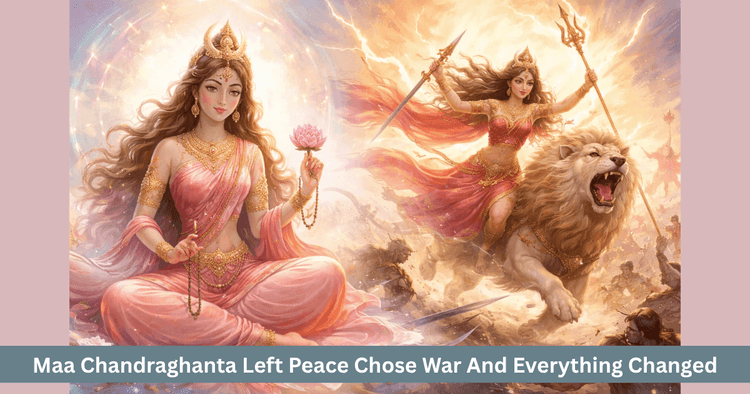
Table of Contents
In every form of the Goddess there is a balance between peace and power. Yet in the story of Maa Chandraghanta, there comes a moment when this balance seems to lean in one direction. It is the moment when she appears to leave peace behind and choose war. But this decision was not a reaction. It was a turning point that changed the direction of the entire cosmic order.
Until then, her presence had remained calm. She was watching, understanding and waiting. She did not respond immediately because she knew that not every conflict is meant to be resolved through battle. As long as balance can be restored without collision, divine power remains gentle. This is the subtle greatness of the Goddess. She does not rise in force without necessity.
How Long Could Peace Remain Sufficient
This question lies at the heart of the story. Peace remains meaningful only as long as it can preserve balance. When disorder still remains within limits, when restoration is still possible without force, divine power remains patient. But once that threshold is crossed, peace in its passive form is no longer enough. This is exactly what happened.
The strength of the asuras was not merely increasing. It was becoming uncontrolled. They had begun to cross their boundaries. This was not only a challenge. It was a warning that if nothing were done, balance itself would break. Maa Chandraghanta understood this deeply. She saw that this was no longer merely a possible conflict. It had become a direct threat to the order of creation.
What Inner Decision Was Taking Place Within Maa Chandraghanta
The beauty of this story is that it is not only about outer war. It is also about an inner decision. Within her were two currents. One still held peace and wished to avoid conflict until the very last moment. The other saw clearly that delay itself could now strengthen adharma. This was not only an outer evaluation of the situation. It was a dialogue within divine power between compassion and duty.
The greatness of divine decision lies in the fact that it is not driven by personal hurt, insult or reaction. What was unfolding within Maa Chandraghanta was not emotional agitation. It was a pure realization. She was not deciding whom to destroy. She was deciding how to restore balance. This is what separates her decision from ordinary battle.
What Was That One Moment When Everything Changed
The story says that then came the one moment when everything changed. The change was not slow. It was a decisive awakening. She opened her eyes and it was as if the resolve within had become visible as radiance. The peace in her form remained but now it was joined by an unshakable firmness. Her gaze was compassionate yet immovable. The energy around her began to transform. The atmosphere itself seemed to understand that waiting was ending and decision was about to take visible form.
This moment is important because it shows that peace did not vanish. Rather, peace rose in its own protective form. Maa Chandraghanta did not abandon peace. She chose battle in order to protect it. This is the difference that must be understood. Otherwise the story becomes only a tale of war, while in truth it is a tale of struggle undertaken to preserve peace.
How Did The Gods Recognize This Transformation
The gods felt the change even before it was fully visible. They knew that the moment they had been waiting for had arrived. This would not be an ordinary war. It would be a conflict in which not only victory but the restoration of dharma itself was at stake. For the gods, the transformation of Maa Chandraghanta was also a sign of assurance, because they understood that when she enters action in this form, the conflict ceases to be mere resistance and becomes a divine decision.
They knew that she was no longer only the silent witness. She was now stepping forward as the active force necessary for the defense of sacred balance. Their waiting had ended. This is one of the deepest aspects of the episode. When the right power rises at the right time, even the divine world experiences a new steadiness.
Why Could The Asuras Not Understand The Sign
The asuras also sensed the change but they could not interpret it rightly. They took it only as another challenge. They assumed that, just as they had faced many divine resistances before, this too would be another conflict of force. This was their greatest error. They were seeing only the outer form. They could not perceive the final resolve that had already been formed within.
When divine power merely stands before the ignorant, it appears as something to challenge. But when divine power has already decided, the wise can sense that the direction of events has changed. The asuras could not understand this difference. They failed to see that Maa Chandraghanta’s step forward was not only entry into battle but the alteration of the very outcome.
What Was The Real Meaning Of Accepting War
The moment Maa Chandraghanta moved forward and accepted battle, it was not merely a physical step. It was a declaration. This declaration was not made in words but in force. Its meaning was that dharma would no longer remain silent. Whatever became necessary for the restoration of balance would now be done. This is the true meaning of divine battle.
Each of her steps was a vow. Each of her glances was a warning. It was clear that this conflict was not personal. It was a battle of principle. The question now was whether order would remain or chaos would spread, whether sacred limits would endure or be broken, whether light would stay steady or darkness would keep extending itself. That is why this war was not merely a clash of weapons. It was a war between truth and disorder.
Are Peace And Struggle Truly Opposites
The story of Maa Chandraghanta gives a profound answer to this question. Peace and struggle are not always opposites. At times, struggle becomes the necessary means for the protection of peace. If one remains silent only to avoid conflict while injustice continues to grow, that is not peace. It is passive surrender. True peace exists only when balance exists. If balance is broken, then the outer appearance of peace becomes only illusion.
Maa Chandraghanta teaches precisely this. Greatness does not lie only in remaining gentle at all times. Greatness also lies in taking a clear stand when the protection of dharma requires it. That is why her choice of battle was not the abandonment of peace. It was the defense of peace.
What Does This Story Teach In Human Life
In our own lives as well, there come moments when a decision becomes necessary. A person may remain patient for a long time, hoping that things will improve, choosing silence, waiting and enduring. Many times this patience is wise. But there are also moments when continued silence begins to strengthen what is wrong. Then decision becomes necessary.
Maa Chandraghanta teaches that a right decision taken at the right time can change everything. It is not wise to enter every conflict but it is also not wise to avoid every conflict. The difference lies in knowing when patience is needed and when firm intervention becomes necessary. This is the practical teaching of her story. It makes the inner being more awake.
Why Was This Transformation So Important
Because it was not only the beginning of a war. It was the beginning of a shift in the cosmic flow itself. When Maa Chandraghanta made her decision, it was not only the battlefield that changed. The entire direction of the conflict changed. Her act proved that when time ripens fully, power must reveal its complete form. That form then protects dharma, restrains chaos and restores order.
This moment is great because it contains not reaction but timely awareness. She was not early, yet she was not late. This is the sign of complete power. It waits as long as waiting remains righteous and when the moment changes, it appears with full clarity.
The Final Meaning Of This Story
In the end, it becomes clear that Maa Chandraghanta did not leave peace in order to choose war. She accepted battle in order to protect peace. This is the deepest light hidden in the story. True power does not lie only in softness, nor only in intensity. It lies in the wisdom to know which form is required at the right time.
Maa Chandraghanta teaches that one right decision can change everything when it is rooted in dharma, balance and awakened understanding. Even battle then becomes sacred. This is the divine essence of her form.
Frequently Asked Questions
Why did Maa Chandraghanta choose war
Because the power of the asuras had moved beyond control and struggle became necessary for the protection of balance.
Did she abandon peace
No. She did not abandon peace. She accepted battle in order to protect peace.
Why did her transformation seem sudden
Because the inner decision had been ripening for a long time and then appeared in one decisive moment.
What is the central message of this story
That silence is not always enough. At the right time, one must also choose a firm stand for dharma.
How is this episode useful in life
It teaches that patience and struggle both have their place but recognizing the right moment is the highest wisdom.
Get your accurate Kundali
Generate KundaliDid you like it?
Author

Pt. Abhishek Sharma (63)
Experience: 20
Consults About: Family Planning, Career
Clients In: Punjab, Haryana, Delhi
Share this article with friends and family
About ZODIAQ
ZODIAQ is an online Vedic Astrology platform. It connects clients seeking astrological advice to experienced astrologers with deep knowledge. Our users also generate kundali and perform kundali milan for free. ZODIAQ also offers services to the Astrologers. Astrologers utilize various offerings by ZODIAQ to serve their clients effectively.
If you are a User
Consult with experienced astrologers and seek their guidance. You can also order handwritten Janm Patrika report with life prediction prepared by experienced astrologers. Generate accurate Kundali, perform Kundali Matching and check horoscope and muhurat. Utilize our online library for all the necessary astrological and spiritual information.
If you are an Astrologer
Create accurate kundali for your clients and perform Kundali Matching for up to 5 people at a time. Write comprehensive Janm Patrika report for your clients with ZODIAQ. Check client details anytime by saving it in client directory. Become more productive by tracking how many clients you guide every day.
WELCOME TO
ZODIAQ
Right Decisions at the right time with ZODIAQ
