Was Maa Katyayani’s Anger Only for the Asuras or Also a Warning for the Gods
By Pt. Suvrat Sharma
How Maa Katyayani’s Anger Signified Both Punishment for Asuras and Warning for Gods
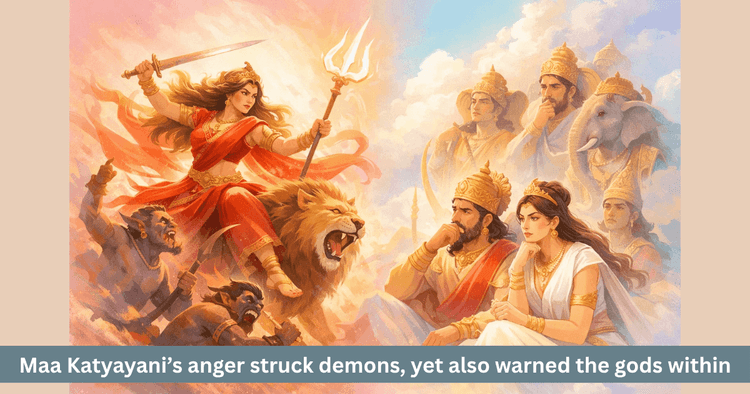
Table of Contents
Whenever the name of Maa Katyayani is spoken, her radiant, fierce and unconquerable form naturally arises in the mind. She is not only a goddess of battle but the symbol of that force which appears when the balance of the cosmos begins to fail. For that reason, to see her anger as only destruction is incomplete. Within her anger there is punishment, correction and also a deep vision that examines not only the enemy but one’s own side as well. That is why this question becomes so important. Was her anger meant only for the asuras or did it also carry a silent warning for the gods.
At that time the condition of the cosmos had become extremely complex. The influence of the asuras had greatly increased. Their power was no longer limited to the battlefield. It had begun affecting order, dharma and stability itself. But it would be incomplete to explain this situation only through the strength of the asuras. Imbalance often grows not only because adharma becomes strong but also because those responsible for protecting dharma do not remain fully alert. Something similar had happened with the gods. They were not unrighteous, yet they were not entirely without fault either. In some places there was softness, in some decisions there was delay and in some moments their duty did not rise with the firmness it required.
That is why the appearance of Maa Katyayani was not merely a reaction. It was a divine decision. This decision was meant to end the growing imbalance that was slowly spreading across all of creation. Yet the meaning of that decision was not limited to destroying the asuras. There was another deeper layer within it. Wherever dharma had weakened, awakening too had become necessary.
What Kind of Anger Was Maa Katyayani’s Anger
The anger of Maa Katyayani was not like ordinary human anger. It carried no impulsiveness, no blindness and certainly no favoritism. It was controlled power. It rises only when balance must be restored. For that reason, this anger was not born of personal hatred. It stood against a condition in which truth had begun to weaken, dharma had begun to fade and power had begun to be misused.
That is why her anger did not remain limited to one direction alone. It became like a divine current touching every element that had drifted away from balance. The asuras were its visible target because adharma had openly spread through them. But the gods also felt its force, because the gaze of the Goddess was not fixed only upon the enemy. It was fixed upon the entire order of existence.
Did the Gods Also Feel That Anger
Yes and this is one of the deepest aspects of this episode. When the anger of Maa Katyayani awakened, the faces of the gods did not reflect only faith and reverence. There was also a subtle hesitation, a quiet fear and a deep alertness within them. This fear was not because of the asuras. It was because of the truth that cannot remain hidden before the presence of the Goddess.
The gods understood that this power was not merely protective. It was also corrective. It had not come only to punish the enemy but also to reveal that the protection of dharma is not only a privilege. It is a responsibility. If the gods themselves became careless in their duties, if they failed to awaken in time, then imbalance would grow before their own eyes. The anger of Maa Katyayani was reminding them of exactly this.
Her gaze was so wide that nothing could remain hidden from it. She was not only seeing the battlefield. She was seeing the cause that had created the war. She was also seeing the slackness that had allowed adharma to spread. In this way, her anger was directed against the asuras, yet its warning was also reaching the gods.
How Did the Asuras See This Anger
The asuras saw the anger of Maa Katyayani as a direct challenge. For them, it was a war in which they had to defend their power. They were looking at it only as a struggle of force against force. They believed that if they showed enough aggression, strength and strategy, they could confront even this divine power. But they failed to understand that the anger of Maa Katyayani was not merely a strike of weapons. It was the blow of truth itself.
For the first time a disturbance arose within them that was not only the fear of outer defeat. They began to sense that this force was challenging the very root of their existence. They could raise weapons but how could they escape the falsehood hidden within themselves. That is why the anger of Maa Katyayani became for them not just war but the sign of their own destruction.
What Did the Gods Learn from This Moment
That day the gods experienced that receiving power is not enough. The right use of power is equally important. If even those entrusted with the protection of dharma drift away from their duty, then divine order will look upon them with the same uncompromising vision with which it looks upon adharma.
This lesson was vital. Maa Katyayani made them understand without direct teaching that true divine force does not act with favoritism. It acts only on the basis of what is right and what is wrong. If the destruction of the asuras was rightful because they had broken balance, then the warning to the gods was also rightful, because they were being reminded never to become careless in their own role.
Was This Anger Also a Form of Purification
The anger of Maa Katyayani was not only punishment. It also contained the element of purification. For the asuras it became destructive because they had become the center of adharma. For the gods it became awakening because they had to regain clarity about their duty. That is why her anger must not be seen merely as fierceness but as a divine process.
When her anger subsided, it was not merely the end of victory. It was the beginning of a new balance. The war ended but along with it a deeper understanding was established. This understanding was that the protection of dharma is not achieved only by defeating the enemy. It is also achieved by keeping oneself aligned and disciplined.
What Does This Story Mean in Human Life
This episode is not limited to gods and asuras alone. It is equally true in human life. Most of us quickly see the faults of others but we do not look at our own inner slackness with the same honesty. We assume that if we are not openly wrong, then we must be fully right. But the balance of life is more subtle than that.
Many times imbalance does not grow because one person is deeply wrong. It grows because those who are right do not stand firmly enough at the right time. Maa Katyayani teaches exactly this. It is not enough to point at the errors of others. One must also look within. Are duties being fulfilled. Is alertness toward truth still alive. Is power being used responsibly. If not, then her anger is also a warning for us.
Is the Message of Maa Katyayani Still Relevant Today
Without doubt. Even today, many situations arise in life where we assume the problem is only outside us. We believe that others need to change, while we ourselves are already right. But the form of Maa Katyayani reminds us that true power first awakens within. It gives us the vision to examine ourselves before judging the world.
Her message is not that anger should only punish. Her message is that awakened power must stop injustice, correct negligence and restore balance. That is why her anger is not the symbol of fear. It is the symbol of truth becoming visible. Wherever it awakens, confusion cannot remain for long.
The Deep Meaning Hidden in This Episode
In the end, it becomes clear that the anger of Maa Katyayani was not meant only for the asuras. The asuras were indeed the visible target because adharma had openly manifested through them. But for the gods as well, a clear signal was hidden within it. It was a signal that divine duty cannot be taken lightly. It was a signal that the protection of dharma does not happen only in moments of crisis but through constant alertness. And it was a signal that true power first examines itself.
This is the greatest truth of the story. Maa Katyayani does not merely destroy the enemy. She also purifies order, awakens the responsible and restores balance. Within her anger there is punishment but even more deeply there is direction.
Frequently Asked Questions
Was Maa Katyayani’s anger meant only for the asuras
No. The asuras were its visible target but within it there was also a clear warning for the gods.
Why were the gods affected by her anger
Because they understood that the gaze of the Goddess was not limited to the enemy. It was directed toward the whole order and its responsibilities.
Does Maa Katyayani act with favoritism
No. Her form is the form of balance. She acts on the basis of right and wrong, not on the basis of sides.
What is the main message of this episode
It is not enough to see the faults of others. One must also examine one’s own duty, alertness and negligence.
What does Maa Katyayani teach us
She teaches that true power does not only confront outer demons. It also recognizes and corrects inner error.
Get your accurate Kundali
Generate KundaliDid you like it?
Author

Pt. Suvrat Sharma (63)
Experience: 20
Consults About: Family Planning, Career
Clients In: Punjab, Haryana, Delhi
Share this article with friends and family
About ZODIAQ
ZODIAQ is an online Vedic Astrology platform. It connects clients seeking astrological advice to experienced astrologers with deep knowledge. Our users also generate kundali and perform kundali milan for free. ZODIAQ also offers services to the Astrologers. Astrologers utilize various offerings by ZODIAQ to serve their clients effectively.
If you are a User
Consult with experienced astrologers and seek their guidance. You can also order handwritten Janm Patrika report with life prediction prepared by experienced astrologers. Generate accurate Kundali, perform Kundali Matching and check horoscope and muhurat. Utilize our online library for all the necessary astrological and spiritual information.
If you are an Astrologer
Create accurate kundali for your clients and perform Kundali Matching for up to 5 people at a time. Write comprehensive Janm Patrika report for your clients with ZODIAQ. Check client details anytime by saving it in client directory. Become more productive by tracking how many clients you guide every day.
WELCOME TO
ZODIAQ
Right Decisions at the right time with ZODIAQ
