When Maa Katyayani Took Charge of the War and Lord Shiva Fell Silent
By Pt. Nilesh Sharma
Maa Katyayani’s Leadership and Shiva’s Silence Signify Cosmic Balance
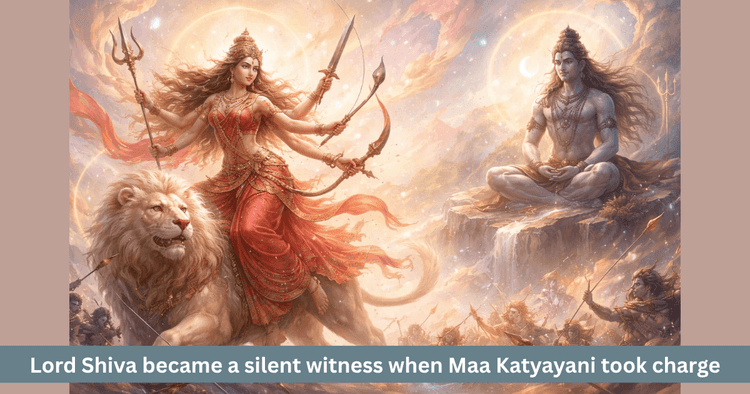
Table of Contents
Whenever a great change takes place in the cosmos, it is never just one event. It becomes a moment in which many powers are working together at once. In the great battle between the gods and the asuras, such a moment also arrived when Maa Katyayani took the responsibility of war into her own hands. Yet the most astonishing part of that moment was this, even Lord Shiva, the deity of dissolution and transformation, became silent.
This silence was not ordinary. The silence of Shiva is always a sign, something filled with deep meaning. When Shiva becomes silent, it is never merely the absence of words. It is a state in which he allows a greater process to unfold on its own. That silence is not passivity. It is a form of complete awareness.
At that time the form of Maa Katyayani was intensely radiant. Her anger had awakened, yet it remained fully controlled. Within her was a clear resolve that adharma had to be brought to an end. This was not merely a war. It was an effort to restore balance itself.
When the gods saw that Maa Katyayani had taken the responsibility of war into her own hands, they stood with her in full support. They trusted that whatever would now happen would unfold in the right direction. Yet one question still stirred within them. Why was Shiva silent.
This Silence Was Not a Simple Silence
The silence of Shiva never means only that he is not speaking. It is itself a signal, a consent and at times a profound declaration. Even when Shiva does not speak, something essential is still being revealed. His silence shows that he is allowing a process to complete itself without interruption. It is not withdrawal from responsibility. It is a higher form of presence.
That is exactly what was happening in this moment. Adharma had spread far enough that the ordinary order could no longer contain it. The gods needed a force that would not only fight but would restore balance at its root. When Maa Katyayani accepted this responsibility, Shiva did not intervene. He gave no order, no outward direction and imposed no visible control. His silence reveals a deeper truth, that power itself was now ready to act in its own complete and awakened form.
What Was the Form of Maa Katyayani Like at That Time
Maa Katyayani was not merely fierce at that moment. She was utterly clear. Her anger had awakened, yet it was not unstable. There was no impulse in it. It carried direction. Within her stood such a firm resolve that adharma was to be brought to its end. This was not merely preparation for war. It was a decision in which no confusion remained.
Her face held radiance, her gaze carried firmness and her presence contained a force that reassured the gods and disturbed the asuras from within. This was the moment where it became clear that the war of Maa Katyayani would not be merely external. It would challenge inner imbalance, the root of adharma and the misuse of power itself. This is why Shiva’s silence becomes so important, because he was witnessing a force that had become fully complete within itself.
How Did the Gods Understand Shiva’s Silence
When the gods saw that Maa Katyayani had taken the responsibility of war, they naturally gathered behind her. They knew that direction had now become clear. Yet it was natural for a question to arise in their minds. Why was Shiva silent. Why did he give no command. Why did he not direct this force.
Slowly they began to understand that this silence was a sign of trust. Shiva’s silence was saying that Maa Katyayani did not require external permission, instruction or control. She herself was the expression of that original power which understands the situation and becomes its answer. This silence was the sign of Shiva’s complete faith in the strength, discernment and resolve of Maa Katyayani.
That is why the confidence of the gods increased even further. They understood that if even Shiva stood as witness and allowed this force to act independently, then this was not merely one battle. It was the full decision of divine order itself.
Why Did This Situation Become Even More Difficult for the Asuras
For the asuras, facing the intensity of Maa Katyayani was itself hard enough. But along with that they also saw Shiva standing in silence. This made the situation even more unsettling for them. Had Shiva openly entered the battle, commanded the gods or acted visibly, the asuras might have understood it as a familiar form of divine conflict. But this was different.
On one side they were facing the rising force of Maa Katyayani. On the other side they could not understand what Shiva’s silence meant. Some among them wondered whether this was part of some deeper plan. Others tried to read it as weakness. But gradually they began to sense that this silence was not fear. It was complete trust. That realization unsettled them even more.
When an enemy realizes that the power standing before him does not even require support, his confidence naturally begins to weaken. That is what happened to the asuras. They were disturbed not only by the martial force of Maa Katyayani but also by the silent order within which she was being allowed to act entirely on her own.
Was Shiva’s Silence a Withdrawal or a Higher Participation
This question is central. From the outside it may appear as though Shiva stepped back but the truth is far deeper. His silence was not abandonment of responsibility. It was a form of higher participation. Many times the deepest presence is not the one that comes forward to control everything but the one that gives the right force full freedom at the right moment.
Shiva knew that the energy of Maa Katyayani was not merely reaction. It was fully awakened decision. For that reason, his intervention would have been unnecessary. Wherever power stands already clear within itself, control is no longer needed. Shiva did exactly this. He remained present in witness consciousness. That witness state is itself a force that allows any process to reach completeness.
What Is the Spiritual Meaning of This Episode
The episode of Maa Katyayani and Shiva is not only a mythological story. It reveals a profound truth about life. We often assume that leadership means always stepping forward, always instructing and always keeping control in one’s own hands. But this story teaches that true leadership also includes trust, the wisdom to step back at the right time and the ability to allow the right force to act in its own full nature.
In life too, we often want to control every situation. We want every decision to remain in our hands. We assume that if we release control, everything will collapse. But that is not always true. Sometimes the situation demands that we trust the right person, the right force or the right process and allow it to unfold in its own integrity. That trust often makes the final outcome deeper and more lasting.
The silence of Shiva teaches exactly this. Where full worthiness and dharmic resolve are present, excessive control can become an obstacle. The form of Maa Katyayani teaches the other side of the truth, that when power becomes clear and awakened, it can establish balance even without external support.
What Did Maa Katyayani Prove
Maa Katyayani proved in that moment that true power does not always require visible support. When truth, firmness and dharmic intelligence are present within, power itself opens its own path. Her every movement showed that she was not acting from reaction but from a deeper divine decision.
She showed no doubt. She did not wait for anyone to direct her. She did not accept the battle merely as an external conflict but as a final clarification between dharma and adharma. That is why every decision she took weakened the asuras further and made the gods steadier.
The Final Message of This Story
In the end, it becomes clear that Shiva’s silence in that moment was not passivity. It was a profound decision. It was a symbol of complete trust in the power of Maa Katyayani. It was the acceptance that the force of Shakti would now act in its own freedom and should not be restrained.
This story teaches that when power and trust come together, the result is not merely victory. It becomes lasting balance. Maa Katyayani took up the responsibility of war and Shiva remained silent as witness. This combination teaches that sometimes the greatest strength lies in stepping forward and fighting, while at other times an equally great strength lies in remaining silent and trusting the right force to act.
In life too the same question arises again and again. Is it always necessary to control everything. Is wisdom only in keeping every decision in one’s own hands. This story answers no. If there is truthful power before us, if resolve is pure and if the purpose is aligned with dharma, then trusting it is just as sacred as waging the battle oneself. That is the truth hidden in that moment when Maa Katyayani took responsibility for the war and Lord Shiva fell silent, watching that power do its work.
Frequently Asked Questions
Did Shiva truly become silent
Yes but it was not passive silence. It was a conscious witness state in which he allowed Maa Katyayani complete freedom to act.
Why did Shiva not intervene
Because the resolve of Maa Katyayani was already clear, awakened and sufficient. No external control was needed.
Was Shiva’s silence a sign of weakness
No. It was a sign of complete trust and higher participation.
What did Maa Katyayani prove in that moment
She proved that when power is clear and aligned with dharma, it can establish balance by itself.
What is the main message of this story
True leadership does not lie only in control. It also lies in trusting the right force at the right time.
Get your accurate Kundali
Generate KundaliDid you like it?
Author

Pt. Nilesh Sharma (63)
Experience: 20
Consults About: Family Planning, Career
Clients In: Punjab, Haryana, Delhi
Share this article with friends and family
About ZODIAQ
ZODIAQ is an online Vedic Astrology platform. It connects clients seeking astrological advice to experienced astrologers with deep knowledge. Our users also generate kundali and perform kundali milan for free. ZODIAQ also offers services to the Astrologers. Astrologers utilize various offerings by ZODIAQ to serve their clients effectively.
If you are a User
Consult with experienced astrologers and seek their guidance. You can also order handwritten Janm Patrika report with life prediction prepared by experienced astrologers. Generate accurate Kundali, perform Kundali Matching and check horoscope and muhurat. Utilize our online library for all the necessary astrological and spiritual information.
If you are an Astrologer
Create accurate kundali for your clients and perform Kundali Matching for up to 5 people at a time. Write comprehensive Janm Patrika report for your clients with ZODIAQ. Check client details anytime by saving it in client directory. Become more productive by tracking how many clients you guide every day.
WELCOME TO
ZODIAQ
Right Decisions at the right time with ZODIAQ
