Why No Deity Could Look Directly at the Radiance of Maa Kushmanda
By Aparna Patni
Maa Kushmanda’s Divine Energy and Its Secret at the Dawn of Creation
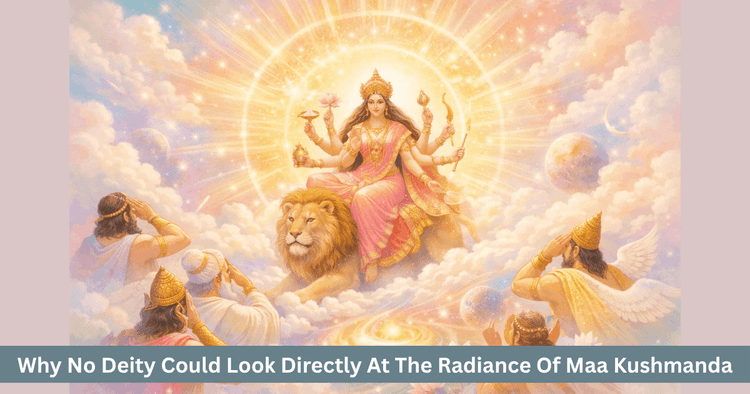
Table of Contents
The form of Maa Kushmanda is not merely a symbol of divine power. She is the center of a force so vast that not every being can endure it. It is said that when she appears in her full radiance, standing before her is difficult and even looking directly at her is not easy for the gods themselves. This is not only poetic praise. Behind it lies a profound secret.
In the earliest phase of creation, when the energy of Maa Kushmanda was spreading across the cosmos, the gods attempted to behold that form directly. They wanted to know what kind of force this was, the force that was shaping the universe itself. But the moment they lifted their awareness toward her radiance, they were inwardly shaken.
This light was not ordinary light. It was the very energy through which creation stood upon its foundation. Its intensity could affect not only vision but consciousness itself. The gods understood that if they continued to remain fixed upon that radiance for too long, even their own sense of separate identity might begin to dissolve.
Why Was Her Light So Difficult To Bear
Ordinary light may dazzle the eyes but the radiance of Maa Kushmanda did not touch only the eyes. It touched the inner field of awareness. That is why the disturbance felt by the gods was not merely visual. It was existential. This was the light that did not simply illuminate the outer universe. It was activating the deepest principles of existence itself. Whoever stood before it felt immediately the difference between limited being and boundless consciousness.
This is why the gods could not keep their gaze steady for long. Their fear was not that they would be burned. Their deeper feeling was that if they remained too long within that radiance, their distinct identity would begin to dissolve into the immense living power before them. This was not bodily fear. It was the awe that arises when the finite recognizes the Infinite.
Was This Truly Fear
This question is important. If the reaction of the gods is called only fear, the meaning remains incomplete. What they felt was fear joined with reverence, humility and an awareness of their own limits. Whenever a power stands before something more ancient, more expansive and more profound than itself, there naturally arises a mixed feeling of attraction and restraint.
The radiance of Maa Kushmanda was of this kind. It was not there to terrify. It was there to reveal that the original light of creation is not an object of ordinary perception. It cannot be held merely by sight. It demands a certain preparedness of consciousness. The gods realized this and that is why their gaze naturally lowered.
What Did Brahma Experience
The story says that Lord Brahma once tried seriously to understand this radiance. Since he is associated with creation, it was natural for him to wish to know the nature of the power from which the foundational light of existence had emerged. He focused his awareness and attempted to look directly into that brilliance. For a few moments he succeeded. Within it he sensed not only luminosity but also a profound creative vibration.
But soon he withdrew his gaze. He understood that this was not a force that could be fully captured by sight. It was not only to be looked at. It was to be experienced. This episode shows that even the creator power must bow before a deeper primordial source and Brahma accepted that truth with humility.
How Did Vishnu Receive This Light
Lord Vishnu approached the matter differently. He did not insist on seeing the radiance directly. Instead, he chose the path of acceptance. His nature is aligned with balance, preservation and harmony. He understood that it was not necessary to seize the light through vision. It was more important to align consciousness with its rhythm.
So Vishnu joined his awareness to that living energy. Through this, he was able to understand the meaning of the radiance. He perceived that the light of Maa Kushmanda was not only brilliance but also the rhythm through which life may be sustained. This reveals a subtle truth. Some realities are understood not by forcefully seeing them but by quietly entering into harmony with them.
Why Was Shiva’s Approach The Most Distinct
The approach of Lord Shiva is the most profound and unusual of all. He did not attempt to look at that radiance directly. This was not because he could not. It was because he already knew what that force was. Shiva is the symbol of void, silence and the unseen foundation beneath existence. When the void recognizes the light of creation, it does not need to look outwardly at it. It knows it at its source.
This teaches an important spiritual lesson. There are some truths that cannot be understood merely by outer seeing. They are understood through inner recognition. Shiva’s silence shows that when consciousness becomes deep enough, the need to see becomes less important, because knowing itself becomes complete.
The Radiance Of Maa Kushmanda Is Not Only Outer Light
The story does not end with the gods being unable to look at her directly. It also has another spiritual meaning. The radiance of Maa Kushmanda is not only an outer blaze. It is the symbol of the primordial consciousness present subtly within every being, every element and every experience. We too cannot fully see it because our own awareness is not yet that stable, clear and expansive.
How can what is inwardly restless hold the vision of total stillness. How can one who is not yet free from inner fluctuation fully endure the original light. In this sense, the experience of the gods is not merely an ancient event. It is an enduring spiritual indication. It tells us that before we can behold the highest truth, we too must become inwardly prepared.
Was Her Radiance Also A Kind Of Test
Many traditions suggest that the great radiance of Maa Kushmanda was not meant to frighten anyone. It was also a subtle test. Whoever could endure that energy with steadiness would be capable of understanding it. Whoever could understand it would be fit to hold the right place within the cosmic order. In this way, what occurred before the gods was not just revelation. It was also a testing of their nature, capacity and readiness.
This test was not external. No questions were asked. No challenge was announced. The light alone was present and each deity related to it according to their own deepest nature. Brahma tried to understand it. Vishnu chose acceptance. Shiva remained in silent recognition. This is what makes the story so spiritually refined.
What Does This Story Mean In Human Life
Many profound truths in human life also cannot be fully grasped only through intellect or physical sight. Love, death, soul, time, divinity, silence and inner intuition are not realities that can be completely understood through outer observation alone. They begin to reveal themselves only when the mind becomes quieter, more humble and more inwardly mature.
The story of Maa Kushmanda teaches that not every truth can be directly seized. Some truths are known only through experience, acceptance and inner vision. If we try to define them too quickly, they slip away from us. If we stand quietly before them, they slowly unveil themselves.
The Final Meaning Of This Secret
In the end, it becomes clear that no deity could look directly at the radiance of Maa Kushmanda because it was not merely light. It was the conscious presence of primordial Shakti. To stand before it and remain fixed in one’s separate identity was not easy. The lowering of the gaze by the gods was not weakness. It was understanding. They accepted that there are some powers which cannot be fully contained in direct perception. They can only be approached with humility.
Maa Kushmanda teaches that to understand true power, eyes alone are not enough. One needs the preparedness of consciousness. And when consciousness becomes ready, the distinction between seeing and knowing slowly begins to dissolve.
Frequently Asked Questions
Why could the gods not look directly at Maa Kushmanda’s radiance
Because her radiance was not only visible light but conscious power that could affect the awareness of the one who beheld it.
Was the lowering of their gaze only fear
No. It was also reverence, humility and a deep recognition of their own limitations before a greater power.
What did Brahma learn from her radiance
He learned that the original light of creation cannot be fully grasped by sight alone but must be known through deep experience.
Why were Vishnu and Shiva different in their approach
Vishnu accepted the energy and understood its rhythm, while Shiva recognized its essence inwardly without needing to look at it directly.
What is the greatest message of this story
That some of the highest truths cannot be seen by the eyes alone. They must be known through consciousness, humility and experience.
Get your accurate Kundali
Generate KundaliDid you like it?
Author

Aparna Patni (63)
Experience: 20
Consults About: Family Planning, Career
Clients In: Punjab, Haryana, Delhi
Share this article with friends and family
About ZODIAQ
ZODIAQ is an online Vedic Astrology platform. It connects clients seeking astrological advice to experienced astrologers with deep knowledge. Our users also generate kundali and perform kundali milan for free. ZODIAQ also offers services to the Astrologers. Astrologers utilize various offerings by ZODIAQ to serve their clients effectively.
If you are a User
Consult with experienced astrologers and seek their guidance. You can also order handwritten Janm Patrika report with life prediction prepared by experienced astrologers. Generate accurate Kundali, perform Kundali Matching and check horoscope and muhurat. Utilize our online library for all the necessary astrological and spiritual information.
If you are an Astrologer
Create accurate kundali for your clients and perform Kundali Matching for up to 5 people at a time. Write comprehensive Janm Patrika report for your clients with ZODIAQ. Check client details anytime by saving it in client directory. Become more productive by tracking how many clients you guide every day.
WELCOME TO
ZODIAQ
Right Decisions at the right time with ZODIAQ
