Did Maa Kushmanda Test Brahma, Vishnu, and Mahesh?
By Pt. Suvrat Sharma
The Secret Before Creation and the Trimurti’s Balance Test
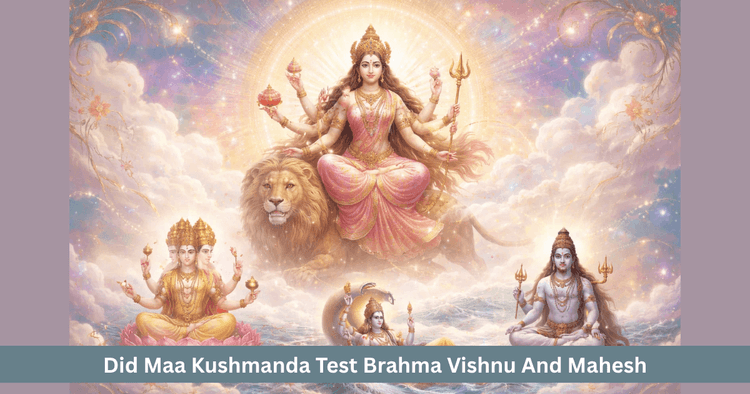
Table of Contents
The time before creation was not merely a period of darkness or emptiness. It was a state in which possibilities already existed but their form had not yet been decided. Within that vast and subtle condition, the consciousness of Maa Kushmanda became active. She did not only bring creation into being. According to certain deeper traditions, before creation itself unfolded, she performed another profound act. It is said that she tested the Trimurti, Brahma, Vishnu and Mahesh.
At first, this sounds unusual, because the Trimurti are generally seen as the principal divine powers responsible for creation, preservation and transformation. Yet according to this story, before the work of the cosmos could be entrusted to any power, it was necessary to know whether that power understood balance. Maa Kushmanda wished to ensure that the ones who would hold the movement of creation in their hands were not only powerful but also inwardly balanced.
Did Such A Test Truly Take Place
This was not a competition, nor a battle, nor an outer contest. It was a subtle testing. Its purpose was not to choose a winner but to reveal the true nature of each force. The governance of creation cannot be entrusted on the basis of strength alone. If there is creativity without order, chaos can arise. If there is preservation without wisdom, stagnation may grow. If there is transformation without timing, balance can break.
For this reason, Maa Kushmanda did not examine who was greatest in force. She examined who understood the dharma of power itself. That is why this was not an outer trial. It was a testing of essential nature.
How Was Brahma Tested
According to the story, Brahma was first given the opportunity to create but without any direct guidance. This is deeply significant, because creation requires not only imagination but also rhythm, patience and proportion. If one knows only how to produce forms but does not know how to place them in balance, then even beautiful creation may not endure.
Brahma began creating. In the beginning, his movement carried force but not complete stability. He continued to shape and expand but that expansion did not yet hold full equilibrium. At this point the deeper meaning of Maa Kushmanda’s insight becomes clear. The power to bring something into existence is not enough by itself. For creation to remain meaningful, the creator must also hold patience and inner order.
This test was not meant to show Brahma as inadequate. It was meant to reveal the nature and limit of his primary gift. Maa Kushmanda saw that he possessed the force of creation, yet this force would need the support of other complementary principles in order to become sustainable.
Why Was Vishnu’s Test So Different
The test given to Vishnu was equally subtle but very different. He was entrusted with the task of maintaining balance, yet without a fully defined set of rules. This is important, because preservation is not always the work of guarding a completed system. Many times it means sustaining harmony amid changing conditions.
At first this task was difficult, because energy was present in all directions but the order of existence had not yet become fixed. Vishnu began to align his consciousness with the larger field of energy that surrounded him. Rather than forcing control, he first chose to understand. From there, the answer to his test began to reveal itself. He came to grasp that preservation is not merely holding things in place. It is entering into living rhythm with what already exists.
Maa Kushmanda recognized from this that Vishnu’s nature was one of adaptive balance. Even without rigid rules, he could discover harmony. This is what made him worthy of the function of preservation.
Why Was Shiva’s Test Considered The Most Difficult
The most extraordinary part of the story is connected with Shiva. He was not given any visible task. He was not asked to create. He was not asked to preserve. He was placed within the void and asked only to remain still, where no action was required. At first this may seem like the simplest role but in truth it was the most difficult.
To do nothing is not as easy as it appears. Where energy is active, possibilities are emerging and creation is beginning to unfold, remaining inwardly still and preserving one’s essential steadiness is a very high discipline. Many forces in such a moment would wish to act, to influence or to express themselves. But Shiva did not. He accepted that stillness with complete ease.
That became the proof of his deepest strength. Shiva revealed that for creation to exist, not only active force but also containing silence is necessary. Maa Kushmanda understood that where creation and preservation would become active, Shiva’s silent principle would give the whole order depth and completion. This is why his was the most subtle and perhaps the most demanding test.
What Did Maa Kushmanda Recognize In The Trimurti
When Maa Kushmanda observed these three, it became clear to her that the work of existence could not be entrusted to one force alone. Brahma held the power of initiation. Vishnu held the capacity to sustain. Shiva held the power to contain, to remain still and when necessary, to transform.
From here, the division of roles among the Trimurti was not simply an assignment of functions. It became a revelation of essential nature. Brahma would create, Vishnu would preserve and Shiva would bring transformation in the right time. This was not merely an order given from above. It was the result of Maa Kushmanda’s insight into the truth of their inner nature.
Was This Test Conducted Only Once
Another deep layer of the story is that this test may not be understood as only a single ancient event. It can also be seen as a continuous principle. In every phase of creation, in every age and in every transformation, the powers of creation, preservation and change are tested again and again. Is creation remaining in balance. Is preservation turning into rigidity. Is transformation arising at the right time. This subtle order is constantly being examined.
That is why the functions of the Trimurti remain distinct yet inseparable. They are linked because the original balance established by Maa Kushmanda was not a temporary arrangement. It was a living cosmic order.
Why Is Maa Kushmanda’s Role So Important In This Story
Very often Maa Kushmanda is remembered only as the source of primordial creation. But this story reveals that her role is deeper still. She did not merely begin creation. She also ensured that the powers who would guide it were balanced, aware and rightly aligned. This is the role of a true cosmic mother. She does not only give birth. She also sees that what is born is entrusted into the right hands.
For this reason, Maa Kushmanda appears here not only as a creative goddess but also as the subtle intelligence behind divine order. Without her, the functions of the Trimurti might have existed but their harmony might not have become stable.
What Does This Story Mean In Human Life
This episode is not only divine narrative. It is also a teaching for life. Human beings also accept responsibilities, take up roles and enter major tasks. But before doing so, do they examine themselves. Do they possess not only ability but also patience, clarity, silence and balance. This is where the story touches human life most deeply.
One person may know how to begin something but not how to sustain it. Another may preserve but not know how to transform. Another may remain silent but not know when to act. For this reason, before responsibility there must be a testing of nature. Maa Kushmanda teaches that true strength is the strength that acts only after it has understood itself.
The Final Light Of This Secret
In the end, it becomes clear that the governance of creation was not entrusted on the basis of power alone. It arose from a balanced order and in establishing that order Maa Kushmanda played the most central role. She observed, tested, understood and then placed the Trimurti according to their true nature. That is why creation did not merely come into existence. It also became ordered.
This is the deepest secret of the story. Maa Kushmanda is not only the mother of light. She is also the intelligence of cosmic order that made creation sustainable. Her form teaches that before any great responsibility, balance must be tested, because power without balance remains incomplete.
Frequently Asked Questions
Did Maa Kushmanda truly test the Trimurti
The story suggests that she examined their essential nature and balance before the functions of creation were fully entrusted to them.
What was the main meaning of Brahma’s test
It revealed whether the power of creation was joined with patience order and balance.
What was tested in Vishnu’s role
It showed whether he could sustain harmony by aligning himself with living energy even without fixed rules.
Why was Shiva’s test the most difficult
Because he had to remain still without action and that became the most subtle test of strength.
What is the greatest message of this story
That before any great responsibility, not only power but also balance, patience and right understanding are essential.
Get your accurate Kundali
Generate KundaliDid you like it?
Author
Pt. Suvrat Sharma (63)
Experience: 20
Consults About: Family Planning, Career
Clients In: Punjab, Haryana, Delhi
Share this article with friends and family
About ZODIAQ
ZODIAQ is an online Vedic Astrology platform. It connects clients seeking astrological advice to experienced astrologers with deep knowledge. Our users also generate kundali and perform kundali milan for free. ZODIAQ also offers services to the Astrologers. Astrologers utilize various offerings by ZODIAQ to serve their clients effectively.
If you are a User
Consult with experienced astrologers and seek their guidance. You can also order handwritten Janm Patrika report with life prediction prepared by experienced astrologers. Generate accurate Kundali, perform Kundali Matching and check horoscope and muhurat. Utilize our online library for all the necessary astrological and spiritual information.
If you are an Astrologer
Create accurate kundali for your clients and perform Kundali Matching for up to 5 people at a time. Write comprehensive Janm Patrika report for your clients with ZODIAQ. Check client details anytime by saving it in client directory. Become more productive by tracking how many clients you guide every day.
WELCOME TO
ZODIAQ
Right Decisions at the right time with ZODIAQ
