Did Maa Shailputri Carry The Memory Of Her Previous Birth And What Was That Pain
By Pt. Abhishek Sharma
Exploring the subtle pain, experiences, and inner connection carried by Maa Shailputri
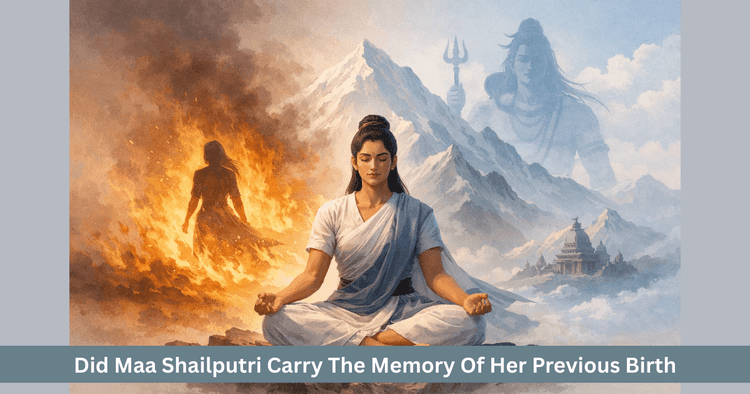
Table of Contents
This question appears simple on the surface, yet it carries immense depth within. While understanding the form of Maa Shailputri, a natural curiosity arises. Did anything of Sati’s previous life remain alive within Parvati after rebirth or did everything end in the fire. This is the most silent, most sensitive and most spiritual part of the story. Here memory is not only about events. It is about experience, pain, incompleteness and inner connection.
When Sati chose the fire for the sake of her self respect and truth, only the body came to an end. The flow of consciousness did not end. Indian spiritual thought often holds that deep experiences do not remain limited to the body. They become impressions and stay in the subtle layers of awareness. From that perspective, the birth of Parvati was not merely a new beginning but the next chapter of a journey already in motion. This is why the power within Shailputri did not arise only because she was born as the daughter of the mountain. It also carried the subtle heat of a previous experience.
What Was Present In Parvati’s Childhood That Made Her Different From Others
When Parvati was born in the house of Himalaya, her outer life resembled that of a royal princess. She had affection, dignity, protection and beauty all around her. Yet there was a certain seriousness in her nature that did not appear ordinary. She was not merely playful and carefree. There was a silence within her, a steadiness and an inner stillness that seemed to arise from a much deeper source.
At times she would sit alone, become inwardly absorbed and it would seem as though her mind was being drawn in a direction she herself could not clearly explain. This was not an explicit memory that she had once been Sati, yet there was an unnamed pull within her. That pull itself becomes the first sign in this narrative that consciousness does not begin from emptiness. It continues carrying something forward.
Does Memory Of A Previous Birth Always Return In Words
An important distinction must be understood here. Memory of a previous birth does not always mean that every event returns like a visible scene. Sometimes memory returns as feeling, sometimes as attraction, sometimes as unexplained sorrow, unspoken attachment or a certainty without logic. Something similar appears in Parvati’s life as well.
The attraction she felt toward Shiva was not ordinary. It was not devotion arising only from hearing his glory or seeing his form. There was a deep sense of recognition within it. It was as though the soul already knew where its center rested. That is why her movement toward Shiva feels less like outer fascination and more like an inner call.
What Kind Of Silent Pain May Have Lived Within Parvati
If this narrative is seen with sensitivity, a silent pain can certainly be felt within Parvati. It was not expressed in words, yet it seemed to appear again and again in her nature, her silence and her decisions. This was the same pain once experienced by Sati through insult, separation and fire. Within Parvati, that pain did not survive as memory of events but as a deep incompleteness.
That incompleteness seems to have called to her from within. At times it may have appeared as an unspoken withdrawal, at times in the depth of meditation, at times in solitude and at times in the resolve that repeatedly turned her toward Shiva. This silent pain lifts her personality beyond ordinary emotional longing. She does not appear merely as a woman in love but as a form of power that has already lost something inwardly and is rising again to reclaim that truth.
Was Her Attraction Toward Shiva Only Love Or Something More
Parvati’s attraction toward Shiva cannot be explained as love alone. Love was certainly there but within it also lived prior experience, soul connection and the call of an unfinished union. It seemed as though her life had not been given for an ordinary purpose. Again and again there arose within her the feeling that she must return to a truth that had once remained incomplete.
When she came to know that Shiva was the goal of her life, that understanding merely gave form to what her inner being was already carrying. Her resolve was no longer simply to attain a divine husband. It became the fulfillment of a bond that had once been broken. This is why her love became so steady, so serious and so deeply ascetic.
How Does The Shadow Of The Earlier Experience Appear In Her Tapasya
Parvati chose the path of tapasya. This decision was not only an expression of devotion but also an answer to the silent pain hidden within her. She renounced royal comfort, entered the solitude of the forest, gave up food and water and turned her resolve into unyielding tapas, meaning sacred austerity. This tapasya was not only for attaining Shiva. It was also a process of transforming the subtle pain she carried within.
Here the deeper truth of the narrative becomes visible. When someone has once been broken inwardly, their resolve, if awakened again, does not remain ordinary. Parvati’s tapas was so intense because it carried not only the longing of the present but also the depth of an earlier experience. In one birth she had endured insult, lived through separation and even relinquished the body. In the next, she was not moving without understanding. There was a silent maturity within her.
Why Was Shiva’s Test So Important For Her Journey
When Shiva tested her by appearing as a sage and speaking critically of himself, Parvati’s firmness was not only proof of present love. It was evidence of the maturity of her consciousness. She was no longer someone who could be swept away by surface emotion. She had recognized within herself a truth that no external word could shake.
In this episode, Parvati’s steadiness suggests that at some level the shadow of the previous experience still lived within her. One who has once lost love, endured dishonor and entered the fire of separation stands differently when life offers another chance. That deeper maturity is clearly present in Parvati’s devotion.
Would It Be Correct To Say That She Remembered Everything Clearly
Perhaps not. To say that Parvati remembered every detail of her previous birth in explicit form would reduce the subtlety of this story. Yet it would also be incomplete to say that she felt nothing from it. The truth rests somewhere between these two views. There was a deep soul memory within her, not present as visual recall but as lived experience.
She may not have remembered the events but she remembered the direction. She may not have recalled the words but she felt the depth of the relationship. She may not have seen the fire again in her mind but the shadow of that pain remained silently within. This quiet memory is what raises her beyond an ordinary life and turns her into a tapasvini, meaning a woman of sacred austerity.
How Was Sati’s Unfinished Pain Completed Through Parvati
When Shiva finally accepted Parvati, it was not only a marriage. It was the completion of an unfinished story. The pain that had remained unresolved in Sati found meaning through Parvati. The love that had once been broken returned in a new form, now supported by stability, tapasya and awakened awareness.
At this point, the form of Maa Shailputri becomes even deeper. She is not merely a reborn goddess. She is the power that transforms pain into tapas, tapas into awareness and awareness into fulfillment. That is why her form is not only gentle but inwardly strong in the deepest way.
What Does This Story Teach About Life
This story teaches that some experiences do not simply leave life. They remain within as impressions. At times they guide us. At times they become the very base of our spiritual discipline. Every pain does not only break. Sometimes the same pain shapes a person, matures them and brings them closer to their truest self.
This aspect of Maa Shailputri reminds us that incompleteness is not always weakness. At times that very incompleteness leads us toward the place where fulfillment waits. Within every silent pain lies the possibility of a new power being born.
From Silent Pain To Awakened Strength
The form of Maa Shailputri reveals that pain does not merely have to be endured. It can be transformed. If there was any memory of Sati within Parvati, it was not memory of words but memory of experience. If there was pain, it did not remain only a wound. It became the ground of transformation. This is the deepest beauty of the story.
For this reason, it is not enough to describe Maa Shailputri only as the first among Navdurga. She is the form of power that turns the fire of one birth into the tapasya of another. She teaches that what burns silently within can one day become the most stable light.
Frequently Asked Questions
Did Maa Shailputri carry the memory of her previous birth
She may not have remembered events clearly but there was certainly a deep soul level impression and subtle inner memory within her.
What pain lived within Parvati
It was the silent pain of insult, separation and unfinished love experienced earlier in the form of Sati.
Was her attraction toward Shiva only love
No, along with love it also carried soul recognition, an earlier bond and the call of an unfinished union.
Why was her tapasya so intense
Because it contained not only present longing but also the depth of previous experience and the transformation of silent pain.
What is the main message of this story
It teaches that pain does not only break a person, it can deepen consciousness and transform into power.
Get your accurate Kundali
Generate KundaliDid you like it?
Author

Pt. Abhishek Sharma (63)
Experience: 20
Consults About: Family Planning, Career
Clients In: Punjab, Haryana, Delhi
Share this article with friends and family
About ZODIAQ
ZODIAQ is an online Vedic Astrology platform. It connects clients seeking astrological advice to experienced astrologers with deep knowledge. Our users also generate kundali and perform kundali milan for free. ZODIAQ also offers services to the Astrologers. Astrologers utilize various offerings by ZODIAQ to serve their clients effectively.
If you are a User
Consult with experienced astrologers and seek their guidance. You can also order handwritten Janm Patrika report with life prediction prepared by experienced astrologers. Generate accurate Kundali, perform Kundali Matching and check horoscope and muhurat. Utilize our online library for all the necessary astrological and spiritual information.
If you are an Astrologer
Create accurate kundali for your clients and perform Kundali Matching for up to 5 people at a time. Write comprehensive Janm Patrika report for your clients with ZODIAQ. Check client details anytime by saving it in client directory. Become more productive by tracking how many clients you guide every day.
WELCOME TO
ZODIAQ
Right Decisions at the right time with ZODIAQ
