Sati to Shailputri: The Forgotten Story of Maa Shailputri
By Pt. Narendra Sharma
The Secret of Navratri’s Start and the Goddess's Rebirth
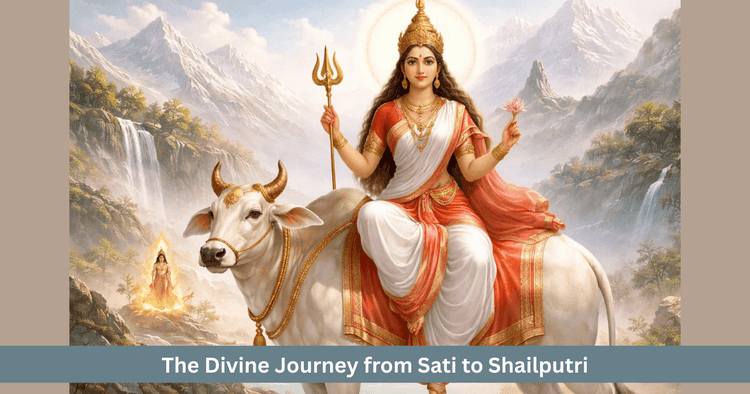
Table of Contents
When devotees worship Maa Shailputri on the first day of Navratri, they usually remember her as the daughter of the Himalayas and the future consort of Lord Shiva. Yet behind this calm and divine form lies an extremely powerful story of sacrifice, unwavering devotion and rebirth. The identity of Maa Shailputri is deeply connected with the earlier life of Goddess Sati, whose destiny transformed the entire course of cosmic history. This forgotten story explains why the journey of Navratri begins with her and why she represents the foundation of spiritual awakening.
The Earlier Birth of the Goddess as Sati
Long before she was known as Shailputri, the Goddess was born as Sati, the daughter of King Daksha. Daksha was one of the Prajapatis created by Lord Brahma and he possessed great pride in his power and the lineage of his family. From childhood Sati possessed extraordinary devotion toward Lord Shiva. When Sati reached a marriageable age she resolved that she would only choose Mahadeva as her husband.
Even though Shiva lived as an ascetic on Mount Kailash, detached from worldly luxuries, Sati’s heart was completely devoted to him. Sati pleased Shiva with her rigorous spiritual practice and eventually their marriage was solemnized. however King Daksha was completely against this marriage because in his eyes Shiva was a secondary figure who lived in cremation grounds and did not fit the royal standards he valued. This resentment and ideological difference eventually led to one of the most tragic events in the universe.
The Yajna of King Daksha and the Great Insult
With the passage of time the hatred toward Shiva grew within King Daksha. He once organized a grand yajna ceremony and invited all gods, sages and divine beings of the universe. however he deliberately chose not to invite Lord Shiva and his daughter Sati. When Sati learned about this grand ceremony through Sage Narada her heart yearned to go to her father's house.
Lord Shiva tried to explain to her that going without an invitation is not appropriate and she might face humiliation there. But Sati insisted that one does not need a formal invitation to go to a father's house. When Sati reached the sacrificial assembly the scene was heart-wrenching. No guest or relative met her with love and King Daksha openly insulted Lord Shiva in front of everyone. Daksha called Shiva inauspicious and lineage-less. Hearing these bitter words against her deity and husband, Sati’s heart filled with deep sorrow and intense anger.
The Self Immolation of Sati and Cosmic Chaos
Sati roared in the assembly that a body born from the essence of such a father who insults Mahadeva is now worthy of being discarded. She declared that she would consume her physical frame in the fire of Yoga so that in the future no one could call her the daughter of Daksha. In that moment Sati closed her eyes and ignited the fire within her body through her internal yogic power. In an instant the physical form of Sati was reduced to ashes near the altar of the yajna.
When this news reached Mount Kailash the Rudra form of Lord Shiva awakened. In fury he plucked a lock of his hair and struck it on the ground from which the fierce Veerabhadra was born. Veerabhadra destroyed Daksha’s yajna with his army and punished those who supported the insult. Shiva wandered throughout the universe in a state of distraction carrying the half burnt body of Sati. Due to his Tandava the crisis of cataclysm began to loom over the creation. Then Lord Vishnu divided Sati’s body into many parts with his Sudarshana Chakra. Wherever parts of Sati’s body fell on the earth 51 Shakti Peethas were created which are still highly revered in Sanatana Dharma.
The New Manifestation as Maa Shailputri, Daughter of the Himalayas
After the departure of Sati the entire universe became deserted and Shiva went into deep meditation. But according to the laws of nature the consciousness of the Goddess had to return in a new and more stable form. King Himalaya and Queen Mena had performed penance for ages to obtain Mother Bhagwati as their daughter. As a result the Goddess took birth in their house as a newborn girl.
Because she was the daughter of Shail or the mountain she was called Shailputri. In this birth the Goddess had stability and firmness like the Himalayas instead of the restlessness of Sati. From childhood there was a celestial radiance on the face of Shailputri and her plays were inspired by spiritual practice. Growing up in the pure atmosphere of the mountain she became the personification of infinite strength and patience. She again started penance in the forest to get Lord Shiva as her husband on the advice of Narada Ji.
Why Navratri Begins with Maa Shailputri
The story of Sati and Shailputri is not just a tale but a deep map of spiritual development. Navratri begins with Maa Shailputri because she represents the power of resolve. The form of Sati was a symbol of emotion that could not bear insult while the form of Shailputri is a symbol of penance that is steadfast. Just as the Goddess gave up her old identity and gained a new and higher identity, devotees also take a resolve for a new spiritual journey on the first day of Navratri by leaving their old vices.
According to yogic science the abode of Maa Shailputri is in the Muladhara Chakra. This chakra is the foundation pillar of the human body. Just as a mountain is stable, similarly it is mandatory for the mind to be stable for spiritual progress. Without strengthening the foundation no seeker can climb the stairs of higher consciousness. Therefore the first stage of Navratri gives the message of strengthening the roots.
Subtle Interpretation of Maa Shailputri’s Form
The depiction of Maa Shailputri is extremely grand and inspiring. She holds a Trishul (trident) in one hand and a lotus flower in the other. The trident indicates the destruction of the three sufferings of man, namely physical, divine and material troubles. The lotus flower teaches the art of remaining detached and pure even while living in the mud of this world.
Her vehicle is the bull, that is, Nandi. The bull is considered an extremely powerful and tolerant creature. This shows that the person who walks on the path of Dharma automatically gets infinite endurance and the capacity to bear burdens. Her white garments are an indicator of her purity and renunciation which acts as a bridge between the sacrifice of Sati and the new resolve of Shailputri.
The Eternal Message of This Great Legend
This complete journey of Maa Shailputri teaches us that difficult circumstances and insults in life do not come to break us but to rebuild us. The end of Sati may seem sad but that very end gave birth to a stable power like Shailputri. If something is being destroyed in your life then have faith that it is a sign of a new and better beginning.
Through devotion, courage and unwavering faith any person can turn the dark chapter of their life into spiritual light. This is why when Navratri begins with the worship of Maa Shailputri it reminds every seeker that the first step for every big goal is humility, connection with roots and the courage to rise again.
Frequently Asked Questions
Is Maa Shailputri actually Sati?
Yes Maa Shailputri is the rebirth of Goddess Sati who took a second incarnation as the daughter of the Himalayas.
Which color should be used in the worship of Maa Shailputri?
The Yellow color is considered extremely auspicious for the first day as it is a symbol of knowledge and new consciousness.
What is the connection between the Muladhara Chakra and Maa Shailputri?
The Muladhara Chakra is the base of the body and Maa Shailputri is the Goddess of stability therefore her worship is mandatory for the awakening of this chakra.
What do the trident and lotus mean?
The trident is a symbol of the destruction of evils and the lotus flower is a symbol of remaining pure while living in the world.
What is the favorite offering for Maa Shailputri?
Maa Shailputri loves to be offered items made of pure cow ghee or offerings made of milk.
Would you like to hear the story of that difficult penance of Maa Brahmacharini in the next chapter of Navratri which even astonished Kamadeva?
Get your accurate Kundali
Generate KundaliDid you like it?
Author

Pt. Narendra Sharma (63)
Experience: 20
Consults About: Family Planning, Career
Clients In: Punjab, Haryana, Delhi
Share this article with friends and family
About ZODIAQ
ZODIAQ is an online Vedic Astrology platform. It connects clients seeking astrological advice to experienced astrologers with deep knowledge. Our users also generate kundali and perform kundali milan for free. ZODIAQ also offers services to the Astrologers. Astrologers utilize various offerings by ZODIAQ to serve their clients effectively.
If you are a User
Consult with experienced astrologers and seek their guidance. You can also order handwritten Janm Patrika report with life prediction prepared by experienced astrologers. Generate accurate Kundali, perform Kundali Matching and check horoscope and muhurat. Utilize our online library for all the necessary astrological and spiritual information.
If you are an Astrologer
Create accurate kundali for your clients and perform Kundali Matching for up to 5 people at a time. Write comprehensive Janm Patrika report for your clients with ZODIAQ. Check client details anytime by saving it in client directory. Become more productive by tracking how many clients you guide every day.
WELCOME TO
ZODIAQ
Right Decisions at the right time with ZODIAQ
