Were All Siddhis Truly Under Maa Siddhidatri?
By Pt. Nilesh Sharma
Why Even the Gods Could Not Attain Them Without Her Grace
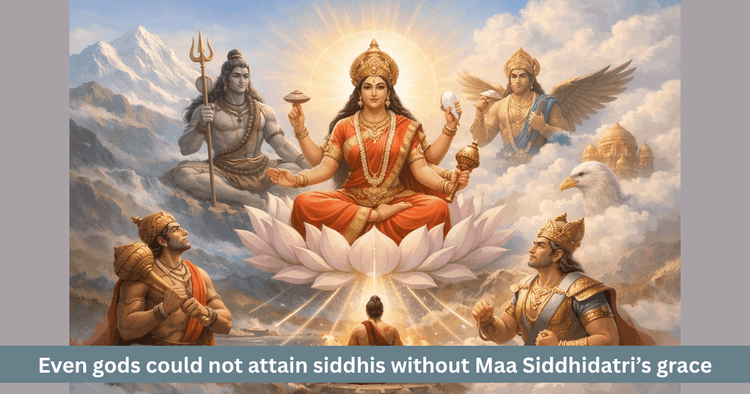
Table of Contents
Creation contains countless powers. Every deity is linked with a particular element, quality or divine function. Somewhere there is knowledge, somewhere there is strength, somewhere there is preservation and somewhere there is the force of transformation. Yet a time came when it became clear that even with all these powers present, there was a realm before which every deity had to pause. In that realm, strength alone was not enough, austerity alone was not enough and even divinity by itself was not enough. That realm was the realm of siddhi and it is there that the supreme importance of Maa Siddhidatri becomes visible.
The question naturally arises that if the gods already possessed extraordinary powers, why did they still need someone else for siddhis. The answer lies in understanding that power and siddhi are not the same thing. Power gives the ability to act but siddhi carries that ability to its most subtle, complete and divine fulfillment. That is why even the gods, though mighty, turned toward Maa Siddhidatri for the final completion of their capacities.
What Are Siddhis In Truth
People often think of siddhis as miraculous powers but their meaning is much deeper than that. Anima, Mahima, Garima, Laghima, Prapti, Prakamya, Ishitva and Vashitva are not merely unusual abilities. They are states of consciousness in which ordinary limitations are transcended.
When a being becomes so subtle that it can enter the innermost layers of existence, that reflects Anima. When the same consciousness expands into vastness, that reflects Mahima. When such steadiness and weight arise that nothing can shake that state, Garima is present. In the same way, every siddhi is not merely an outer power but the flowering of an inwardly perfected consciousness.
That is why siddhis were never regarded as objects to be collected. They were understood as the result of a consciousness entering fullness. And the presiding power of that fullness is Maa Siddhidatri.
The Gods Had Power So What Was Missing
The gods possessed their own divine capacities. Brahma could create, Vishnu could preserve and Shiva was the lord of dissolution and transformation. Indra held rulership, Agni held radiance, Varuna held depth and Vayu held movement. Yet none of these, by themselves, were final completeness.
The lack was that every force functioned within its own rightful boundary. Each was great but not universal. Each was powerful but not yet perfected. The gods realized that what they possessed was immense, yet when it came to entering the subtlest level of consciousness and moving within the deepest divine freedom, a higher grace was required.
That is where Maa Siddhidatri becomes central. She is not merely the giver of siddhis. She is the source consciousness of all siddhis. To say that siddhis are under her does not mean limitation. It means origin.
Did The Gods Try To Attain Siddhis By Themselves
Yes, the gods did strive to attain siddhis through their own means. They undertook tapas, discipline, meditative focus and divine refinement. They knew that siddhis could not be attained through ordinary methods. Yet with every effort they touched a subtle boundary.
That boundary revealed that they were close but the final gate had not opened. This became a very important realization, because it showed them that siddhi is not the result of effort alone. Grace is essential.
From that point, their understanding began to change. They no longer looked at siddhis as powers to be conquered but as divine states to be received. That understanding led them into the refuge of Maa Siddhidatri.
Why Are Siddhis Received Through Grace
This is the deepest center of the story. Siddhis cannot arise from austerity alone because austerity opens the path but the final entry happens through divine grace. If siddhis came only through effort, they would become the property of the merely powerful. But the law of creation is more balanced than that.
Maa Siddhidatri ensures that siddhis remain stable only in the consciousness that is fit to hold them. Without purity, siddhi can become destructive. Without balance, siddhi can become the cause of pride. Without compassion, siddhi can spread disorder. That is why her grace does not merely give. It also awakens worthiness.
What must be understood here is that Maa Siddhidatri does not restrict anyone. She is the guardian of that divine threshold through which siddhi enters consciousness in a safe and balanced way.
Why Did The Gods Take Refuge In Her
When the gods understood that their own power had limits, they turned together toward Maa Siddhidatri. This was not merely an act of prayer. It was an act of humble acceptance. They admitted that until the grace of the goddess touched them, their own efforts could not become complete.
That very acceptance was already half the attainment. Wherever pride ends, the true spiritual journey begins. The gods realized that to attain siddhi, they had first to accept the source from which siddhi itself arises.
At that time, the form of Maa Siddhidatri was deeply serene. Yet within that serenity was an immeasurable divinity that fully understood the efforts, the limits and the inner condition of all the gods.
What Did Maa Siddhidatri Actually Give
Maa Siddhidatri did not place siddhis into the hands of the gods as though they were objects. She showed them the level of consciousness in which siddhis naturally manifest. This is the most subtle dimension of the story.
If siddhis were simply handed over, their use would remain external. But when consciousness becomes worthy of siddhi, that power becomes stable. It remains balanced within the being who holds it. That is true attainment.
The gods experienced this process directly. A new clarity arose within them. They understood that siddhi does not come from outside. It awakens in an inner state of purity. The grace of the goddess makes that awakening possible.
Why Did The Asuras Fail
The asuras also desired siddhis but their intention was different. They wanted siddhis as a form of possession, wished to hold them as an expression of ego and tried to reach them through force. That was their greatest mistake.
Siddhi is not related only to capacity but also to worthiness. Where there is no balance, siddhi cannot remain. Where there is no purity, siddhi becomes distortion. The asuras wanted power but they did not seek refinement of consciousness. That is why they could not reach the true essence of siddhi.
This episode also teaches that every power is not placed in every hand. Divine order always examines who is capable of bearing it.
How Does Shiva And Ardhanarishvara Relate To This Truth
Lord Shiva knew this mystery already. That is why he too accepts the grace of Maa Siddhidatri. The form of Ardhanarishvara is also a profound symbol of this very balance. In it, masculine consciousness and divine power stand as one. That is completeness.
Shiva knows that without Shakti, even Shiva may appear incomplete and without consciousness, Shakti may become unbalanced. Maa Siddhidatri presides over this fulfilled harmony. Therefore her grace is not limited to one siddhi. It extends to the total balance of divine existence.
What Does This Story Teach Us
This story is not only about the gods. It applies deeply to our lives as well. Very often we make efforts, gain knowledge, refine our skills and adopt discipline, yet the final result still does not come. At such moments we often think perhaps the effort is insufficient. But many times the lack is not in effort. The lack lies in inner worthiness and in the acceptance of grace.
Maa Siddhidatri teaches that true siddhi does not arrive from outside. It awakens from within. But for that to happen, balance, humility and purity must arise in the inner being. When that happens, what once seemed impossible begins to unfold naturally.
Where Siddhi Became The Meaning Of Fulfillment
In the end it becomes clear that all siddhis were under Maa Siddhidatri because she was their source. This does not mean she restricts them. It means she protects the divine path that leads to fulfillment.
Even the gods could not attain siddhis completely without her grace because siddhi is not mere power. It is the gift of balanced consciousness. This is the deeper truth of the story. Maa Siddhidatri teaches that when one reaches that inward level where ego falls away and balance awakens, no boundary remains.
Frequently Asked Questions
Who is Maa Siddhidatri
Maa Siddhidatri is the ninth form of Navadurga and is revered as the presiding goddess of all siddhis.
Were all siddhis truly under her
Yes, because she is understood as the original source and divine guardian of all siddhis.
Why could the gods not attain siddhis by themselves
Because even after effort and austerity, final siddhi still required the grace of the goddess and the worthiness of consciousness.
Why could the asuras not attain siddhis
Because they desired power but did not walk the path of purity, balance and divine worthiness.
What does this story teach human life
It teaches that effort alone is not enough. When balance, humility and the acceptance of grace arise within, true siddhi becomes possible.
Get your accurate Kundali
Generate KundaliDid you like it?
Author

Pt. Nilesh Sharma (63)
Experience: 20
Consults About: Family Planning, Career
Clients In: Punjab, Haryana, Delhi
Share this article with friends and family
About ZODIAQ
ZODIAQ is an online Vedic Astrology platform. It connects clients seeking astrological advice to experienced astrologers with deep knowledge. Our users also generate kundali and perform kundali milan for free. ZODIAQ also offers services to the Astrologers. Astrologers utilize various offerings by ZODIAQ to serve their clients effectively.
If you are a User
Consult with experienced astrologers and seek their guidance. You can also order handwritten Janm Patrika report with life prediction prepared by experienced astrologers. Generate accurate Kundali, perform Kundali Matching and check horoscope and muhurat. Utilize our online library for all the necessary astrological and spiritual information.
If you are an Astrologer
Create accurate kundali for your clients and perform Kundali Matching for up to 5 people at a time. Write comprehensive Janm Patrika report for your clients with ZODIAQ. Check client details anytime by saving it in client directory. Become more productive by tracking how many clients you guide every day.
WELCOME TO
ZODIAQ
Right Decisions at the right time with ZODIAQ
