Why Maa Skandamata Remained Calm on the Lotus Before the War and What This Silence Truly Means
By Pt. Sanjeev Sharma
The Secret of Maa Skandamata’s Calm Power and Balance During War
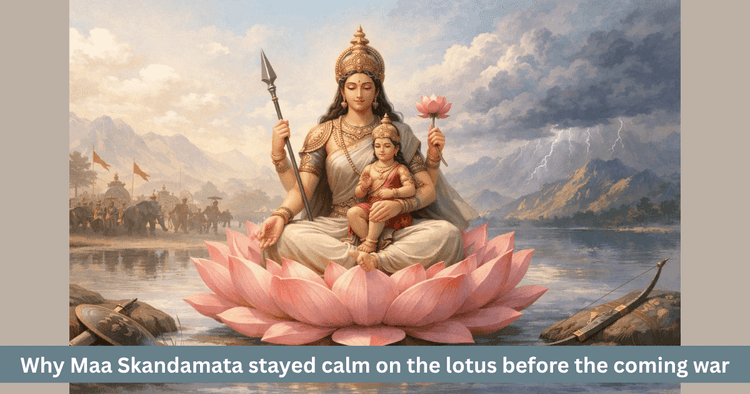
Table of Contents
When the moment of a great war approaches, it is not only the battlefield that changes, the entire state of consciousness begins to shift. The pace among the gods increases, thoughts become sharper, weapons are prepared and a subtle tension spreads in every direction. In such a time, it is natural to expect that every divine force would appear active, intense and visibly engaged in preparation. Yet, the form of Maa Skandamata presents a completely different and deeply thought provoking image. The war is near, the strength of the demons is rising, the gods are concerned and still Maa Skandamata is seated on a lotus in complete calmness. This very moment makes the entire narrative extraordinary.
This calmness was not ordinary. It was not the calmness of ignorance, nor was it a distant detachment from the situation. It was the calmness of a power that remains centered even while being fully present within the situation. Maa Skandamata was not away from the war. She was present within the same tension, the same pressure and the same unfolding events. Yet her form remained balanced. That is why her presence on the lotus becomes a profound spiritual indication rather than a simple visual.
What Did the Gods Feel When They Saw This
When the gods witnessed Maa Skandamata in this form, many questions arose within them. They wondered that when the war had become inevitable and the strength of the demons was increasing, what does such stillness signify. Was it a sign of deep trust. Was it an awareness of the outcome already known. Or was it a silent force that could change the direction of the war even before it began.
At that time, the gods were experiencing fear. Their challenge was not only external but also internal. They were concerned about the result. Even though they understood that wars are not won by weapons alone, fear clouds clarity. In that moment, the calm presence of Maa Skandamata began to influence them. At first, they could not understand her silence but gradually they realized that this was not inactivity but the highest form of self control.
Why Is the Lotus So Important in This Story
Maa Skandamata being seated on a lotus is the essence of this entire episode. The lotus is not merely a beautiful seat. In the Indian spiritual tradition, it represents purity, detachment and elevated awareness. The lotus grows in mud, yet it remains untouched by it. Water surrounds it, yet it does not weigh it down. It maintains its inner balance and clarity in every condition.
This is why Maa Skandamata seated on the lotus indicates that she was aware of everything happening around her, yet she was not bound by it. She was within the war but the war was not within her. She was present in the conflict but the conflict had not disturbed her inner state. This form teaches that even in the midst of chaos, consciousness can remain clear and steady.
What Message Was Maa Skandamata Giving Through Her Silence
Her presence itself was the answer. She did not pick up any weapon. She did not make any announcement. She did not try to explain anything. Yet her silence became the message. This message was that every battle is not won through panic but through balance. When the mind is filled with fear, even strength loses direction. When the mind is stable, even limited resources become sufficient.
Maa Skandamata demonstrated that the war is first decided within. If the minds of the gods remained disturbed, their strength would scatter. If their confidence broke, their weapons would fail. Her calmness was therefore the greatest preparation before the war. She was not visibly acting, yet she was establishing the foundation of awareness.
What Does the Silence of Lord Shiva Indicate Here
It is said that Lord Shiva was also witnessing this moment, yet he remained silent. His silence adds depth to this entire event. Shiva understood that this was not a moment for external action but for understanding the nature of power. The form of Maa Skandamata was not only maternal but also deeply stabilizing in nature.
The silence of Shiva indicates recognition. He was aware that this was the moment where inner clarity and focused consciousness mattered more than outward movement. Where the mind becomes pure and centered, the possibility of victory becomes stronger.
How Did the Demons Interpret This Calmness
An interesting dimension of this story is that even the demons observed this calmness but failed to understand it. They looked at it from a surface level. To them, such stillness appeared like weakness. They could not comprehend that a power which becomes stable within cannot be shaken easily from outside.
This highlights the difference between demonic perception and divine understanding. The demons mistook calmness for passivity. The gods initially questioned it but later recognized it as strength. Maa Skandamata’s form reveals that true power does not always appear loud. Sometimes it is so silent that those who only observe externally fail to recognize its depth.
How Did the Situation Change Without Any Weapon
Maa Skandamata did not engage in direct combat at that moment, yet her presence transformed the environment. The anxiety within the gods slowly began to dissolve. Their thoughts became clearer. Their confidence started returning. Where there was tension, composure began to arise. This subtle shift was what eventually influenced the direction of the war.
There is a profound principle here. Not every victory begins with action. Some victories begin when fear dissolves and clarity returns. Maa Skandamata proved that the greatest power is not only in striking but in stabilizing the mind, direction and decision before the strike.
How Do Motherhood and Power Come Together in Her Form
Maa Skandamata is not just a calm deity before a war. She is a mother and this aspect adds deeper meaning to her presence. A mother does not only protect externally but also provides inner assurance. When a child is afraid, words are not always needed. Sometimes the presence itself is enough. The same was true for the gods.
Her calmness became a shelter for them. Her silence became reassurance that balance is still possible even in the most difficult times. This is the unique union of motherhood and strength. She is gentle, yet unshakable. She is silent, yet deeply influential.
What Does This Story Teach About Human Life
This story is not limited to an ancient war. It reflects human life itself. Whenever life presents challenges, when decisions become difficult and when pressure builds, the mind is the first to become unstable. At that point, one either reacts in panic or pauses to find inner stability. Maa Skandamata teaches that before any external struggle, one must first stabilize the inner state.
If the mind is disturbed, the right path becomes unclear. If fear dominates, even available strength appears insufficient. But when the mind becomes steady, even complex situations begin to make sense. Her lotus posture is therefore not just divine imagery but a profound life principle. Calmness is not escape. It is the state from which right action emerges.
Is Remaining Calm Before War a Sign of Inaction
This is an important question. Many people misunderstand calmness as inactivity. They assume that if someone does not react immediately, it indicates weakness. however Maa Skandamata’s form reveals the opposite truth. Remaining calm before a battle is not inactivity, it is conservation of energy. It is protecting awareness from scattering. It is keeping decision making free from emotional disturbance.
A force that reacts impulsively often weakens itself. A force that can remain steady until the right moment acts with full impact. Maa Skandamata represents this subtle yet powerful dimension of strength.
The Deeper Meaning of This Divine Moment
Ultimately, it becomes clear that Maa Skandamata seated calmly on the lotus was not an ordinary moment. It was the deepest preparation before the war. It was a declaration that inner victory precedes outer victory. It was a reminder that a balanced mind protects dharma. It was a teaching that when calmness and power unite, transformation becomes inevitable.
Maa Skandamata teaches that struggles in life may be unavoidable but panic is not. If the inner lotus remains untouched, if awareness remains pure and steady, even the most difficult times do not lose direction. This is the true meaning of her serene form.
Frequently Asked Questions
Why did Maa Skandamata remain calm on the lotus before the war
She demonstrated that inner balance and stability of consciousness are essential before any external battle.
What does the lotus symbolize in this story
The lotus represents detachment, purity and a steady awareness that remains untouched even in difficult situations.
Did the gods understand her calmness immediately
No. Initially they questioned it but gradually they realized that her calmness was removing their fear.
How did the demons perceive this calmness
They misunderstood it as weakness because they could not recognize the power hidden within that stillness.
What is the most important message of this story
True strength lies not only in action but in stabilizing the mind, clarity and awareness before action.
Get your accurate Kundali
Generate KundaliDid you like it?
Author

Pt. Sanjeev Sharma (63)
Experience: 20
Consults About: Family Planning, Career
Clients In: Punjab, Haryana, Delhi
Share this article with friends and family
About ZODIAQ
ZODIAQ is an online Vedic Astrology platform. It connects clients seeking astrological advice to experienced astrologers with deep knowledge. Our users also generate kundali and perform kundali milan for free. ZODIAQ also offers services to the Astrologers. Astrologers utilize various offerings by ZODIAQ to serve their clients effectively.
If you are a User
Consult with experienced astrologers and seek their guidance. You can also order handwritten Janm Patrika report with life prediction prepared by experienced astrologers. Generate accurate Kundali, perform Kundali Matching and check horoscope and muhurat. Utilize our online library for all the necessary astrological and spiritual information.
If you are an Astrologer
Create accurate kundali for your clients and perform Kundali Matching for up to 5 people at a time. Write comprehensive Janm Patrika report for your clients with ZODIAQ. Check client details anytime by saving it in client directory. Become more productive by tracking how many clients you guide every day.
WELCOME TO
ZODIAQ
Right Decisions at the right time with ZODIAQ
