Did the Demons Make Their Greatest Mistake by Mistaking Maa Skandamata’s Compassion for Weakness
By Pt. Abhishek Sharma
The Demons’ Misjudgment of Maa Skandamata’s Compassion and Serene Power During War
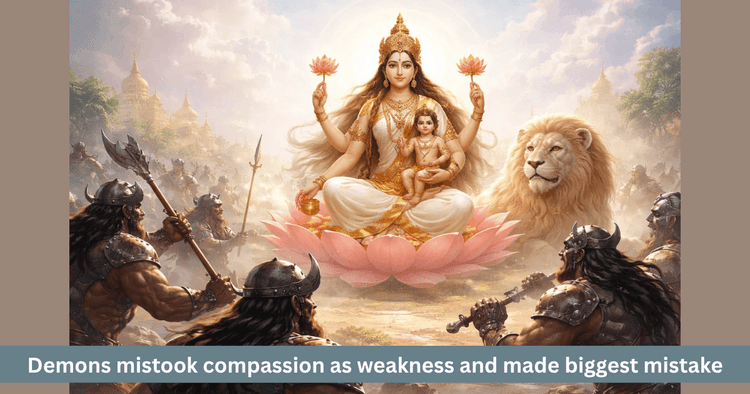
Table of Contents
In times of war, a common belief quickly takes hold of the mind that the one who is harder, more aggressive and more fear inducing will ultimately be victorious. During that great conflict between the gods and the demons, the same idea had settled deeply within the demons. They understood strength only as attack, domination and visible control. For them, compassion had no place and peace seemed even more suspicious. At such a moment, when Maa Skandamata appeared near the battlefield in her serene and compassionate form, the demons made the very mistake that arrogance often makes. They mistook depth for softness and compassion for weakness.
Maa Skandamata was seated upon a lotus. Her face carried neither anger nor battle fury nor any outward agitation. There was in her form a stability that was not merely to be seen but to be felt. She was near the war, yet untouched by its fever. This was exactly what the demons found hardest to understand. They were accustomed to a power that shouts, challenges and displays itself outwardly. So when they saw Maa Skandamata in this form, they made their first and greatest mistake. They assumed that whatever is calm must be weak, whatever is compassionate will not resist and whatever is steady can be easily shaken.
Why Did the Demons Mistake Compassion for Weakness
This question does not belong only to that battle. It points toward a deep spiritual and psychological error. The nature of the demons was built upon outer force. They believed that if there was no harshness visible in a form, there could also be no true power within it. For them, strength meant only what could be seen with the eyes. They failed to understand that compassion too can be power and at times a far greater power.
The form of Maa Skandamata appeared gentle to them. They did not see that the same gentleness was the expression of a higher equilibrium. They did not recognize that the force which remains fully established within itself is often the most powerful of all. Their confusion began there. They believed the moment was favorable. They thought they could advance without facing any great resistance. This assumption gradually fed their ego and made them even less capable of understanding what stood before them.
What Was Hidden Within Maa Skandamata’s Compassion That Began to Restrain Them
As soon as the demons tried to move toward attack, they began to experience something strange within themselves. There was no outer obstacle. No wall stood before them, no visible line of force appeared, no roar was heard. Yet their steps became heavy. Their thoughts lost clarity. A subtle uneasiness began to grow inside them. This was the point at which the true effect of Maa Skandamata’s compassion began to unfold.
This compassion was not sentimentality. It was a divine energy that quieted the impulse to attack from within. When a consciousness is filled with balanced compassion, the one who stands before it cannot escape his own inner disorder. This is exactly what happened to the demons. They were not merely seeing a goddess before them. They were, without knowing it, being brought face to face with their own hidden fear, instability and disorder.
Was This Influence Already Changing the War Before It Began
Yes and this is the most important dimension of the story. A war does not change only when weapons are used. It changes even earlier when the direction of the mind begins to shift. Maa Skandamata did not launch a visible attack, yet her presence began altering the psychological and spiritual foundation of the battle. The demons had arrived with outward confidence in victory. Now they were forced to confront doubt within themselves.
Doubt can become the greatest weakness of any warrior. As long as the mind is clear, strength remains concentrated. The moment the mind becomes confused, outer force begins to scatter. Maa Skandamata’s compassion did exactly this. She did not stop the demons from outside. She stopped them from within. In any battle, that is the deepest turning point.
What Did the Gods Perceive in This Form
Where the demons misread compassion as weakness, the gods slowly began to experience its real meaning. They saw that the peaceful form of Maa Skandamata was not mere softness. It was a foundation capable of steadying a fearful mind. Her silence was not empty silence. It held assurance, balance and a profound trust that the outcome of war would not be decided by visible violence alone.
There was tension in the minds of the gods as well. They fully understood the seriousness of the conflict. Yet the compassionate presence of Maa Skandamata awakened a new confidence in them. They began to feel that this was not merely war but also a test of dharma. And in such a test, not only hardness but also inner balance was necessary. In this way, Maa Skandamata’s form revealed to them a new meaning of power.
How Did the Demons Become Trapped in Their Own Error
The demons first took the form of Maa Skandamata lightly. Then, when they began to feel inner uneasiness, they assumed it was temporary. They tried to suppress their fear. They attempted to harden their minds. They forced themselves to maintain confidence. But the more they tried to hide the disturbance within, the more clearly it arose.
This was their second mistake. The first mistake was to mistake compassion for weakness. The second was to refuse to understand the experience that was already unfolding within them. Had they stopped and truly reflected on what kind of power stood before them, they might have seen the situation differently. But their arrogance prevented them from learning. That is why they continued to weaken before the very compassion they had already underestimated.
How Did Maa Skandamata Change the Direction of the War Without Raising a Weapon
This is the most subtle part of the story. Maa Skandamata neither roared nor struck nor issued any challenge. Yet her compassion itself became her greatest weapon. This weapon does not wound the body but it exposes inner instability. It does not stop someone by force but it places them before their own illusions.
When the mind of the demons began to shake, their ability to fight was also affected. They could no longer remain inwardly steady. They could not fully trust their own strength. This was the moment when the direction of the war began changing, even without visible combat. Maa Skandamata proved that there is a form of true power that can create the deepest transformation without making noise.
What Happens When Compassion and Power Stand Together
The greatest teaching of this story lies here. Compassion and power are not opposite forces. In truth, when power is joined with compassion, it becomes an even higher order of power. Hardness may create pressure. Compassion can reveal the inner truth. Hardness may control from outside. Compassion can create inner transformation.
The form of Maa Skandamata represents precisely this higher power. She shows that the force which can only destroy is not complete. The force that can also bring balance, reveal hidden confusion and guide inwardly is the truly divine one. The demons failed to understand this truth and that failure became their greatest mistake.
What Does This Story Teach for Human Life
In human life too, we often make the same mistake that the demons made. We frequently interpret compassion as weakness. We assume that hardness is strength, loudness is influence and immediate reaction is power. But deeper experience of life repeatedly shows that the most enduring strength is the one that is balanced, inwardly peaceful and able to remain steady before another without breaking.
When a person remains compassionate even in difficulty, that person is revealing the highest strength within. This is not easy. That is why to mistake compassion for sentimental weakness is itself an error. Maa Skandamata teaches that the person who can remain compassionate and yet unshaken is the truly powerful one.
What Is the Final Meaning of This Story
In the end it becomes clear that the defeat of the demons did not come merely from lack of strength. They were defeated also because they failed to recognize the kind of power standing before them. They saw only the outer form, not the inward effect. They saw compassion but not the divine force hidden within it. That became their greatest mistake.
Maa Skandamata demonstrated that when compassion is joined with balance, it can become more powerful than aggression itself. She teaches that strength does not always lie in becoming hard under every circumstance. At times, to remain calm and compassionate is the highest courage. And when clarity joins that courage, no conflict can truly shake us from within.
Frequently Asked Questions
Why did the demons mistake Maa Skandamata’s compassion for weakness
Because they understood power only as outward hardness and aggression.
What effect did Maa Skandamata’s compassion have on the demons
It created doubt, uneasiness and inner instability in them, weakening their confidence.
Did Maa Skandamata launch any direct attack
No. Her peaceful presence and compassionate energy became the greatest force on the battlefield.
What did the gods learn from this form
They understood that war is not won only through weapons but also through steadiness of mind and inner balance.
What is the main teaching of this story
Compassion is not weakness. When joined with strength and balance, it becomes the highest form of divine power.
Get your accurate Kundali
Generate KundaliDid you like it?
Author

Pt. Abhishek Sharma (63)
Experience: 20
Consults About: Family Planning, Career
Clients In: Punjab, Haryana, Delhi
Share this article with friends and family
About ZODIAQ
ZODIAQ is an online Vedic Astrology platform. It connects clients seeking astrological advice to experienced astrologers with deep knowledge. Our users also generate kundali and perform kundali milan for free. ZODIAQ also offers services to the Astrologers. Astrologers utilize various offerings by ZODIAQ to serve their clients effectively.
If you are a User
Consult with experienced astrologers and seek their guidance. You can also order handwritten Janm Patrika report with life prediction prepared by experienced astrologers. Generate accurate Kundali, perform Kundali Matching and check horoscope and muhurat. Utilize our online library for all the necessary astrological and spiritual information.
If you are an Astrologer
Create accurate kundali for your clients and perform Kundali Matching for up to 5 people at a time. Write comprehensive Janm Patrika report for your clients with ZODIAQ. Check client details anytime by saving it in client directory. Become more productive by tracking how many clients you guide every day.
WELCOME TO
ZODIAQ
Right Decisions at the right time with ZODIAQ
