Did a Mother’s Gaze Change the Entire War Strategy of the Gods
By Pt. Narendra Sharma
The Secret of Maa Skandamata’s Deep Gaze and Its Impact During War
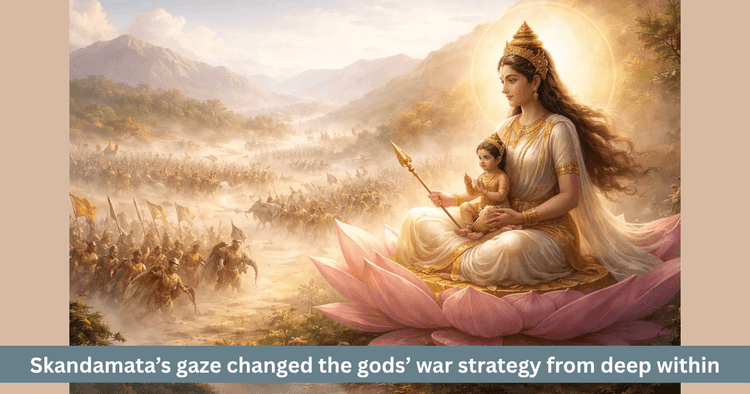
Table of Contents
In war, strategy is considered one of the most decisive elements. It determines who will advance, who will withdraw and what step will be taken at what moment. During that great conflict between the gods and the demons, the same principle was at work. The gods had created a detailed plan based on their experience, their power and their knowledge. They believed that this plan would carry them to victory. Yet they had no idea that a single gaze, a silent presence, would alter their entire way of thinking.
Maa Skandamata was seated near the battlefield upon a lotus. Her face held the same peaceful expression, yet her gaze was immensely deep. This was not merely the gaze that sees events. It was the gaze that understands. She was not only seeing the outer battle. She was seeing the emotions, fear, impulse and uncertainty moving within each warrior. Slowly, this gaze began to reach the minds of the gods.
As the gods experienced this presence, something within them began to shift. Their earlier strategy had been based mainly on aggression. They believed that faster and stronger attacks would bring a quicker victory. But now a new thought began to arise within them. They started asking whether attack alone is always the right path or whether there might be another direction that is wiser and more complete.
Why Was Maa Skandamata’s Gaze Not an Ordinary Gaze
The difference between ordinary sight and divine sight is that ordinary sight sees the event, while divine sight sees the truth behind the event. When Maa Skandamata looked upon the gods, she was not merely seeing their army, their weapons or their battlefield arrangement. She was also seeing who carried fear within, who was overtaken by impulse, who was driven only by anger and who was truly standing for dharma.
There was no force in her gaze and no pressure. It did not impose. It inspired inwardly. That is why the gods did not simply look at her. They felt her gaze. It was as though a subtle reminder was flowing from her still eyes that war is not fought only to win but to restore dharma and balance.
On What Basis Had the Gods Built Their Earlier Strategy
At first, the strategy of the gods was largely based on outer force. Their thought was that if they advanced together with speed, intensity and concentrated attack, the demons could be defeated quickly. This perspective was not entirely wrong, because valor has its rightful place in battle. Yet it was incomplete. It lacked a deeper awareness of timing, inner balance and the mental state of the opponent.
Through the influence of Maa Skandamata’s gaze, this incompleteness gradually became visible. For the first time, the gods began to ask whether every situation requires attack. Does speed always help. Is immediate reaction always courage. Or are there moments when pausing, observing and understanding become more necessary than striking.
Who Felt This Change First
The first and deepest experience of this change was felt by Lord Kartikeya. He was the commander of the divine army and the full responsibility of war rested upon him. He already possessed brilliance, courage and decisive power. Yet now a new depth began to enter his capacity to decide. He was not only seeing where the enemy stood. He was beginning to understand the state of mind from which the enemy was moving.
It was as though an added clarity had awakened within him. This clarity did not arrive through words. Maa Skandamata gave him no direct instruction. Yet her gaze awakened such balance within him that his decisions became more composed, more farsighted and more precise. This is the point where motherhood ceased to be only emotion and became guidance.
Can a Gaze Truly Transform Strategy
From the outside, this may seem like an unusual question. Yet every great strategy first changes as a way of seeing and only then as a plan. If the perspective changes, the strategy naturally changes as well. Maa Skandamata did not alter the battle plan from outside. She altered the inner perspective from which the gods were looking at the war.
Earlier their center was victory. Now dharma, balance and the understanding of right timing began to enter that center. Earlier they emphasized outer attack. Now they began to understand that unsettling the enemy inwardly, breaking his rhythm and allowing him to fall into wrong decision making was also essential. This subtle change eventually became the reason their entire war strategy evolved.
Why Could the Demons Not Understand This Change
The demons were accustomed to reading visible movements. They measured numbers, force, direction of attack and arrangement of weapons in order to predict what the other side would do. But when greater flexibility and depth entered the strategy of the gods, the demons could no longer read them clearly. At times the gods advanced, at times they paused, at times they waited and at times they altered their movement altogether. This unpredictability was not confusion. It was the result of increased understanding.
The demons also saw the calm presence of Maa Skandamata behind the gods. Yet they could not understand that her influence was not working through outward signals but through inner consciousness. That is why they continued to interpret the change merely as a tactical shift, while in truth it was a transformation of vision.
What Was the Decisive Moment When This Changed Thinking Produced Results
There came a significant moment in the battle when the gods stood before two possible paths. One was immediate attack. It was swift, looked heroic and seemed forceful but it also carried great risk. The other was to wait for a short while, study the movement of the enemy and advance at the right moment. In their earlier state of mind, the gods may have chosen the first path without much reflection. But now, affected by the gaze of Maa Skandamata, their minds had become more composed.
Lord Kartikeya chose the path of waiting. Outwardly this may seem simple but in the heat of battle waiting often demands more strength than attacking. This patient decision later proved highly beneficial. It allowed the formation of the demons to loosen, their impatience to grow and the gods to gain a clearer advantage. It becomes evident here that Maa Skandamata’s gaze had not merely changed emotion. It had altered the actual direction of battle.
How Does Her Motherhood Reveal Itself in This Story
A mother does not only protect. She also awakens wisdom, patience and balance in the one who stands before her. This is exactly what Maa Skandamata represents here. She was not present on the battlefield merely as the embodiment of affection. She was present as the maternal force that was inwardly sustaining her son and, through him, the entire army of the gods.
The influence of her gaze was such that the gods were no longer acting only out of command. They began to think, to understand and to decide with greater maturity. This is the highest form of motherhood. It does not create dependence. It awakens independent discernment. That is what Maa Skandamata did.
What Does This Story Mean for Human Life
This is not only a mythological event. It also reveals a deep truth about life. Many times we prepare plans, gather strength and decide a direction. Yet one small moment of clarity, one deeper understanding or one silent gaze from someone stable and wise changes our entire way of seeing. We then realize that our preparation was not wrong but it was incomplete.
In life too, not every problem is solved by speed or immediate reaction. At times we need a silent perspective that brings us back to ourselves and asks whether the chosen path is truly right or merely fast. Maa Skandamata’s form teaches this very truth. Without the right vision, even strong decisions remain incomplete.
What Is the Final Teaching of This Story
In the end, it becomes clear that the victory of the gods was not merely the victory of their force. It was also the victory of a changed way of thinking. One peaceful gaze of Maa Skandamata awakened new discernment, new balance and new patience within them. This change became their greatest strength. The war was the same, the armies were the same, the enemy was the same, yet the mode of seeing had changed. And when the mode of seeing changes, the outcome begins to change as well.
Maa Skandamata teaches that the greatest guidance is not always given in words. Often it is hidden in a gaze. When vision becomes clear, the path begins to form on its own. Then struggle no longer remains only a fight. It becomes a lesson, a discipline and a process of inner maturation.
Frequently Asked Questions
Did Maa Skandamata directly change the war strategy of the gods
No. She did not change it through command but through her gaze and calm presence she changed how the gods were thinking.
What effect did this gaze have on Lord Kartikeya
His decisions became more balanced, clearer and more aligned with the right timing.
Why was this change difficult for the demons to understand
Because they could read outer movements but they could not understand inwardly transformed consciousness and strategic depth.
What is the main message of this story
The right vision can itself become the greatest strategy. When thinking changes, the direction of conflict also changes.
What does Maa Skandamata symbolize here
She symbolizes maternal guidance, balanced wisdom, compassion and the divine direction hidden within silence.
Get your accurate Kundali
Generate KundaliDid you like it?
Author

Pt. Narendra Sharma (63)
Experience: 20
Consults About: Family Planning, Career
Clients In: Punjab, Haryana, Delhi
Share this article with friends and family
About ZODIAQ
ZODIAQ is an online Vedic Astrology platform. It connects clients seeking astrological advice to experienced astrologers with deep knowledge. Our users also generate kundali and perform kundali milan for free. ZODIAQ also offers services to the Astrologers. Astrologers utilize various offerings by ZODIAQ to serve their clients effectively.
If you are a User
Consult with experienced astrologers and seek their guidance. You can also order handwritten Janm Patrika report with life prediction prepared by experienced astrologers. Generate accurate Kundali, perform Kundali Matching and check horoscope and muhurat. Utilize our online library for all the necessary astrological and spiritual information.
If you are an Astrologer
Create accurate kundali for your clients and perform Kundali Matching for up to 5 people at a time. Write comprehensive Janm Patrika report for your clients with ZODIAQ. Check client details anytime by saving it in client directory. Become more productive by tracking how many clients you guide every day.
WELCOME TO
ZODIAQ
Right Decisions at the right time with ZODIAQ
