Did Maa Skandamata’s Peaceful Form Invisibly Influence the Decisions of Lord Kartikeya
By Aparna Patni
Maa Skandamata’s Serene Presence and Its Influence on Decisions During War
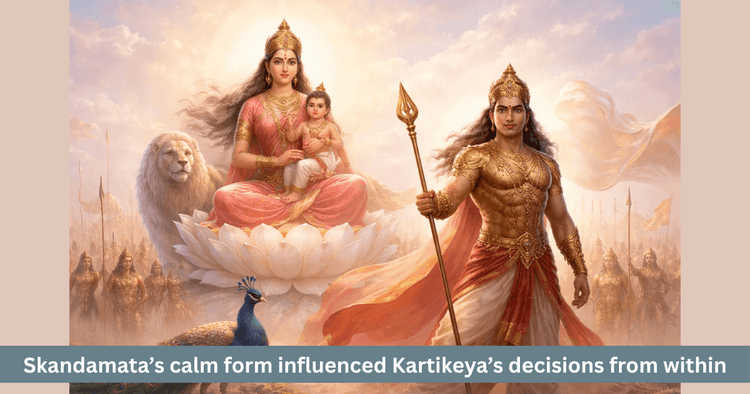
Table of Contents
War is not fought by weapons alone. It has a visible side and an invisible side. On the visible side there are weapons, armies, strategy and attack. On the invisible side there are mind, thought, patience, fear, clarity and decision. When that decisive moment arrived between the gods and the demons, the eyes of the entire divine army were fixed upon Lord Kartikeya. He was the commander of the celestial forces and the outcome of the battle depended upon each of his decisions. Yet at that very time another power was present, visible in form but difficult to understand in influence. That power was Maa Skandamata, seated in serene stillness upon a lotus.
Her peaceful form was not merely an expression of maternal grace. It was the presence of a subtle force that had become the center of balance near the battlefield itself. Outside there was the possibility of war, inside the minds of the gods there was tension and in the midst of all this the silence of Maa Skandamata appeared like the calm flow of a deep river, outwardly quiet yet inwardly guiding direction. This is the point where the story rises from being a tale of battle and becomes a story of consciousness, decision and divine guidance.
Why Was the Presence of Maa Skandamata Near the Battlefield So Significant
Maa Skandamata was near the battlefield, yet she was not under the influence of the battlefield. That distinction is extremely important. Her face was composed, her gaze was calm and her presence showed no agitation that would suggest anxiety about the result. That stillness itself was her greatest strength. She was not in the front line like a warrior carrying weapons, yet her influence was deeper than the front line itself.
The lotus seat also has its own meaning. The lotus symbolizes a consciousness that remains untouched even in difficult circumstances. It grows in mud yet remains pure. In the same way Maa Skandamata’s form reveals that she was aware of everything taking place, yet she was not bound by it. She was near the war but the war had not entered her inner being. She was present in conflict, yet conflict had not captured her mind. This teaches that even amidst great outer turbulence, consciousness can remain clear, pure and steady.
Were the Decisions of Lord Kartikeya Only a Result of Valor
Lord Kartikeya was naturally radiant, brave and supremely skilled in war. He was not only powerful but deeply strategic. Yet the central question of this story is whether there was something in his decisions that came from beyond training, skill and valor. The indications of the narrative suggest that there was indeed an inner clarity at work within him which made him different from ordinary warriors.
Whenever he came close to making an important decision, a brief stillness seemed to descend within him. From that stillness he gained direction. He was not merely thinking about how to defeat the enemy. He was also understanding what step would be right, balanced and capable of producing a meaningful outcome. This was not just military skill. It was the influence of a subtle consciousness that allowed his decision to ripen rather than emerge in haste.
How Did Maa Skandamata’s Influence Work Through Presence Rather Than Command
This is where the deepest secret of the story lies. Maa Skandamata did not guide Kartikeya through spoken instruction. She gave him no visible command and no direct battlefield sign. Yet her influence remained active throughout. It worked not through words but through presence. Often the deepest guidance is not something heard from outside but something understood from within.
This is the highest form of motherhood shown here. A mother does not only protect. She can also create such stability within the one near her that his own wisdom awakens. That was exactly what Maa Skandamata was doing for Kartikeya. She was not giving him decisions. She was placing him in such a field of consciousness that the right decision could arise naturally. This is why her influence was not direct, yet profoundly real.
How Did the Gods Recognize This Subtle Change
The gods observed that Kartikeya’s decisions were not merely swift, they were deep. He was making choices without panic, moving ahead without confusion and every step carried the mark of thoughtful vision. Seeing this, a new confidence arose within the gods. They felt that their commander was not only fighting the war but carrying it in the right direction.
For the gods this experience was significant because they themselves were occupied by the outer conflict. In such a time, when everything is shifting rapidly, if the commander remains balanced, the morale of the whole army changes. That balance was visible in Kartikeya’s decisions and the gods sensed that behind it the subtle peaceful energy of Maa Skandamata was at work.
Why Did Kartikeya’s Strategy Become So Difficult for the Demons to Read
The demons wanted to understand Kartikeya as a military leader. They tried to measure the direction of his attack, the speed of his decisions and the pattern of his warfare. But they could not find one fixed pattern. At times he struck immediately, at times he remained composed, sometimes he waited and sometimes he advanced with such precision that the demons had no time to recover.
This unpredictability was not weakness. It was the sign of living balance. A mind that moves only in one fixed way is easy to study. But a mind that responds by understanding each moment and each circumstance cannot be easily confined. This became the greatest challenge for the demons. They tried to read Kartikeya as a warrior, yet they could not limit him to that alone. His decisions held a combination of peace and sharpness that kept confusing them.
Did the Demons Also Feel the Presence of Maa Skandamata
Yes but they could not understand it. They saw Maa Skandamata seated behind Kartikeya in calm stillness. For them, the sight could have seemed merely emotional or symbolic. Yet gradually they began to feel that this presence was not only symbolic. Something was active on the battlefield that could not be explained through visible strength alone.
Still, they could not grasp the truth of it because this power was not working outwardly. It was working inwardly. The demons were accustomed to reading outer moves, not inner fields of consciousness. therefore the more they tried to understand Kartikeya, the more deeply they became confused. This was the point where Maa Skandamata’s silent presence was invisibly reshaping the direction of the war.
What Was the Decisive Moment That Revealed This Influence Most Clearly
The story suggests that there came a moment when the result of the war seemed completely uncertain. Kartikeya stood before two choices. One was immediate attack, swift but highly risky. The other was waiting, which required patience. Outwardly the first option appeared more heroic but the second was more balanced.
At that moment he chose waiting. This was no ordinary decision. In the heat of battle, waiting is often more difficult than attacking. Yet that very decision later became the cause of victory. This reveals clearly that some deeper force was active within him, helping him understand that every moment does not demand immediate action. At times, waiting for the right moment is itself the greatest strategy. It is here that the invisible influence of Maa Skandamata becomes most evident.
What Does This Story Mean in Human Life
This is not only a story about a mythic war. It applies directly to the decisions of human life as well. There are many moments when immediate reaction seems easy but not right. There are situations that demand not force but clarity, not speed but patience, not attack but balance. If the mind is disturbed, decisions become confused. If the mind is still, the path begins to reveal itself.
Maa Skandamata’s form teaches exactly this. The greatest guidance does not always come in words. Sometimes it appears as a silent inner peace that steadies us from within. From that steadiness, right thought arises. Through that, the right timing becomes visible. And from that, a decision emerges that can later become the cause of victory.
Is Maa Skandamata Only a Mother Here or Also a Guru
Her form is not only that of a mother but also that of a guru. She teaches without speaking, shows direction without interfering and awakens wisdom without commanding. That is also the sign of a true teacher. Such guidance does not destroy a person’s own intelligence. It purifies it so deeply that truth can be recognized from within.
This is what Maa Skandamata did for Kartikeya. She gave him shelter but not dependency. She gave him strength but not agitation. She gave him stability but not inertia. This is the remarkable union of motherhood and the guru principle. That is why her influence can be seen in Kartikeya’s decisions, not as outer control but as inner awakening.
What Is the Final Teaching of This Story
In the end it becomes clear that victory was not the victory of weapons alone. It was the victory of decisions made at the right moment, thoughts held in clarity and a peace that remained present throughout. The presence of Maa Skandamata kept alive within Kartikeya the balance through which he became not merely a brave commander but a knower of dharmic action.
This story compels us to ask whether there is also such a silent source in our own lives, something that guides without speaking. Can we recognize the peace within us that influences our decisions from beneath the surface. Maa Skandamata teaches that when inner steadiness is present, decisions begin to move toward the right direction. And when decisions are right, even the hardest conflict can change in its outcome.
Frequently Asked Questions
Did Maa Skandamata directly instruct Lord Kartikeya
No. Her influence did not work as spoken command but as peaceful presence and subtle energy.
What was unique about Kartikeya’s decisions
His decisions were not only swift but balanced, clear and appropriate to the moment.
How did the gods sense this hidden influence
They saw that Kartikeya was acting with deep understanding, free from panic and haste.
Why were the demons unable to read Kartikeya’s strategy
Because his actions were not based on one fixed pattern but on balance, timing and clarity.
What is the greatest message of this story
True guidance often comes not through words but through a peace that gives rise to inner clarity and right decision.
Get your accurate Kundali
Generate KundaliDid you like it?
Author

Aparna Patni (63)
Experience: 20
Consults About: Family Planning, Career
Clients In: Punjab, Haryana, Delhi
Share this article with friends and family
About ZODIAQ
ZODIAQ is an online Vedic Astrology platform. It connects clients seeking astrological advice to experienced astrologers with deep knowledge. Our users also generate kundali and perform kundali milan for free. ZODIAQ also offers services to the Astrologers. Astrologers utilize various offerings by ZODIAQ to serve their clients effectively.
If you are a User
Consult with experienced astrologers and seek their guidance. You can also order handwritten Janm Patrika report with life prediction prepared by experienced astrologers. Generate accurate Kundali, perform Kundali Matching and check horoscope and muhurat. Utilize our online library for all the necessary astrological and spiritual information.
If you are an Astrologer
Create accurate kundali for your clients and perform Kundali Matching for up to 5 people at a time. Write comprehensive Janm Patrika report for your clients with ZODIAQ. Check client details anytime by saving it in client directory. Become more productive by tracking how many clients you guide every day.
WELCOME TO
ZODIAQ
Right Decisions at the right time with ZODIAQ
