The Transformation Brahma Could Not Understand: Light of Maa Mahagauri
By Pt. Suvrat Sharma
The extraordinary transformation of Maa Mahagauri born from Parvati’s tapasya
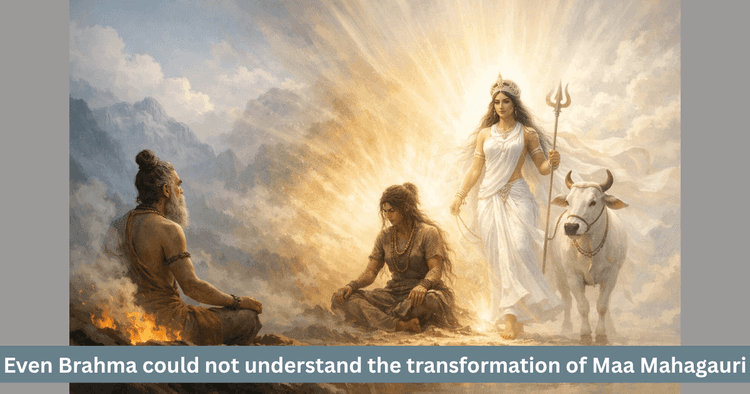
Table of Contents
From the beginning of creation until now, Brahma had witnessed countless transformations. He had seen creation take birth, elements take form and every movement of time unfold through order and meaning. Yet a moment came when Brahma himself fell silent, because what was happening before him was beyond the reach of his knowledge. This was the moment when Maa Parvati was appearing as Maa Mahagauri.
This transformation was not ordinary. It was not unfolding according to a familiar rule, nor was it following any clearly defined process. It was a change arising from within and revealing itself outside on its own. Brahma tried to understand it, yet he could not clearly determine what was causing it.
The tapasya Maa Parvati had performed was not of the body alone. It was austerity of the mind and the soul. She had crossed every inner limit, dissolved every instability and endured every layer of struggle within herself. That is why this transformation was not caused by something external. It arose from an inner fullness.
When the waters of Ganga were touching her body, Brahma first thought that this was the process of purification. But as the transformation deepened, he began to understand that this was more than purification. This was the birth of a new form, one that had not existed before in this way.
The form of Maa Mahagauri was so radiant and peaceful that no imbalance remained within it. It was a state where everything had come to its rightful place, where no inner conflict remained. Brahma saw this condition and tried to understand how such a state had become possible.
Why Did Brahma Pause
The nature of Brahma is to understand. He seeks cause behind every change. In creation, whatever occurs is linked to some rule, some order, some reason or some subtle design. So when he saw this extraordinary transformation within Maa Parvati, he naturally tried to interpret it according to the laws of creation.
At first he thought it was the natural result of tapasya. Then he thought it was the effect of purification through the waters of Ganga. But as the transformation continued, he began to sense that this was not mere purification. A new state of consciousness was appearing. That was the moment where his knowledge paused. The cause was present but it was so deep that ordinary explanation could not hold it.
This Was Not Only A Change Of Form
The becoming of Maa Parvati into Maa Mahagauri is not merely a tale of change in color. If it is reduced only to whiteness and darkness, the true depth of the episode is lost. This was the emergence of a spiritual state in which tapasya completes itself in light. It was the point where the inner struggle becomes quiet and transforms into balance. It was the state where discipline is no longer effort alone but nature itself.
When the conflict within a seeker ends, radiance appears in a different way. The form of Maa Mahagauri symbolizes that divine radiance. Therefore this event was not beginning from an outer cause. It had already taken birth within her. What appeared outside was only its revelation.
The Touch Of Ganga And A Deeper Process
When the waters of Ganga touched the body of Maa Parvati, most of the gods who witnessed the scene saw it as outer purification. Water fell, the form covered by tapasya was washed and a new white radiance appeared. But this was only the outer vision. What was happening in greater depth was far more subtle.
The touch of Ganga here is a symbol. It is not only the touch of water but the meeting point where the fire of tapasya and the flow of peace come together. It is where hardness is touched by grace. It is where long austerity receives divine acceptance. Brahma saw this process but he could not decide whether purification came first or whether the light had already existed within. That was his question and that is also the mystery of this story.
How Did The Light Of Maa Mahagauri Appear
The light of Maa Mahagauri was not the result of outer praise or some bestowed blessing. It was the visible form of her inner complete balance. When the mind becomes still, when the soul stands firm in its resolve, when austerity moves beyond the body and reaches consciousness itself, then the light that is born is the light of Mahagauri.
This light was not blinding. It held peace, steadiness and dignity. It was the kind of radiance that does not affect the eyes first but the heart. That is why the gods did not see only a bright form. They experienced a kind of balance in which no conflict remained. For this reason Brahma could not call it merely light. Before him, that light stood as a state.
Why Did The Laws Of Creation Seem Too Small Here
The laws of creation rest upon cause and effect. Whoever performs tapasya gains fruit. Whoever becomes purified becomes radiant. Whoever lives in discipline reaches higher consciousness. All this is true. Yet the episode of Maa Mahagauri goes beyond this ordinary sequence. Here cause and effect do not appear separately. They seem to exist within one another.
This is the point where Brahma’s knowledge became silent. He saw that transformation was happening but could not say from where its beginning truly arose. Did tapasya give birth to the light or did the inner light itself lead tapasya to completion. When an event goes beyond the ordinary logic of creation, the next form of knowledge becomes silence.
What Was The Difference Between Shiva And Brahma In This Moment
The roles of Lord Shiva and Brahma in this episode are deeply meaningful. Brahma wanted to understand. Shiva was experiencing. Brahma was seeking the cause. Shiva was seeing fullness. For Brahma this was an astonishing transformation. For Shiva it was the completion of the journey that Parvati had built through her own tapasya.
This is the difference between knowledge and realization. Knowledge asks how this happened. Realization knows that this had to happen. That is why Shiva’s silence is of a different kind. It holds no question. It holds acceptance. Brahma’s silence is different. It holds wonder. Both are silent, yet the direction within each silence is not the same. This is another subtle dimension of the story.
What Did The Gods And Asuras See
The gods saw this event as a marvel. They felt that a new divine form had appeared and with it a new divine force. They were moved by the dignity of the scene, yet not all of them could grasp its complete spiritual meaning. For them it was a moment of wonder and grace.
The asuras saw it in an even shallower way. For them it was only a transformation of appearance. They thought it was merely an outer change in radiance. They could not understand that the power standing before them was now not only luminous but perfectly balanced. And balanced power is far more potent than unbalanced force.
What Is The Spiritual Meaning Of This Story
The story of Maa Mahagauri teaches that true transformation is not imposed from outside. It is born through inner purification. When one places inner confusion, conflict, restlessness and ego into the fire of tapasya, a new light slowly begins to arise. This light does not come from outer decoration. It comes from the ripening of the soul.
That is why this episode should be understood not only as a goddess story but also as a symbol of spiritual discipline. It tells us that inner struggle is not wasted. If it is joined with truth, patience and surrender, that struggle eventually becomes light.
Can Every Transformation Be Understood
This question lies at the center of the story. If even Brahma, the creator, could not fully understand this transformation, it does not mean that the event was irrational. It means that some transformations cannot be grasped through logic alone. They require inner sensitivity.
This also happens in human life. Many times a person appears suddenly transformed from the outside. People see the result but they do not see the long tapasya, pain, patience and inner journey behind it. The episode of Maa Mahagauri teaches that the deepest transformations are not always fully visible from outside.
The Truth Hidden Within This Transformation
In the end it becomes clear that the light of Maa Mahagauri did not arise in a single external instant. It had already taken shape within her. The touch of Ganga, the witnessing of the gods and the wonder of Brahma only became occasions through which that divine state revealed itself. This is why Brahma could not fully understand it, because before him there was not merely light but fullness itself.
Maa Mahagauri teaches that true transformation happens when inner tapasya, outer purification and spiritual maturity meet at one point. The light that is born then changes not only the one who carries it but also the consciousness around them. This is the deeper truth of this story.
Frequently Asked Questions
Why could Brahma not fully understand the transformation of Maa Mahagauri
Because it was not only an outer purification but the revelation of complete inner consciousness that went beyond ordinary laws of creation.
Did the light of Maa Mahagauri appear only because of the waters of Ganga
The waters of Ganga became the medium through which the transformation was revealed but the light had already taken birth through the tapasya and inner fullness of Maa Parvati.
What does the form of Maa Mahagauri symbolize
It symbolizes purity, balance, the completion of tapasya and spiritual radiance.
What was the difference between Shiva and Brahma in their understanding of the moment
Brahma was trying to understand the event, while Shiva was witnessing and accepting it at the level of direct realization.
What does this story teach human life
It teaches that true transformation is born from inner discipline and its full mystery is not always visible from the outside.
Get your accurate Kundali
Generate KundaliDid you like it?
Author

Pt. Suvrat Sharma (63)
Experience: 20
Consults About: Family Planning, Career
Clients In: Punjab, Haryana, Delhi
Share this article with friends and family
About ZODIAQ
ZODIAQ is an online Vedic Astrology platform. It connects clients seeking astrological advice to experienced astrologers with deep knowledge. Our users also generate kundali and perform kundali milan for free. ZODIAQ also offers services to the Astrologers. Astrologers utilize various offerings by ZODIAQ to serve their clients effectively.
If you are a User
Consult with experienced astrologers and seek their guidance. You can also order handwritten Janm Patrika report with life prediction prepared by experienced astrologers. Generate accurate Kundali, perform Kundali Matching and check horoscope and muhurat. Utilize our online library for all the necessary astrological and spiritual information.
If you are an Astrologer
Create accurate kundali for your clients and perform Kundali Matching for up to 5 people at a time. Write comprehensive Janm Patrika report for your clients with ZODIAQ. Check client details anytime by saving it in client directory. Become more productive by tracking how many clients you guide every day.
WELCOME TO
ZODIAQ
Right Decisions at the right time with ZODIAQ
