Maa Chandraghanta Puja Vidhi and Significance 2026
By Pt. Amitabh Sharma
Chaitra Navratri Day 3: Transmission of Courage
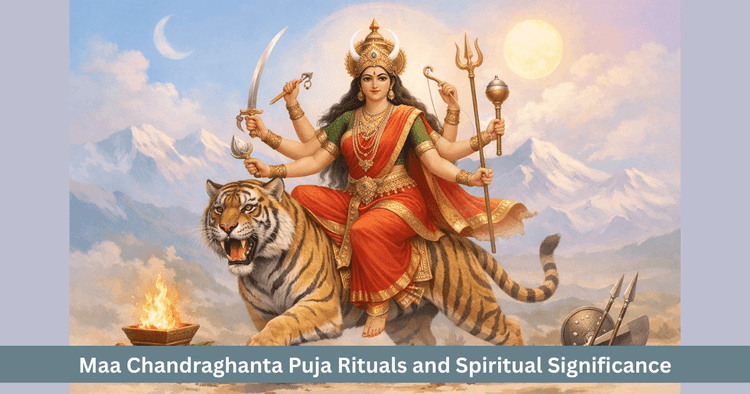
Table of Contents
The third day of Chaitra Navratri is entirely dedicated to the worship of Maa Chandraghanta, the third divine form of Goddess Durga. This specific day represents courage, divine protection and the awakening of inner strength. After the discipline and Tapasya symbolized by Maa Brahmacharini on the second day, the third day of Navratri reflects the transformation of that accumulated spiritual energy into bravery and a readiness to overcome negativity. Devotees perform the worship of Maa Chandraghanta to attain fearlessness and the destruction of all life obstacles.
Important Dates and Timings for Chaitra Navratri 2026 Day 3
In Chaitra Navratri 2026, the third day of Navratri falls on Saturday 21 March 2026. This day corresponds to Tritiya Tithi according to the Panchang and is also reverently associated with Gauri Puja and Saubhagya Teej in several Indian traditions. Devotees seek shelter with Maa Chandraghanta to obtain protection from obstacles, fear and negative influences.
| Description | Information |
|---|---|
| Date | 21 March 2026 |
| Day | Saturday |
| Navratri Day | Third Day |
| Tithi | Tritiya |
| Key Observances | Gauri Puja, Saubhagya Teej |
| Goddess Worshipped | Maa Chandraghanta |
| Auspicious Color | Grey |
Who is Maa Chandraghanta?
Maa Chandraghanta is the warrior form of Goddess Parvati that appeared after her marriage with Lord Shiva. The name Chandraghanta comes from the half moon shaped like a bell placed on her forehead. This crescent moon resembles a bell and gives the Goddess her unique name. It is believed that the sound of this celestial bell destroys negative energies and protects devotees from evil forces. Maa Chandraghanta transmits the divine power that removes fear from the mind and grants courage. She embodies both compassion and strength, showing that divine grace can also take a powerful form when needed.
According to ancient legends, when the terror of demons increased, the Goddess assumed this form to protect the deities. Merely meditating on this form starts the flow of bravery within the seeker.
Iconography and Symbolism of Maa Chandraghanta
Maa Chandraghanta is depicted riding a lion, which symbolizes bravery and unwavering determination. She has ten arms and each hand holds divine weapons such as a Trishul (trident), Gada (mace), sword, bow, arrow, lotus and other symbolic instruments. The crescent moon shaped like a bell shines on her forehead. Despite her warrior appearance, her face reflects calmness and divine compassion. Her form teaches that true strength always comes with wisdom and self-control. Her body, shining like gold, is surrounded by an aura that provides energy to devotees.
What is the Spiritual Secret of the Third Day of Navratri?
From a spiritual perspective, the third day of Navratri is associated with the activation of the Manipura Chakra (Solar Plexus Chakra). This chakra is considered the center of confidence, courage and personal power. Worshipping Maa Chandraghanta is believed to remove fear, strengthen the mind and fill life with positive energy. Devotees pray to this form of the Goddess to gain the ability to overcome challenges and move forward on the path of life with confidence. When the Manipura Chakra of the seeker awakens, their decision-making ability improves wonderfully.
Special Color and Significance of the Third Day
The auspicious color for the third day of Navratri is Grey. Grey symbolizes balance, calmness and maturity. Wearing grey on this day reflects the idea of maintaining inner stability even during difficult situations. This color teaches us that gentleness should remain even amidst the ups and downs of life. Using this color keeps the mind of the seeker concentrated and prevents distraction.
Systematic Worship of Maa Chandraghanta
On this special day, devotees continue the worship of the Kalash established on the first day. After cleaning the altar, fresh flowers, incense and lamps are offered to the Goddess. It is essential to pay special attention to purity in the worship of Maa Chandraghanta.
- Special prayers and mantras dedicated to Maa Chandraghanta are recited.
- Many devotees read specific portions of the Durga Saptashati (Seven Hundred Verses to Durga) and meditate on the protective form of the Goddess.
- The ringing of bells during the worship is considered highly auspicious and mandatory.
- This sound is symbolic of the divine bell on the forehead of the Goddess which drives away negative forces.
Favorite Offering for Maa Chandraghanta
On the third day of Navratri, the traditional offering to Maa Chandraghanta is milk or sweets prepared with milk. Milk represents purity, calmness and nourishment. It is believed that offering milk to the Goddess removes all sufferings and brings peace, prosperity and happiness into the life of the devotee. It is mandatory to have a feeling of devotion and dedication in the mind at the time of offering the Bhog (sanctified food).
Powerful Mantra for Maa Chandraghanta
To seek the blessings of Maa Chandraghanta, one should chant this sacred mantra:
Om Devi Chandraghantayai Namah
Chanting this mantra with devotion removes mental weakness and fear while increasing the level of spiritual energy. The infinite compassion of the Mother is obtained only by dedicating oneself at her feet.
Divine Message of Maa Chandraghanta for Life
The third day of Navratri teaches that courage and calmness must exist together. Maa Chandraghanta reminds devotees that true strength lies not in aggression but in fearless wisdom. By worshipping her, devotees seek the divine power to face challenges and maintain their inner peace in every situation. This is a day to take a resolve that we will conquer our inner evils.
Frequently Asked Questions
What is the significance of the moon on the forehead of Maa Chandraghanta?
The crescent moon on her forehead is shaped like a bell, the sound of which has the power to destroy sins and evil forces.
How is the Manipura Chakra related to the third day of Navratri?
The spiritual practice of the third day awakens the Manipura Chakra, which develops the ability to take decisions and increases willpower in an individual.
Why is Maa Chandraghanta shown riding a lion?
The lion is a symbol of fearlessness, showing that a devotee of the Goddess is never afraid of the problems of life.
Why is ringing a bell important in the puja of the third day?
The sound of the bell is very dear to Goddess Chandraghanta and it is rung to purify the environment from negativity.
When will the third day of Chaitra Navratri 2026 be celebrated?
The third day of Chaitra Navratri in the year 2026 will be celebrated on Saturday 21 March.
Get your accurate Kundali
Generate KundaliDid you like it?
Author
Pt. Amitabh Sharma (56 Years)
Experience: 20
Consults About: Family Planning, Career
Clients In: Punjab, Haryana, Delhi
Share this article with friends and family
About ZODIAQ
ZODIAQ is an online Vedic Astrology platform. It connects clients seeking astrological advice to experienced astrologers with deep knowledge. Our users also generate kundali and perform kundali milan for free. ZODIAQ also offers services to the Astrologers. Astrologers utilize various offerings by ZODIAQ to serve their clients effectively.
If you are a User
Consult with experienced astrologers and seek their guidance. You can also order handwritten Janm Patrika report with life prediction prepared by experienced astrologers. Generate accurate Kundali, perform Kundali Matching and check horoscope and muhurat. Utilize our online library for all the necessary astrological and spiritual information.
If you are an Astrologer
Create accurate kundali for your clients and perform Kundali Matching for up to 5 people at a time. Write comprehensive Janm Patrika report for your clients with ZODIAQ. Check client details anytime by saving it in client directory. Become more productive by tracking how many clients you guide every day.
WELCOME TO
ZODIAQ
Right Decisions at the right time with ZODIAQ
