The Day Sati Entered The Sacred Fire And Changed Everything Forever
By Pt. Nilesh Sharma
A defining moment that divided time into before and after Sati’s act
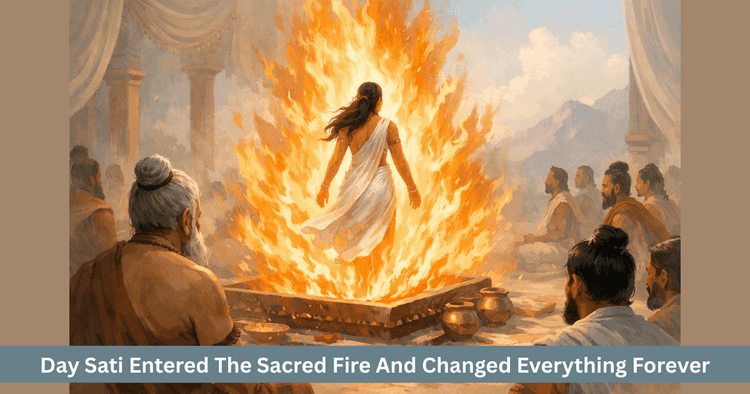
Table of Contents
This narrative does not merely describe an event, it reveals a defining moment that divided time into two phases. One when Sati existed in her embodied presence and another when everything transformed after her departure. This was not just an act of self immolation, it was the breaking of a boundary where a woman chose between her love, her self respect and her existence. On that day, the sacred fire of the yajna became a flame that exposed ego, insult and truth together.
When Sati reached the yajna, a gentle hope still lived within her. She believed that even without an invitation, she would be welcomed as a daughter. She thought that her father’s heart would soften upon seeing her and past differences would dissolve. however as she entered the assembly, a deep silence surrounded her. No one greeted her and no one acknowledged her presence. The deepest pain came when even her own father showed no affection.
What Truly Happened To Sati In The Yajna Assembly
King Daksha’s behavior was not only harsh but filled with ego. His words were not simple disagreement, they were deliberate insult. He mocked Lord Shiva, ridiculed his form, his way of life and his existence. These were not mere words, they were wounds that reached Sati’s inner being. The gods and sages present remained silent, as if none had the courage to oppose the insult. In that gathering, Sati stood completely alone.
The Awakening Of Inner Power That Transformed Her Decision
In that moment, a deep transformation began within Sati. Her heart was breaking, yet within that pain a new awareness emerged. She realized that this was not just an insult to her husband but also to her own existence. She could not accept herself while witnessing the dishonor of the truth she had chosen as her life’s foundation.
Standing in the center of the assembly, she declared that this was not only an insult to Shiva but to dharma, meaning the fundamental order and truth. Her words carried pain but also unwavering strength. At that moment, Sati was no longer just a daughter or a wife, she became the embodiment of Shakti, meaning divine power.
The Moment When Sati Chose The Fire
What followed was both sudden and profound. Sati declared that she could no longer retain a body connected to such arrogance. She made it clear that living where her husband was insulted was against her self respect. This was not an impulsive act, it was taken with complete awareness.
Then she stepped toward the fire.
The yajna fire, which had been a ritual element, transformed into a force that would shape history. Without fear and without hesitation, Sati entered it. The sight left everyone stunned. One moment she stood before them and the next she had merged into the flames.
What Message Did That Fire Send To The Universe
That fire was not just burning, it was a message spreading across existence. It declared that no relationship can survive without self respect, no matter how sacred it may appear. It revealed that ego, no matter how powerful, ultimately leads to destruction.
Shiva’s Tandava And The Pain Behind It
When Shiva received the news, it was not just sorrow but the beginning of deep anger and destruction. His calm form transformed into a fierce one. His tandava, meaning a powerful divine dance, was an expression of unbearable pain. He created Veerabhadra, who destroyed the yajna and ensured that Daksha faced the consequences of his actions.
Did Everything Truly End After Sati’s Departure
This event did not end there. It became the beginning of a new direction. Sati’s end marked the rise of a new power. It paved the path for her rebirth. She later took birth as Parvati and was worshipped as Maa Shailputri.
The Deeper Life Message Within This Story
This story offers a profound truth. It teaches that self respect stands above all relationships, that true love does not accept insult and that sometimes a difficult decision can change the course of existence. Maa Shailputri reminds that strength is not only in gentleness but also in the courage to stand for one’s truth.
FAQs
Why did Sati enter the sacred fire
Sati chose this path to protect her self respect and uphold her truth.
Was her decision purely emotional
Her decision was guided by emotion as well as deep awareness and realization.
Why did Daksha insult Shiva
Daksha’s ego prevented him from accepting Shiva, leading to the insult.
What does Shiva’s tandava signify
It represents the expression of intense sorrow and pain through destruction.
What is the main message of this story
It teaches that self respect, truth and love are the most essential foundations of life.
Get your accurate Kundali
Generate KundaliDid you like it?
Author

Pt. Nilesh Sharma (63)
Experience: 20
Consults About: Family Planning, Career
Clients In: Punjab, Haryana, Delhi
Share this article with friends and family
About ZODIAQ
ZODIAQ is an online Vedic Astrology platform. It connects clients seeking astrological advice to experienced astrologers with deep knowledge. Our users also generate kundali and perform kundali milan for free. ZODIAQ also offers services to the Astrologers. Astrologers utilize various offerings by ZODIAQ to serve their clients effectively.
If you are a User
Consult with experienced astrologers and seek their guidance. You can also order handwritten Janm Patrika report with life prediction prepared by experienced astrologers. Generate accurate Kundali, perform Kundali Matching and check horoscope and muhurat. Utilize our online library for all the necessary astrological and spiritual information.
If you are an Astrologer
Create accurate kundali for your clients and perform Kundali Matching for up to 5 people at a time. Write comprehensive Janm Patrika report for your clients with ZODIAQ. Check client details anytime by saving it in client directory. Become more productive by tracking how many clients you guide every day.
WELCOME TO
ZODIAQ
Right Decisions at the right time with ZODIAQ
