Sati’s Departure and Rebirth as Shailputri: A Divine Plan
By Pt. Amitabh Sharma
Was Sati’s entry into the fire and rebirth as Shailputri part of a divine plan?
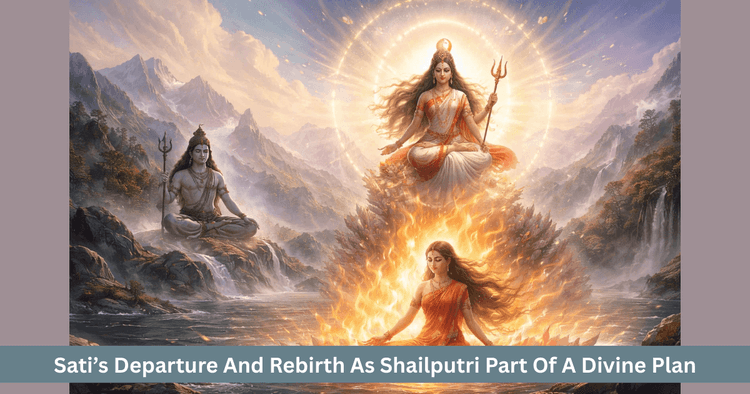
Table of Contents
This episode is not merely a sorrowful event. It is a question that becomes deeper the more one contemplates it. At first glance, it seems like the story of a daughter’s humiliation, a wife’s pain and a goddess’s self respect. But when viewed through the lens of creation, Shakti, Shiva and cosmic balance, its meaning becomes far more expansive. It no longer remains only a story of bodily sacrifice. It becomes the prelude to a transformation where destruction and creation are not opposites but interconnected truths.
When Sati entered the sacred fire, everything appeared to end from the outer point of view. A sacred bond broke, a body dissolved into fire, a family collapsed into destruction and even the gods stood before a situation that could not be managed through ordinary means. Yet this is also where another dimension of the story opens. The question no longer remains why Sati chose the fire. The question becomes whether this was only a response to pain or whether a deeper divine design was unfolding through it.
Sati Was Not Born Merely As A King’s Daughter
If Sati is understood only as Daksha’s daughter, then the narrative remains incomplete. She was a form of Adi Shakti, meaning the primordial divine power. Her birth was not limited to a family lineage. It carried purpose. The union of Shiva and Shakti in Indian spiritual thought is never seen as only a marital bond. It is the union of consciousness and creative force. Where Shiva is present, there is still awareness. Where Shakti is present, there is movement, manifestation and creation. When both unite, balance is born.
For this reason, Sati’s life was never ordinary from the beginning. The pull she felt toward Shiva cannot be reduced to personal love alone. It was also the movement of the soul toward its own source. She was drawn to Shiva not simply because he was extraordinary but because her connection with him was cosmic in nature. That is why their union was not only marriage but the establishment of a deeper balance necessary for creation itself.
If Everything Had Remained Peaceful Would The Next Form Of Power Have Emerged
Here the story raises another subtle question. If Daksha’s ego had not become so intense, if there had been no humiliation at the yajna and if Sati’s life had continued in the same form, would that same divine power have later manifested in the fuller dimension that appeared as Parvati and then as Shailputri. This is not an easy question, yet the narrative itself offers a direction toward its answer.
At times, great processes of creation do not move in a straight line. They pass through rupture, pain, separation and rebuilding. Sati represents the fire of emotion and devotion, while Parvati represents the fire of tapas, patience and awakened resolve. This does not mean one was lesser and the other greater. It means the divine power had to pass through a profound transformation in order to reveal its fuller dimension.
Daksha’s Ego Was Not Merely A Personal Flaw
In this story, Daksha cannot be seen only as an angry father. His ego symbolizes the force that breaks balance. He was the guardian of order, yet the pride of order gradually separated him from truth. He rejected Shiva because Shiva did not fit the outer structure Daksha glorified. Thus Daksha stands for that mindset which recognizes external dignity but fails to perceive spiritual truth.
That is why the yajna becomes more than a family incident. It becomes the stage upon which ego openly insults truth. Sati’s journey to the yajna and the humiliation she experiences there are not merely emotional events. They reveal that where truth is insulted, the old structure cannot continue. Therefore the breaking of the yajna was not merely the result of anger. It was the natural collapse of an imbalance that had already taken shape.
Was Sati’s Entry Into Fire Only A Reaction Or The Turning Of A Cycle
Sati’s entry into the fire is often seen only as the extreme result of wounded feeling. Yet the inner seriousness of this event goes much deeper. She did not simply declare that she had been insulted. She realized that the body born from a house aligned with such arrogance was no longer fit for the truth she had chosen. Here leaving the body is not only physical departure but the ending of an older cycle.
At one level, Sati comes to an end in that moment. Yet at the same time, a new path of divine power begins to open. This is the point where the story rises above tragedy. If she had not entered the fire, life might have continued outwardly but the new dimension of Shakti that later appeared as Parvati may not have unfolded in the same way. Thus the event was not only an ending. It was the doorway to a shift in consciousness.
What Do Shiva’s Tandava And The Formation Of Shakti Peethas Indicate
After Sati’s departure, Shiva’s Rudra Tandava becomes the next decisive dimension of the narrative. This was not merely an expression of grief. It also revealed that when Shiva and Shakti fall out of harmony, the entire universe is affected. Shiva’s pain does not remain personal. It shakes the movement of creation itself.
Then comes Vishnu’s act of dividing Sati’s body and the establishment of the Shakti Peethas, meaning sacred seats of divine feminine power. This reveals that divine energy never truly ends. It moves from one form into another, from the limited into the expansive. What had once been centered in one body was now spread across the earth in many holy centers. This was not only a solution. It was a process of the expansion of Shakti. Here again destruction becomes a form of creation.
Was Rebirth As Parvati Merely A Return
Sati’s rebirth as Parvati was not merely a return. It was the reappearance of power in a more mature, more awakened and more stable form. This time she was not only the form of emotional surrender. She became the embodiment of tapas, patience, self knowledge and unyielding resolve. This is why the form of Shailputri becomes so significant. To be the daughter of the mountain is not only a sign of birth but also of stable power.
Parvati attained Shiva again through austerity, inner discipline and clarity of purpose. This means that rebirth was not merely destiny. It was the next stage of a divine plan in which power first moved through emotion, then sacrifice, then expansion and finally returned as awakened steadiness.
Would It Be Correct To Say That Everything Was Predetermined
To say that every moment in this story was fixed mechanically from the beginning would limit its living depth. For the story contains emotion, choice, pain, freedom and the reality of experience. Yet it would also be incomplete to say that everything happened by mere accident. It is clearly visible that the events are not unfolding only on a personal level but also in the direction of a larger cosmic purpose.
Therefore it is more fitting to say that this was a divine plan in which both free experience and the wider order of creation were working together. Sati’s sacrifice, Shiva’s tandava, the formation of the Shakti Peethas and Parvati’s rebirth together reveal that at times destruction itself becomes a necessary part of creation.
What Final Meaning Emerges Through The Form Of Shailputri
Maa Shailputri becomes the calm and steady answer to this entire story. What was emotion in Sati becomes tapas in Parvati. What was pain in Sati becomes the basis of strength in Shailputri. What was an ending in Sati returns as a beginning in Shailputri. This is the deepest message of the narrative.
In life as well, many events that seem only tragic in the moment later become the cause of a greater awakening, a new balance and a wider power. That is why Maa Shailputri teaches that not every breaking is meaningless. Not every ending leads only to darkness. At times that very ending prepares the ground for a more awakened and more balanced life.
The Living Indication Of This Story
This story shows that within every major event of creation there may be a deeper purpose, even when it is not immediately understood. Sati’s sacrifice, Shiva’s sorrow, Vishnu’s intervention and Shailputri’s rebirth together teach that destruction, love, power and balance are not enemies. They are different dimensions of the same great cycle of existence.
That is why Maa Shailputri is not merely a reborn goddess. She is the symbol of the truth that when an old form reaches its limit, Shakti returns in a new one. More stable, more awakened and more expansive.
Frequently Asked Questions
Was Sati’s departure only an emotional decision
No. It carried emotional pain but also deep self realization and the ending of a larger cycle.
Was Shailputri’s rebirth already predetermined
It may not be correct to call it mechanically predetermined, yet it is clear that a larger divine plan was active behind it.
Why is the union of Shiva and Shakti so important
Because it symbolizes the balance of consciousness and creative energy and that balance sustains creation.
What does the formation of the Shakti Peethas mean in this story
It reveals that divine power never ends. It can expand from one center into many sacred manifestations.
What is the deepest message of this story
It teaches that destruction is not always an end. At times it becomes the medium for a new power, a new balance and a new beginning.
Get your accurate Kundali
Generate KundaliDid you like it?
Author
Pt. Amitabh Sharma (56 Years)
Experience: 20
Consults About: Family Planning, Career
Clients In: Punjab, Haryana, Delhi
Share this article with friends and family
About ZODIAQ
ZODIAQ is an online Vedic Astrology platform. It connects clients seeking astrological advice to experienced astrologers with deep knowledge. Our users also generate kundali and perform kundali milan for free. ZODIAQ also offers services to the Astrologers. Astrologers utilize various offerings by ZODIAQ to serve their clients effectively.
If you are a User
Consult with experienced astrologers and seek their guidance. You can also order handwritten Janm Patrika report with life prediction prepared by experienced astrologers. Generate accurate Kundali, perform Kundali Matching and check horoscope and muhurat. Utilize our online library for all the necessary astrological and spiritual information.
If you are an Astrologer
Create accurate kundali for your clients and perform Kundali Matching for up to 5 people at a time. Write comprehensive Janm Patrika report for your clients with ZODIAQ. Check client details anytime by saving it in client directory. Become more productive by tracking how many clients you guide every day.
WELCOME TO
ZODIAQ
Right Decisions at the right time with ZODIAQ
