Why Did Lord Shiva Become Half Woman And What Was Maa Siddhidatri’s Role In This Transformation
By Pt. Suvrat Sharma
How Maa Siddhidatri helped bring balance and completeness into creation
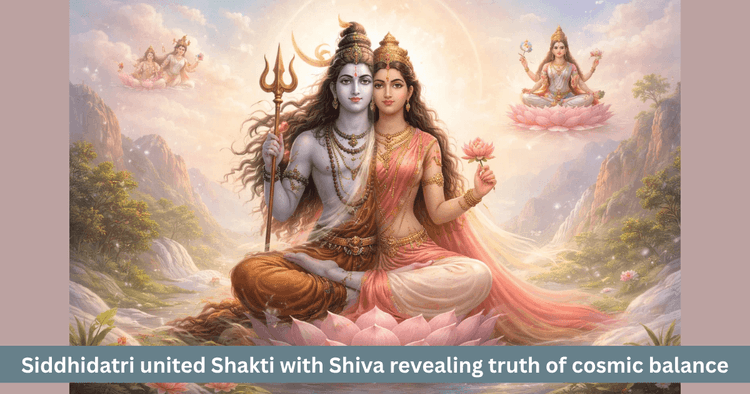
Table of Contents
This question appears simple on the surface, yet it carries great depth. Lord Shiva, who is regarded as complete in himself, who is described as the source of the beginning and the endless, why did he become half woman. This was not merely a symbolic form. It was a truth that creation itself needed to understand. And in revealing that truth, the role of Maa Siddhidatri was profoundly important.
In the earliest stages of creation, everything looked orderly. Brahma was engaged in creation, Vishnu was established in preservation and Shiva was absorbed in deep meditation. Yet within that divine order a subtle imbalance remained. This imbalance was not outward. It existed at the level of energy. The masculine principle was active but the feminine principle had not yet manifested in its complete and integrated presence. For this reason, creation was moving forward, yet it lacked the depth and balance needed for true wholeness.
The gods felt this lack but they could not find its solution. The problem was so subtle that knowledge alone could not resolve it. Their attention then turned toward the power who is regarded as the presiding goddess of all siddhis and all forms of divine completeness. That power was Maa Siddhidatri.
Where Was The Imbalance In Creation
Whenever only one polarity becomes dominant in any system, movement can continue but fullness cannot emerge. That was exactly what was happening then. Creation had radiance, direction, resolve and motion, yet it lacked the quality that makes balance enduring. The feminine principle here should not be understood in a merely physical sense. It is an energetic principle. It represents compassion, receptivity, nourishment, depth of creation, beauty, patience, ease and the soft expansion of divine energy.
The masculine principle without the feminine can become severe. The feminine without the masculine can lose direction. Until both stand in balance with one another, creation may continue but it does not become whole. This is what the gods began to sense. Existence still awaited the divine harmony that would allow future creation to become more balanced and more complete.
What Maa Siddhidatri Saw
Maa Siddhidatri saw at once that the problem was not outside but in the structure of manifestation itself. She understood that until the feminine principle was visibly integrated even within Shiva, creation would lack the living symbol it needed. Shiva is the highest symbol of consciousness. But if consciousness appears separate from Shakti, the world may fail to understand that the two are truly one. For this reason, what was required was not merely the transfer of energy. It was a divine revelation.
Maa Siddhidatri understood that creation needed to see that Shiva and Shakti are not two. They may be experienced in different forms, yet without one another their fullness cannot be known. That is why she offered a part of her own power to Shiva. It appears like a boon but in truth it was the restoration of cosmic balance.
Why Did Lord Shiva Become Half Woman
The deepest question is this. If Shiva is already complete, why was it necessary for him to assume such a form. The answer is subtle. Shiva’s completeness is true but unless that completeness is visibly united with Shakti, its secret remains hidden from creation. Shiva becoming half woman was not the filling of a lack. It was the visible revelation of a hidden truth, that fullness is born through the balance of dual principles.
When Maa Siddhidatri flowed her power into Shiva, this was not merely a change in half the body. It was a moment in which consciousness and energy, stillness and flow, transcendence and compassion, meditation and creation appeared together within one being. This is Ardhanarishvara.
Ardhanarishvara does not mean that one half of Shiva was separated and an external feminine half was attached. It means that what had always existed in subtle truth now became visible. The power already inherent in Shiva became manifest in form. That form then became a message for creation itself.
The Spiritual Meaning Of Ardhanarishvara
Ardhanarishvara is one of the greatest symbols in Indian spiritual thought. It teaches that no principle in creation is complete by itself. Where there is only firmness and no compassion, balance cannot remain. Where there is only emotion and no direction, stability cannot remain. Where there is only knowledge and no lived realization, life remains incomplete. Where there is only resolve and no nurturing quality, creation dries inwardly.
The form of Ardhanarishvara teaches that the masculine and the feminine are not opposites but complements. This is not a philosophy of conflict. It is a philosophy of integration. It also teaches that the divisions visible to us are not the final truth. The final truth is unity, yet that unity does not erase distinction. It accepts distinction and then transforms it into balance.
What Did The Gods See In This Form
For the gods, this was more than a miracle. It was a moment of revelation. For the first time they saw directly that Shiva and Shakti are not separate divinities. Brahma realized that creation could now reach a fuller form. Vishnu sensed that the balance of preservation would become more complete. The gods understood that creation would now move not only through momentum but through harmony.
This form was a divine declaration for them. Until then, they had known Shiva as the lord of meditation, renunciation, tandava and transcendence. Now they saw Shiva in a form where Shakti herself was visibly present within him. This expanded their understanding.
Why Could The Asuras Not Understand This Truth
The vision of the asuras remained limited to outer forms. They saw Ardhanarishvara as a strange transformation. They could not understand that this form would become the greatest challenge to their own power. Imbalance always fears balance, because balance ends its expansion. Where Shiva and Shakti stand together, confusion, arrogance and one sided force cannot endure for long.
That is why Ardhanarishvara is not only a philosophical symbol. It is also a silent answer to all forms of inner and outer imbalance.
Why Was Maa Siddhidatri’s Role So Important
Maa Siddhidatri is not merely the giver of siddhis. She is the power who leads consciousness toward completion. Her role is not only to give power but to place power in its rightful state of harmony. Through this transformation she revealed that divinity remains incomplete in appearance until the light of balance becomes visible within it.
Her role in this episode was decisive because she did not merely alter one form. She changed the understanding of creation itself. She revealed that what we often see as separate is, in truth, the expression of one greater reality. This is the highest siddhi of all, not an outer miracle but the unveiling of the right truth at the right moment.
What Does This Story Teach Human Life
This story belongs not only to the gods. It belongs to human life as well. Within every person, both masculine and feminine principles exist. This does not refer merely to the body. It refers to dimensions of consciousness. Within us there is the power to decide and the power to nurture. There is firmness and there is tenderness. There is clarity and there is feeling. When one of these becomes excessively dominant, life loses balance.
The story of Maa Siddhidatri and Ardhanarishvara teaches that true fulfillment comes when we accept and harmonize both sides within ourselves. Strength alone is not enough. Sensitivity alone is not enough. Strength needs compassion and compassion needs grounding. This is the deeper equilibrium of life.
Where Becoming Half Became True Fullness
In the end, it becomes clear that Lord Shiva becoming half woman was not an ordinary event. It was a great spiritual message given to creation. Maa Siddhidatri did not merely give power to Shiva. She revealed that fullness is never one sided. It is born in balance, flowers in integration and becomes stable in oneness.
The form of Ardhanarishvara remains eternal because it reminds us that even what appears complete shines in its fullest light only when consciousness and power are revealed together in balance. That was the divine role of Maa Siddhidatri and that is the deepest secret hidden in this story.
Frequently Asked Questions
What does Ardhanarishvara mean
Ardhanarishvara is the divine form of the oneness of Shiva and Shakti, where one half appears masculine and the other half feminine.
Why did Lord Shiva become half woman
Because creation needed to understand that consciousness and power are not separate. Fullness is possible only in their balance.
What was the role of Maa Siddhidatri
Maa Siddhidatri offered a part of her own power to Shiva and made visible the truth that was already present in subtle form.
Is this only a symbolic story
It is symbolic but it is also a spiritual truth. It reveals a profound principle about creation, balance and completeness.
What does this story teach human life
It teaches that the balance of firmness and tenderness, clarity and feeling, strength and compassion within us is the foundation of true completeness.
Get your accurate Kundali
Generate KundaliDid you like it?
Author
Pt. Suvrat Sharma (63)
Experience: 20
Consults About: Family Planning, Career
Clients In: Punjab, Haryana, Delhi
Share this article with friends and family
About ZODIAQ
ZODIAQ is an online Vedic Astrology platform. It connects clients seeking astrological advice to experienced astrologers with deep knowledge. Our users also generate kundali and perform kundali milan for free. ZODIAQ also offers services to the Astrologers. Astrologers utilize various offerings by ZODIAQ to serve their clients effectively.
If you are a User
Consult with experienced astrologers and seek their guidance. You can also order handwritten Janm Patrika report with life prediction prepared by experienced astrologers. Generate accurate Kundali, perform Kundali Matching and check horoscope and muhurat. Utilize our online library for all the necessary astrological and spiritual information.
If you are an Astrologer
Create accurate kundali for your clients and perform Kundali Matching for up to 5 people at a time. Write comprehensive Janm Patrika report for your clients with ZODIAQ. Check client details anytime by saving it in client directory. Become more productive by tracking how many clients you guide every day.
WELCOME TO
ZODIAQ
Right Decisions at the right time with ZODIAQ
