Why Did Shiva Not Stop Sati And Why Was This Decision So Painful
By Pt. Narendra Sharma
A Story of Love, Freedom, Destiny, and Inner Conflict
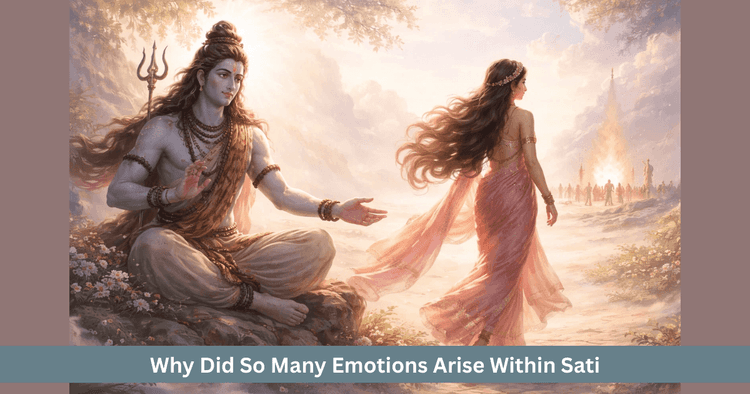
Table of Contents
This episode does not simply answer a question. It reveals a subtle connection between love, freedom, destiny, awareness and self realization that is not easy to understand from an ordinary perspective. When Sati came to know that her father Daksha had organized a grand yajna and had not invited her or Lord Shiva, a deep wave of emotions arose within her. On one side, she was a wife who clearly felt the insult toward her husband. On the other side, she was a daughter whose heart was still drawn toward her birthplace and her father. This was the moment when the inner conflict became more significant than the outer situation. That is why this question continues to touch the heart, if Shiva knew everything, why did he not stop Sati.
Why Did So Many Emotions Arise Within Sati At The Same Time
When Sati heard about the yajna, it was not only sorrow that arose within her. There was pain of insult, attachment to memories, the tenderness of a daughter’s heart and the wounded dignity of a wife. This is the kind of state where decisions are not made by logic alone. Emotional bonds influence the mind deeply. For Sati, it was not just about not receiving an invitation. There was also a hope that perhaps her father’s heart had changed, that perhaps she would still be welcomed as a daughter. This hope shaped her decision.
What Was Hidden In Shiva’s Words When Sati Spoke To Him
When Sati expressed her wish to attend the yajna, Shiva remained calm and composed. He did not react with anger, he did not impose authority and he did not speak harshly. He simply said that one should not go where respect is absent. This was not just advice but a principle of life. Shiva did not try to frighten her about the future. He only revealed the truth.
Shiva Could Have Stopped Sati So Why Did He Not
This is the most profound and painful aspect of the story. Shiva could have stopped Sati. He was all knowing, powerful and fully aware. Yet he chose not to stop her because his love was not based on control. Shiva’s nature is beyond attachment. He does not bind, he does not impose and he allows the soul the freedom to complete its own journey.
It is important to understand that Shiva’s decision was not indifference. It was a form of mature love. He knew that some truths cannot be understood through words. They must be experienced. If he had stopped Sati, her body might have remained safe but her inner questions would have remained unresolved.
Was Letting Sati Go Also A Spiritual Process
This situation was not only emotional but also a deep spiritual process. Sati still carried a connection to her past, her father and her origin. Until that connection was broken, her complete union with Shiva was not possible. Going to the yajna became part of that transformation.
What Did Sati Witness At The Yajna That Changed Everything
When Sati reached the yajna, the environment was deeply painful. No one welcomed her and no one honored her presence. The greatest pain came when Daksha insulted Shiva. He mocked his existence, his way of life and his identity. These were not just words but a deep wound to Sati’s inner being.
Why Sati’s Self Immolation Is Not Just A Tragic Event
Sati entering the fire was not just a tragic event. It was the highest expression of self respect. She chose to leave a body connected to a place where her truth was not respected. This decision was not taken in impulse but with complete awareness. It established that love without respect is incomplete.
What Shiva’s Grief And Tandava Represent
When Shiva learned about Sati’s departure, his sorrow was immense. His tandava, meaning a fierce divine dance, was not just anger but an expression of deep pain. His withdrawal from the world showed the depth of his love. This was not just a reaction but a reflection of profound emotional intensity.
Was Shiva’s Decision Harsh Or The Highest Form Of Love
From the outside, this decision may appear harsh. however at a deeper level, it represents the highest form of love. True love does not only protect. It allows a person to reach their truth. Shiva did not stop Sati because he did not want to control her. He accepted her as a free soul.
How Maa Shailputri’s Story Explains This Decision
The emergence of Maa Shailputri gives a new meaning to this entire episode. Sati’s end was actually a new beginning. She was reborn in a stronger and more awakened form. This shows that every destruction leads to the birth of a new power.
What This Story Teaches Us
This story teaches that true love does not create bondage. It gives freedom. It also shows that some painful experiences lead to deep realization. Sometimes the greatest love is the one that allows a soul to complete its own journey.
FAQs
Why did Shiva not stop Sati from going to the yajna
Shiva did not stop Sati because his love was not based on control and he gave her the freedom to decide.
Did Shiva already know what would happen at the yajna
It is believed that Shiva was aware of the future and warned Sati beforehand.
Was Sati’s decision purely emotional
Her decision involved emotions but also a deeper inner conflict.
What does Shiva’s decision represent
It represents that true love gives freedom and allows self realization.
What is the main message of this story
It teaches that love, self respect and awareness are the most important aspects of life.
Get your accurate Kundali
Generate KundaliDid you like it?
Author

Pt. Narendra Sharma (63)
Experience: 20
Consults About: Family Planning, Career
Clients In: Punjab, Haryana, Delhi
Share this article with friends and family
About ZODIAQ
ZODIAQ is an online Vedic Astrology platform. It connects clients seeking astrological advice to experienced astrologers with deep knowledge. Our users also generate kundali and perform kundali milan for free. ZODIAQ also offers services to the Astrologers. Astrologers utilize various offerings by ZODIAQ to serve their clients effectively.
If you are a User
Consult with experienced astrologers and seek their guidance. You can also order handwritten Janm Patrika report with life prediction prepared by experienced astrologers. Generate accurate Kundali, perform Kundali Matching and check horoscope and muhurat. Utilize our online library for all the necessary astrological and spiritual information.
If you are an Astrologer
Create accurate kundali for your clients and perform Kundali Matching for up to 5 people at a time. Write comprehensive Janm Patrika report for your clients with ZODIAQ. Check client details anytime by saving it in client directory. Become more productive by tracking how many clients you guide every day.
WELCOME TO
ZODIAQ
Right Decisions at the right time with ZODIAQ
