When Parvati Became Maa Mahagauri, What Did Shiva See That No One Else Could Understand
By Pt. Abhishek Sharma
The Depth of Transformation Seen Only Through Shiva’s Vision
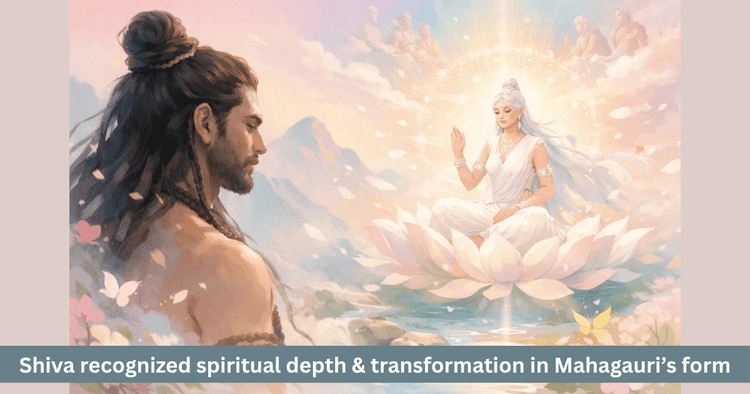
Table of Contents
That moment was not only about union. It was a moment of recognition. When Maa Parvati crossed the severity of her tapasya, her limits and every inner conflict and appeared as Maa Mahagauri, it was not merely a change in form. It was the expansion of her consciousness, the state in which she had fully come to know herself. But the deepest witness of that transformation was only one, Lord Shiva.
When Shiva beheld Maa Mahagauri for the first time, he did not see only a radiant and peaceful goddess standing before him. Before him stood the entire journey Parvati had completed. Every struggle hidden behind that luminous form, every pain, every resolve, seemed to become present before Shiva all at once. That is why in that moment Shiva was not merely observing. He was experiencing the transformation itself.
The form of Maa Mahagauri was so peaceful that no outer disturbance remained in it, yet within that peace there was a depth not easy to understand. It was the peace that comes after struggle, the balance that is gained only through lived experience. Shiva saw that peace and understood that this was not merely an external transformation. It was a state of fullness.
The gods saw this scene as well but for them it remained a divine event. They could see the beauty and the radiance but they could not perceive the depth that Shiva experienced. That perception was possible only for one who could understand such a level of consciousness.
Why Was the Journey from Tapasya to Mahagauri So Profound
Parvati’s austerity was not only the discipline of attaining Shiva. It was the discipline of raising herself to a state where desire itself becomes pure, the mind becomes steady and consciousness recognizes its own true nature. Severe tapasya had transformed her body. Dust, heat, restraint and unwavering focus had brought her into a form that might appear harsh to ordinary vision, yet inwardly it was fully awakened.
When the resolve of a seeker becomes so deep that every inner conflict is crossed, the form itself becomes a witness to that journey. The same ascetic form of Maa Parvati later unfolds into the peace of Maa Mahagauri. That is why the transformation was not sudden. It was purity born through the fire of tapasya.
This is also why the white form of Maa Mahagauri is not merely a symbol of beauty. It is the symbol of a consciousness that has crossed struggle and arrived at stillness.
Shiva Saw Not Only the Form but the Entire Journey
The gods saw Maa Mahagauri and were filled with wonder at her white radiance, peaceful presence and divine glow. But before Shiva stood not only her present form. Her entire journey stood before him. He saw the tapasya, the silence, the pain no one had heard in words and the surrender that needed no outer proof.
That is why Shiva’s silence became so meaningful in that moment. It was silence of wonder, of acceptance and of recognition. He understood that Parvati was no longer merely the ascetic moving toward him. She had become a complete divine presence in herself.
Here the deepest point of the episode appears. True love does not keep the other incomplete. True union happens only when both powers stand before one another in their own fullness. Shiva saw that very fullness.
What Power Was Hidden in the Peaceful Form of Maa Mahagauri
The form of Maa Mahagauri is considered deeply peaceful. Her complexion is radiant, her posture gentle and her presence carries astonishing balance. Yet this peace is not passive. It is the peace attained after crossing struggle. That is why it holds profound stability and dignity within it.
In this form power does not roar, yet it changes everything. It is the kind of strength that shifts direction without noise. The form of Maa Mahagauri teaches that power is not always expressed through intensity. Sometimes its highest form appears as pure, balanced and compassionate stillness.
Shiva saw exactly this. He saw that this form was not simply softness after austerity. It was fullness after austerity. It was gentle but not weak. It was peaceful but not without force. It was bright but not only outwardly so. It was illumined from within.
What the Gods Saw and What They Could Not See
The gods witnessed this transformation like a divine wonder. For them it was astonishing that the goddess who had been immersed in severe tapasya could now appear so radiant, balanced and calm. They saw light, peace and divinity. But they could not fully see the inner journey behind this form.
That was the difference between Shiva’s perception and that of the other gods. The gods were seeing the result. Shiva was seeing the process as well. The gods were seeing the radiance of the form. Shiva was recognizing the source of that radiance. The gods were seeing beauty. Shiva was seeing the spiritual austerity behind that beauty.
That is why Shiva’s experience in this story becomes unique. No one else could understand the transformation so deeply as the one who himself knows destruction, silence, meditation and the highest states of consciousness.
Why Shiva’s Silence Was the Truest Answer
Sometimes the answer to a question is not in words. It is in silence. When Shiva beholds Maa Mahagauri and becomes silent, that silence is not helplessness. It is the sign of deep realization. Some truths are so vast that language reduces them.
Shiva’s silence also reveals that he recognized within Parvati that self revealed state which no longer needed any outer validation. It was acceptance that the power now standing before him was complete in itself, radiant in itself and balanced in itself.
That silence was also love. For where there is complete recognition, words become less necessary. Presence alone becomes enough.
Is Maa Mahagauri’s Form Only a Symbol of Purity
Maa Mahagauri is generally understood as the embodiment of purity and sacredness. This is true but it is not the whole truth. Her form is also the symbol of self acceptance, the fruit of tapasya, inner balance and liberated consciousness. She did not erase her struggle. She transformed it. She did not reject her journey. She turned it into light.
That is why her white form is not a sign of emptiness. It is a sign of ripened being. It is the identity of a soul that did not deny its inner darkness but crossed beyond it. For this reason the story of Maa Mahagauri is not only the story of becoming pure. It is the story of becoming complete.
Why the Asuras Could Not Understand This Change
The asuras saw this transformation only externally. For them it was simply a calm form. They took it to be gentleness and perhaps even weakness. But they could not understand that balanced power is the deepest power. A being who has crossed inner conflict cannot be easily shaken by outer attack.
The peace of Maa Mahagauri had itself become her greatest strength. For now there was no inner imbalance left within her. Where there is inner steadiness, outer challenge remains only a circumstance, not a crisis.
This was the mistake of the asuras. They saw the form, not the essence. They saw peace but not its depth. They saw whiteness but did not recognize the fire behind it.
What This Episode Teaches Human Life
This story belongs not only to the goddess but to every seeker. Human beings also pass through stages where struggle makes them hard, experience changes them and an inward journey continues silently. Then a time comes when, freed from old burdens, insecurities and inner conflicts, they enter a new peace.
Maa Mahagauri teaches that true transformation does not come only through outer achievement. It comes when we complete the journey within. When we understand our pain, accept our struggle and establish our consciousness in balance, our real form begins to appear.
It also becomes clear that no tapasya in life goes in vain. Every difficult experience, if lived in the right consciousness, turns into inner maturity. And that maturity one day becomes the ground of our peace.
What Did Shiva Truly See
If the whole episode must be understood in one statement, it can be said that Shiva did not see only a transformed form in Maa Mahagauri. He saw a soul in its completeness. He saw the truth in which struggle had turned into peace, tapasya had turned into light and Parvati had become firmly established in her true nature.
He also saw what cannot be contained in words. He recognized that this union was no longer only of love. It was the balance of two complete powers. That is why his silence became the most accurate answer to that moment.
The Deep Meaning Hidden in This Transformation
In the end it becomes clear that the appearance of Maa Mahagauri is not merely a mythic event. It is the symbol of the evolution of consciousness. It reveals that when the soul crosses its struggles and truly recognizes itself, its light spreads not only outwardly but in every direction.
Maa Mahagauri is the goddess of this truth that completeness comes not from outer gain but from inner acceptance. And Lord Shiva in this episode stands as the witness to the fact that when a soul reaches its true nature, it is not merely seen. It is recognized.
Frequently Asked Questions
What is the main meaning of Parvati becoming Maa Mahagauri
It symbolizes severe tapasya, self purification, inner balance and the completeness of consciousness.
Why could Shiva understand this transformation most deeply
Because he saw not only the white form of Maa Mahagauri but the entire discipline, struggle and inner journey of Parvati all at once.
Why is the peace of Maa Mahagauri considered so powerful
Because it is not ordinary peace. It is the stability attained after struggle, tapasya and self realization.
Why could the gods not fully understand the depth of this transformation
They saw the form and the radiance but they could not experience the fullness of inner tapasya and consciousness the way Shiva did.
What does this story teach human life
It teaches that true transformation happens when a person understands inner struggle and reaches balance and self acceptance.
Get your accurate Kundali
Generate KundaliDid you like it?
Author

Pt. Abhishek Sharma (63)
Experience: 20
Consults About: Family Planning, Career
Clients In: Punjab, Haryana, Delhi
Share this article with friends and family
About ZODIAQ
ZODIAQ is an online Vedic Astrology platform. It connects clients seeking astrological advice to experienced astrologers with deep knowledge. Our users also generate kundali and perform kundali milan for free. ZODIAQ also offers services to the Astrologers. Astrologers utilize various offerings by ZODIAQ to serve their clients effectively.
If you are a User
Consult with experienced astrologers and seek their guidance. You can also order handwritten Janm Patrika report with life prediction prepared by experienced astrologers. Generate accurate Kundali, perform Kundali Matching and check horoscope and muhurat. Utilize our online library for all the necessary astrological and spiritual information.
If you are an Astrologer
Create accurate kundali for your clients and perform Kundali Matching for up to 5 people at a time. Write comprehensive Janm Patrika report for your clients with ZODIAQ. Check client details anytime by saving it in client directory. Become more productive by tracking how many clients you guide every day.
WELCOME TO
ZODIAQ
Right Decisions at the right time with ZODIAQ
