The Moment Vishnu Realized Creation Was Not Entirely Under His Control
By Pt. Amitabh Sharma
Divine Insight into Cosmic Balance and Inner Realization
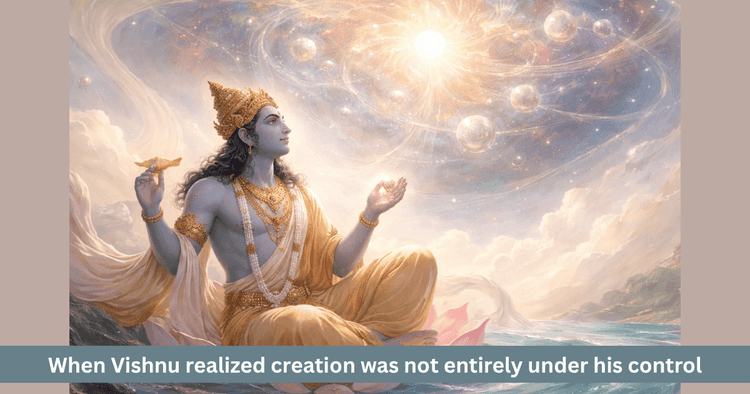
Table of Contents
Lord Vishnu is known as the preserver of creation. Balance order, protection and the continuity of life are all associated with his role. Once creation had moved beyond its earliest expansion and had begun entering a stable rhythm, it was natural to see every realm, every being and every current of energy as protected under Vishnu’s care. Yet within this vast order, there came a moment that led Vishnu himself to reflect deeply. It was the moment when he realized that the complete movement of creation was not held in his hands alone but that another subtle, deeper and wider force was also at work.
This is not a story of defeat or challenge. It is a story of inner realization. It tells of the point at which the preserver comes to understand that preservation itself belongs to a greater cosmic order. Vishnu does not become lesser through this realization. Rather, his form becomes deeper, because the power that recognizes a truth greater than itself is the power most fit to uphold true balance.
What Was Changing Beneath The Appearance Of Order
When the responsibility of cosmic preservation became established in Vishnu’s hands, everything appeared to be moving in a meaningful rhythm. The realms were in motion, the elements were in order, life currents were flowing and energetic balance seemed intact. To any observer it would have appeared that the universe was functioning in a harmonious pattern under Vishnu’s protection. In one sense this was true, because the dharma of preservation was active through him.
Yet many changes in existence do not first appear on the surface. They begin on subtle levels. This is what happened here as well. In some regions of creation, the flow of energy began shifting in ways that were barely visible. In certain realms, balance began restoring itself without any visible act of intervention. In some places it seemed as though an unseen force was quietly correcting disturbance and doing so without any announced divine action. This was the first sign that awakened a question within Vishnu.
How Did Vishnu First Understand These Changes
At first he took it as part of the natural process of cosmic unfolding. Subtle adjustments within creation were not unusual. In the work of preservation, many movements do indeed settle over time on their own. So initially he did not treat the change as a mystery. But when this current began appearing again and again, across many levels, in a strikingly similar way, his awareness deepened.
One of Vishnu’s greatest qualities is that he does not see only the surface. He sees rhythm and when rhythm shifts, he seeks its cause. He turned his consciousness more deeply toward the source from which this subtle balance seemed to be arising. There he sensed a presence beyond the range of his own direct function. This realization was surprising, yet it carried no resistance within it.
What Was This Power That Seemed Independent Of Vishnu’s Own Function
Here the mystery opens. Vishnu felt, for the first time in a clear way, the subtle energy associated with Maa Kushmanda. This was not an open intervention. No command had been announced. No formal divine act had taken place. Yet there was a current silently maintaining balance throughout creation from within. This current was not limited to one realm, nor was it a reaction to one event. It seemed to be a foundational stream of life and equilibrium working deep beneath visible order.
For Vishnu, this was a new kind of experience. He was the preserver, yet here was a force sustaining the inner harmony behind preservation itself. It was not issuing instructions. It was creating balance simply through its presence. In that moment he understood that preservation is not sustained only from above. Much of it also arises from within and it is that inward balance that often produces order without outward intervention.
Was This A Challenge To Vishnu Or A Moment Of Deeper Understanding
If this moment is seen as a challenge, the meaning becomes too narrow. It was not a contest of strength. It was a moment of recognition. Vishnu experienced that the movement of creation is not guided only by visible roles. Behind those roles work subtle principles that cannot always be seen, yet without them visible order cannot endure.
Before him were two possible responses. He could attempt to define this force within his own field of authority or he could accept that his preserving role itself was unfolding within a greater primordial balance. He chose the second path. This reveals his greatness. He did not try to restrain, test, seize or regulate that energy. He chose to accept it.
What Did Vishnu Understand After Accepting This Truth
This is the most beautiful turning point of the story. Once Vishnu accepted that subtle energy rather than trying to contain it, his own role became clearer to him. He realized that he was not only a preserver but part of a vast cosmic order in which creation, preservation, transformation and subtle balance all work together. His role remained immensely important but it was not solitary. Behind it there was an active primordial field of equilibrium.
This realization is linked to humility but even more to wholeness. The power that can recognize a greater system becomes more complete in its own dharma. Vishnu understood that sustaining creation is not merely the work of control. It is also the work of cooperation, understanding and harmonious acceptance.
How Did Shiva And Brahma See This Subtle Energy
The story says that Lord Shiva already knew of this current, which is why he remained silent. Shiva’s silence often points to a level of knowing beyond speech. He understood that behind the visible movement of creation there is always an invisible axis of balance and that the energy of Maa Kushmanda was active precisely at that level. That is why he offered no separate reaction.
Brahma too felt this force but he saw it as a natural part of the creative process itself. For him it was an extension of the original consciousness through which creation became possible. But for Vishnu, the realization became especially profound, because his dharma was directly connected with balance and preservation. When he understood that there was a subtler level of harmony at work beyond his visible guardianship, it became a transformative inner moment.
Can Control Itself Be An Illusion
This is where the story gives one of its deepest lessons. Human beings often assume that if they hold a role, manage a system, support a family, protect a relationship or carry responsibility, then everything should be under their control. But life, like creation, does not move only on one visible level. It contains many unseen currents, many subtle forces, many layers that we neither fully perceive nor fully control.
The realization of Vishnu teaches that total control may often be an illusion. This does not mean one should abandon responsibility. It means that while fulfilling responsibility, one must also understand that there are elements in life that operate beyond direct management. True balance comes not when one clings to control but when one learns to choose understanding and harmony over domination.
What Is The Deeper Meaning Of Maa Kushmanda’s Subtle Energy
The subtle energy of Maa Kushmanda reveals that behind visible order there is an invisible field of balance. What appears outwardly as structure and rhythm rests inwardly upon a far subtler order. This order works without noise, without declaration, without needing recognition. It quietly keeps things within their rightful measure. That is why her form is linked not only to creation but also to the inner equilibrium of existence.
When Vishnu recognized this energy, he did not become diminished. He became wider. He understood that preservation is not only the act of standing over creation but also the act of moving in accord with the deeper rhythm that supports everything from within.
What Does This Story Teach In Human Life
There are many moments in our own lives when we feel that much is happening through our efforts, yet at the same time something else is also supporting the balance of things in ways beyond our direct action. A relationship sometimes heals without force. A confusion sometimes resolves through an inner shift rather than an outer plan. At times help arrives in life that we neither arranged nor predicted. All this suggests that alongside visible effort there are also invisible supporting forces at work.
The story of Maa Kushmanda teaches that instead of trying to control everything, one must also learn to notice the deeper balance already present beneath events. When this recognition arises, a person becomes calmer, humbler and more inwardly awake.
The Final Light Of This Secret
In the end, it becomes clear that the moment Vishnu realized creation was not entirely under his control was not a moment of weakness. It was a moment of expansion. It was the point at which the preserver saw himself within a greater cosmic truth. He understood that creation is a shared process. His role is central but not solitary. The subtle energy of Maa Kushmanda is the foundational balancing power of that shared order.
This is the final message of the story. True power is not the power that wants absolute control over everything. True power is the one that knows its place, accepts the larger truth and fulfils its own dharma within that greater order.
Frequently Asked Questions
When did Vishnu feel that creation was not entirely under his control
When he noticed subtle balances being restored without any direct intervention from him.
What was the power he sensed
It was the subtle energy of Maa Kushmanda, silently maintaining equilibrium within creation.
Was this experience a challenge to Vishnu
No. It was a moment of deep understanding and inner realization through which he recognized a larger cosmic order.
What did he do with this realization
He did not try to control that energy. He accepted it and understood his own role more clearly.
What is the greatest teaching of this story
That total control may be an illusion and true balance comes through understanding, acceptance and harmony.
Get your accurate Kundali
Generate KundaliDid you like it?
Author
Pt. Amitabh Sharma (56 Years)
Experience: 20
Consults About: Family Planning, Career
Clients In: Punjab, Haryana, Delhi
Share this article with friends and family
About ZODIAQ
ZODIAQ is an online Vedic Astrology platform. It connects clients seeking astrological advice to experienced astrologers with deep knowledge. Our users also generate kundali and perform kundali milan for free. ZODIAQ also offers services to the Astrologers. Astrologers utilize various offerings by ZODIAQ to serve their clients effectively.
If you are a User
Consult with experienced astrologers and seek their guidance. You can also order handwritten Janm Patrika report with life prediction prepared by experienced astrologers. Generate accurate Kundali, perform Kundali Matching and check horoscope and muhurat. Utilize our online library for all the necessary astrological and spiritual information.
If you are an Astrologer
Create accurate kundali for your clients and perform Kundali Matching for up to 5 people at a time. Write comprehensive Janm Patrika report for your clients with ZODIAQ. Check client details anytime by saving it in client directory. Become more productive by tracking how many clients you guide every day.
WELCOME TO
ZODIAQ
Right Decisions at the right time with ZODIAQ
