Anant Chaturdashi 2026: Date, Vrat, Puja Vidhi and Significance
By Pt. Abhishek Sharma
Anant Chaturdashi Vrat, Ananta Sutra Puja, and Ganesh Visarjan Significance
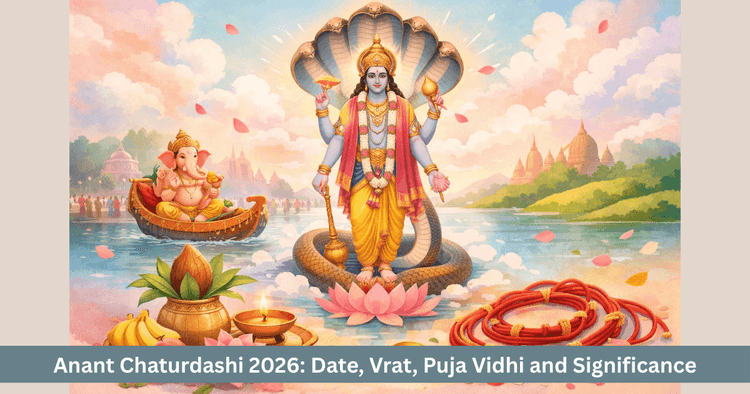
Table of Contents
Anant Chaturdashi is a sacred vrata and festival observed on the Chaturdashi tithi of the bright fortnight of Bhadrapada. This day is dedicated to Lord Vishnu in His Ananta form and in many regions it is known as Anant Chaudas. On this auspicious day devotees worship Lord Vishnu with a special fourteen knotted sacred thread called Ananta sutra. In many cities the same tithi also marks the completion of Ganeshotsav and devotees perform Ganesh Visarjan with devotion.
Anant Chaturdashi arrives every year on Bhadrapada Shukla Chaturdashi. In recent years this festival was celebrated on 6 September 2025, 17 September 2024, 28 September 2023 and 9 September 2022. In coming years it will again fall on 14 September 2027 and 2 September 2028 with renewed devotion. Since the fixed tithi is Bhadrapada Shukla Chaturdashi, all worship, vrata and wearing of the Ananta thread are performed according to the lunar calendar.
Reference to Anant Chaturdashi 2025 timings
To understand the practical observance of Anant Chaturdashi it is helpful to see a recent example. In the year 2025 Anant Chaturdashi was celebrated on Saturday 6 September. For that year the main details were as follows.
| Element | Details |
|---|---|
| Festival date | 6 September 2025 Saturday |
| Main puja period | 6 September 2025, 6:02 AM to 7 September 1:41 AM |
| Chaturdashi tithi begins | 6 September 2025, 3:12 AM |
| Chaturdashi tithi ends | 7 September 2025, 1:41 AM |
When Chaturdashi tithi prevails during morning hours, that day is chosen for Ananta vrata, puja and thread wearing. Householders generally complete their worship and rituals from sunrise till before evening. Those who follow detailed procedures refer to the exact tithi span and complete their anushthana within that auspicious window.
What is Anant Chaturdashi and why is it special
The name itself reveals the essence. Ananta means without end, eternal and limitless. It refers directly to Lord Vishnu in His infinite aspect. On this day Lord Shri Hari is worshipped through a fourteen knotted thread which symbolises the fourteen worlds and the energy of the Chaturdashi tithi.
Another special feature of this festival is its connection with Ganeshotsav. In many regions the tenth day of Ganesh worship concludes on Anant Chaturdashi with reverent immersion of Ganapati idols. Thus this day forms a bridge between bidding farewell to Lord Ganesha and invoking the protection of Lord Vishnu in His Ananta form.
Many devotees know this festival as Anant Chaudas or Ananta vrata. Scriptures describe that by taking this vrata sincerely one prays for release from suffering, resolution of marital disharmony, removal of financial obstacles and purification of the mind. It is recommended in several traditions that the vrata be observed continuously for fourteen years for very deep results.
Traditional Puja Vidhi of Anant Chaturdashi
On Anant Chaturdashi fasting, worship and rituals are performed in a certain devotional sequence. Devotees try to keep body and mind pure and restrained from early morning.
Preparing the place of worship
After an early bath one should clean the altar or chosen place of worship thoroughly. Spread a clean cloth on a wooden seat or raised platform. In some traditions a lotus with eight petals, called ashtadala kamala, is made from kusha grass and a kalasha is established upon it. This ashtadala symbolises the spread of Lord Vishnu grace in all eight directions.
Near the kalasha place a picture or deity of Lord Vishnu. Some families also worship Shaligrama or a Narayana deity. Arrange lamps, incense, flowers and a plate of naivedya near the altar. The entire space should look calm and inviting for worship.
Preparation and meaning of the Ananta sutra
The heart of this observance is the Ananta sutra, the sacred thread. It is not an ordinary piece of string. According to tradition
- Take cotton thread usually in red or yellow colour.
- Prepare a mixture of sindoor, kesar and haldi.
- Soak or anoint the thread in this mixture with reverence.
- Tie fourteen knots on the thread carefully.
These fourteen knots are seen as symbols of the fourteen worlds and of many subtle aspects of life and dharma. Some elders connect them with four Vedas, eighteen Puranas and cosmic levels. The prepared Ananta sutra is first offered at the feet of Lord Vishnu and remains on the altar during the puja. Only after worship and mantra chanting it is worn by family members.
Vishnu worship with Shodashopachara
After the thread is ready, Lord Vishnu is worshipped with Shodashopachara, the sixteenfold offering.
- Perform achamana and simple pranayama, then meditate on Lord Vishnu.
- Offer water, akshata, flowers, chandan, roli and kumkum.
- Light incense and lamps and present naivedya.
- Offer tulsi leaves, as no Vishnu worship is considered complete without tulsi.
At the end many families listen together to the Ananta vrata katha, which explains the glory and purpose of this observance. Reading or hearing the story strengthens the sankalpa and brings the family into a shared spiritual mood.
Mantra chanting and wearing the Ananta sutra
After the main offerings a special Ananta mantra is recited in honour of Lord Vishnu.
tapta-kancana-gaurangi radhe vrindavanesvari
vrishabhanu-sute devi pranamami hari-priye
In the original Ananta vrata tradition another mantra is generally spoken that invokes protection in the ocean of existence and salutes the Ananta sutra. The essence is a prayer for divine shelter across the waves of worldly life. After mantra chanting the Ananta sutra is lifted from the altar and tied on the wrist.
According to custom men wear the thread on the right wrist whereas women wear it on the left wrist. While tying the thread devotees inwardly pray that the Lord may guard them in every phase of life and grant steadiness and faith. The thread is not treated as a mere charm but as a living reminder of the vow and trust placed in Lord Vishnu.
After puja the prasada is distributed among family members. Many households invite a brahmana or a sadhu and serve them a respectful meal, which completes the vrata beautifully. Children also receive prasada and grow up with memories of a warm and devotional atmosphere.
Indication of the Anant Chaturdashi legend
The main legend of Anant Chaturdashi is traditionally linked to the period of the Mahabharata. A brief indication is sufficient to understand its tone. When King Yudhishthira performed the Rajasuya yajna, a very wonderful sacrificial hall was constructed. That hall was so marvellous that one could hardly distinguish water from ground. Where there was water it appeared like land and where there was land it appeared like water.
The detailed Ananta vrata katha uses this setting to teach that in times of illusion, pride or confusion, remembering the Ananta form of Lord Vishnu brings clarity and rescue. Through the observance of this vrata Yudhishthira and the Pandavas regained balance and peace in their life. In the same spirit devotees today turn to this vrata when they seek stability and guidance.
Importance of Anant Chaturdashi in Jain tradition
Anant Chaturdashi is not limited to Vaishnava followers alone. In Jain dharma it is also an important spiritual date.
Shvetambara Jains observe Paryushan Parva during the last ten days of the month of Bhadra. This is a period dedicated to deep reflection, study, austerity and self control. Digambara Jains celebrate the Das Lakshana Parva, a ten day festival focusing on ten cardinal virtues. The completion of these days often falls around or on Anant Chaturdashi.
The day following Anant Chaturdashi is known as Kshamavani among Jains. On this day Jain monks, nuns and lay followers ask forgiveness from each other and from all living beings for mistakes committed knowingly or unknowingly. It becomes a day of forgiveness, compassion and inner cleansing.
Jain tradition also remembers this as the date when Bhagwan Vasupujya, the twelfth Tirthankara of the current cosmic cycle, attained nirvana. Thus Anant Chaturdashi carries strong spiritual association for Jain communities as well, serving as a reminder of liberation and humility.
Key facts related to Anant Chaturdashi
To have an integrated view of Anant Chaturdashi the main points can be seen at one glance.
| Topic | Details |
|---|---|
| Main deity | Lord Vishnu in Ananta form |
| Other names | Anant Chaudas, Ananta vrata |
| Tithi | Bhadrapada Shukla Chaturdashi |
| Primary reasons | Vishnu worship, Ananta sutra vrata, Ganesh Visarjan, Jain observance |
| Mode of celebration | Home puja, Vishnu temple darshan, vrata and charity |
| Duration | One day |
| Frequency | Annual |
Future and previous dates show that this tithi recurs every year as a reminder of divine protection and eternal shelter.
How to celebrate Anant Chaturdashi simply at home
Not everyone can arrange large public celebrations yet Anant Chaturdashi can be honoured gently at home.
- Take an early bath and decorate the home shrine with flowers.
- Prepare the Ananta sutra with faith if possible.
- Perform a simple Vishnu puja and sing aarti with family.
- Spend the day in remembrance through Vishnu nama japa or Ananta mantra.
- In the evening visit a temple if convenient and accept prasada.
Those who also celebrate Ganeshotsav may perform Ganesh Visarjan with reverence on this same day, then shift their focus to Ananta worship in a natural devotional flow.
Spiritual benefits of Anant Chaturdashi vrata
The Anant Chaturdashi vrata is associated with stability, long term protection and peace of mind.
The Ananta thread tied on the wrist becomes a constant reminder that divine shelter is present. Couples often undertake this vrata for harmony in marriage. Many families see improvement in financial steadiness, mutual respect and devotional culture in the household.
One who follows this vrata year after year experiences growth in patience and inner strength. Over time Anant Chaturdashi stops being just a date in the calendar and becomes a living vow that shapes character and priorities.
Common questions on Anant Chaturdashi
On which tithi is Anant Chaturdashi observed?
It is observed on Bhadrapada Shukla Chaturdashi. In recent years it fell on 6 September 2025, 17 September 2024, 28 September 2023 and 9 September 2022.
Is it compulsory to wear the Ananta sutra on Anant Chaturdashi?
The tradition considers the Ananta sutra as a central part of the vrata. Men usually wear it on the right wrist and women on the left.
Is fasting necessary on Anant Chaturdashi?
If health allows, at least a light sattvic fast or fruit based diet is recommended. Those who cannot fast may still gain benefit through puja, charity and mantra chanting.
Is this day significant only for devotees of Vishnu?
No. It holds deep meaning in Jain tradition as well because it is linked with Paryushan, Das Lakshana Parva and the nirvana remembrance of Bhagwan Vasupujya.
Which main practices are recommended on Anant Chaturdashi?
Vishnu worship, wearing the Ananta sutra, observing vrata, giving charity, feeding brahmanas or needy persons and performing Ganesh Visarjan where that tradition is followed.
Get your accurate Kundali
Generate KundaliDid you like it?
Author

Pt. Abhishek Sharma (63)
Experience: 20
Consults About: Family Planning, Career
Clients In: Punjab, Haryana, Delhi
Share this article with friends and family
About ZODIAQ
ZODIAQ is an online Vedic Astrology platform. It connects clients seeking astrological advice to experienced astrologers with deep knowledge. Our users also generate kundali and perform kundali milan for free. ZODIAQ also offers services to the Astrologers. Astrologers utilize various offerings by ZODIAQ to serve their clients effectively.
If you are a User
Consult with experienced astrologers and seek their guidance. You can also order handwritten Janm Patrika report with life prediction prepared by experienced astrologers. Generate accurate Kundali, perform Kundali Matching and check horoscope and muhurat. Utilize our online library for all the necessary astrological and spiritual information.
If you are an Astrologer
Create accurate kundali for your clients and perform Kundali Matching for up to 5 people at a time. Write comprehensive Janm Patrika report for your clients with ZODIAQ. Check client details anytime by saving it in client directory. Become more productive by tracking how many clients you guide every day.
WELCOME TO
ZODIAQ
Right Decisions at the right time with ZODIAQ
