Ashadha Gupt Navratri 2026
By Pt. Sanjeev Sharma
Correct dates, Ghatasthapana muhurat and the nine Goddess forms for Gupt Navratri from 15 to 23 July 2026
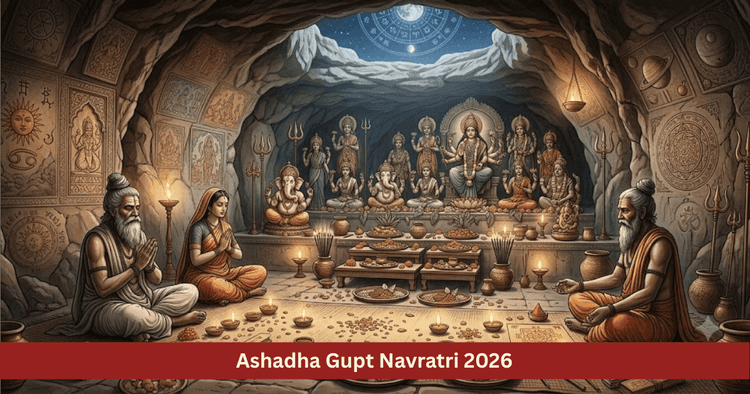
Table of Contents
Sacred Beginning of the Nine Days
Ashadha Gupt Navratri 2026 begins on Wednesday, 15 July 2026 and ends on Thursday, 23 July 2026. On the first day, Ghatasthapana or Kalash Sthapana will be performed during the auspicious muhurat from 5:33 AM to 10:09 AM. During these nine days, devotees worship the nine forms of Goddess Durga. They seek strength, devotion, protection and spiritual grace. This observance appears quiet from outside, yet it awakens deep consciousness within.
Ashadha Gupt Navratri is different from a regular festival. It is a time when sadhana becomes more inward and the remembrance of the Goddess becomes more subtle. A person who lives these days with faith and restraint may feel courage, patience and mental purification growing within. The effect of Gupt Navratri comes not from public display but from inner surrender.
| Subject | Details |
|---|---|
| Festival | Ashadha Gupt Navratri 2026 |
| Start | 15 July 2026, Wednesday |
| End | 23 July 2026, Thursday |
| Ghatasthapana muhurat | 5:33 AM to 10:09 AM |
| Main worship | Navadurga |
| Core feelings | Strength, devotion, protection, sadhana |
The essence of Ashadha Gupt Navratri is inner power.
The Spiritual Meaning of Gupt Navratri
Gupt Navratri does not only mean a festival celebrated quietly. Its deeper message is to move sadhana away from outer display and toward inner experience. When the mind is calm, the worship of the Goddess yields subtler fruit. During this festival, a seeker recognises inner weakness, fear, confusion and laziness.
The nine days of Navratri are not only for worship. They are for a step by step spiritual journey. Each day awakens a particular quality within the human being. One form gives stability, another gives patience, another courage, another compassion and another final accomplishment. That is why the worship of Navadurga touches many layers of life.
Main features of this festival
- Begins with Ghatasthapana.
- Worship of the nine forms of Navadurga.
- Regular sadhana and discipline.
- Purification of the mind and patience.
- Victory over fear.
- Spiritual upliftment.
- Awakening of inner strength.
Navratri is not only worship. It is transformation within the seeker.
The Importance of Ghatasthapana
Ghatasthapana or Kalash Sthapana has special significance on the first day. It is not only a ritual. It symbolically marks the beginning of invoking the Goddess. The aim of establishing the kalash in the auspicious muhurat is to stabilise sacred energy in both the home and the mind. Water, coconut, mango leaves and other worship items make the kalash a symbol of purity and prosperity.
The time from 5:33 AM to 10:09 AM is considered especially auspicious. The foundation of sadhana is believed to become stronger when the kalash is established during this period. A person who begins with full sincerity may find the coming nine days more meaningful.
| Subject | Indication |
|---|---|
| Ritual | Ghatasthapana |
| Muhurat | 5:33 AM to 10:09 AM |
| Symbol | Sacred beginning |
| Purpose | Invocation of the Goddess |
| Result | Strong foundation for sadhana |
Ghatasthapana is not just a beginning. It is the gateway to resolve.
The Nine Forms of Navadurga
During Ashadha Gupt Navratri, the nine forms of Goddess Durga are worshipped over nine days. Each form has its own character, message and spiritual task. One form gives strength, another patience, another victory, another compassion and another siddhi. When a seeker remembers them in sequence, life gradually comes into balance.
This sequence is not only tradition. It is a way of raising human consciousness. As the days move forward, the mind too becomes more refined. By the time Siddhidatri is reached, sadhana moves toward its full fruit.
The Navadurga sequence
- Maa Shailputri
- Maa Brahmacharini
- Maa Chandraghanta
- Maa Kushmanda
- Maa Skandamata
- Maa Katyayani
- Maa Kalaratri
- Maa Mahagauri
- Maa Siddhidatri
The sequence of Navadurga is a complete path of upliftment.
Day 1 Maa Shailputri
On the first day, Maa Shailputri is worshipped. She is the daughter of the Himalayas and represents strength, purity and devotion. As the first form of Goddess Durga, she marks the beginning of the spiritual journey. Devotees seek stability, courage and inner strength through her blessings.
The form of Shailputri teaches that the first condition of sadhana is a pure foundation. If mind and intention are pure, the path ahead becomes smoother. She creates earth like steadiness within the seeker.
| Day | Goddess | Main qualities |
|---|---|---|
| 1 | Maa Shailputri | Strength, purity, devotion |
Worship of Maa Shailputri begins stability.
Day 2 Maa Brahmacharini
On the second day, Maa Brahmacharini is worshipped. She symbolises penance, dedication and devotion. Discipline and determination are her central message on the path of spirituality. Devotees seek patience, wisdom and the strength to overcome difficulty through her blessings.
The form of Brahmacharini teaches that sadhana requires austerity, not attraction. Any deep accomplishment needs continuity. The one who can remain fixed on the goal begins to change from within. This form turns the mind away from distraction and toward practice.
| Day | Goddess | Main qualities |
|---|---|---|
| 2 | Maa Brahmacharini | Penance, discipline, dedication |
Maa Brahmacharini gives the power of patience and restraint.
Day 3 Maa Chandraghanta
On the third day, Maa Chandraghanta is worshipped. She represents courage, peace and protection. The crescent moon on her forehead is her special mark. Worship of her is believed to help devotees overcome fear, negativity and obstacles.
The form of Chandraghanta is especially useful for those who feel pressure both inwardly and outwardly. She does not only remove fear. She also gives confidence. This balance of peace and strength is the special gift of her form.
Message of the third day
- Freedom from fear.
- Growth in confidence.
- Establishment of peace.
- Removal of negativity.
- Inner protection.
Maa Chandraghanta is the balance of courage and peace.
Day 4 Maa Kushmanda
On the fourth day, Maa Kushmanda is worshipped. She is associated with cosmic energy, prosperity and vitality. Devotees believe that worshipping her brings positivity, good health and happiness. She represents the creative energy of the universe.
The form of Kushmanda teaches that creation is not only external. It is also internal. When positive energy awakens within the mind, many areas of life can be illuminated. This form gives enthusiasm and life force.
| Day | Goddess | Main qualities |
|---|---|---|
| 4 | Maa Kushmanda | Energy, prosperity, health |
Maa Kushmanda is the light of vitality.
Day 5 Maa Skandamata
On the fifth day, Maa Skandamata is worshipped. She is the mother of Lord Kartikeya. Motherhood, compassion and wisdom are her main qualities. Devotees seek happiness in family life, protection, peace and spiritual growth from her blessings.
The form of Skandamata reminds one that compassion is not weakness. It is a higher form of strength. Her grace can make the home peaceful and secure. This form brings both tenderness and balance to the mind.
Results of the fifth day
- Happiness in family life.
- A sense of protection.
- Peace of mind.
- Growth of compassion.
- Spiritual upliftment.
Maa Skandamata is the meeting of motherhood and wisdom.
Day 6 Maa Katyayani
On the sixth day, Maa Katyayani is worshipped. She is considered a warrior form of Goddess Durga. Courage, strength and victory over negative forces are her central message. Devotees pray to her for protection, confidence and fulfilment of wishes.
The form of Katyayani inspires a person to stand against conflict. It teaches that silence is not always the right answer in the face of injustice, fear and obstacles. When inner strength awakens, a person begins to see the path clearly.
| Day | Goddess | Main qualities |
|---|---|---|
| 6 | Maa Katyayani | Courage, victory, strength |
Maa Katyayani is the inspiration of victory.
Day 7 Maa Kalaratri
On the seventh day, Maa Kalaratri is worshipped. She is one of the fiercest forms of Goddess Durga. Her form is linked with the destruction of evil and the removal of fear. Devotees believe that she protects them from negativity, obstacles and difficulties.
The form of Kalaratri may look fierce from outside, yet within it lies compassion and protection. It reminds one that darkness is never truly permanent. When the Goddess is remembered, inner fear slowly begins to weaken.
Message of the seventh day
- Removal of fear.
- Protection from negativity.
- End of obstacles.
- Awakening of inner strength.
- Victory over darkness.
Maa Kalaratri is the Goddess of protection and transformation.
Day 8 Maa Mahagauri
On the eighth day, Maa Mahagauri is worshipped. She represents purity, peace and compassion. Devotees seek harmony, happiness and spiritual progress through her blessings. Her form is calm, gentle and transformative.
The message of Mahagauri is that purity is not only external. Inner purity of thought is equally important. When the mind becomes calm, balance enters life. This form gives the seeker both patience and depth.
| Day | Goddess | Main qualities |
|---|---|---|
| 8 | Maa Mahagauri | Peace, purity, compassion |
Maa Mahagauri is the living form of cleanliness of heart.
Day 9 Maa Siddhidatri
On the ninth and final day, Maa Siddhidatri is worshipped. She is regarded as the giver of spiritual wisdom, divine blessings and fulfilment. Devotees pray to her for success, knowledge and the completion of their spiritual journey.
The form of Siddhidatri is the final fruit of Navratri sadhana. When the seeker remembers all the forms in sequence, the experience of completeness may arise. This form teaches that sadhana is not only about beginning. It is also about reaching fulfilment.
Fruits of the final day
- Attainment of knowledge.
- Blessing of siddhi.
- Completion of tasks.
- Spiritual balance.
- Fulfilment of the life journey.
Maa Siddhidatri presides over siddhi and completeness.
How Sadhana Deepens During This Festival
The greatest secret of Gupt Navratri is that it gives more importance to inner practice than to outer activity. When a person regularly takes up mantra chanting, remembrance of the Goddess, fasting, lamp offering and meditation, the layers of the mind begin to open. The effect of sadhana grows slowly but its base becomes very deep.
This festival is especially meaningful for those who seek stability, protection, mental strength and spiritual progress in life. The purity of Gupt Navratri disciplines the mind and makes the seeker more mature. That is its greatest gift.
Useful attitude for sadhana
- Regular chanting.
- Sattvic food.
- Purity of mind.
- Respect for time.
- Faith and silence.
- Self control.
- Sequential remembrance of the nine forms.
Gupt Navratri is a festival of inner practice.
FAQ
When does Ashadha Gupt Navratri 2026 begin
Ashadha Gupt Navratri 2026 begins on Wednesday, 15 July 2026.
What is the auspicious muhurat for Ghatasthapana
The auspicious muhurat for Ghatasthapana is from 5:33 AM to 10:09 AM on the first day.
Whom do devotees worship during Gupt Navratri
During this period, the nine forms of Goddess Durga are worshipped.
Which goddess is worshipped on the first day
Maa Shailputri is worshipped on the first day.
Which goddess is worshipped on the ninth day
Maa Siddhidatri is worshipped on the ninth day.
Get your accurate Kundali
Generate KundaliDid you like it?
Author

Pt. Sanjeev Sharma (63)
Experience: 20
Consults About: Family Planning, Career
Clients In: Punjab, Haryana, Delhi
Share this article with friends and family
About ZODIAQ
ZODIAQ is an online Vedic Astrology platform. It connects clients seeking astrological advice to experienced astrologers with deep knowledge. Our users also generate kundali and perform kundali milan for free. ZODIAQ also offers services to the Astrologers. Astrologers utilize various offerings by ZODIAQ to serve their clients effectively.
If you are a User
Consult with experienced astrologers and seek their guidance. You can also order handwritten Janm Patrika report with life prediction prepared by experienced astrologers. Generate accurate Kundali, perform Kundali Matching and check horoscope and muhurat. Utilize our online library for all the necessary astrological and spiritual information.
If you are an Astrologer
Create accurate kundali for your clients and perform Kundali Matching for up to 5 people at a time. Write comprehensive Janm Patrika report for your clients with ZODIAQ. Check client details anytime by saving it in client directory. Become more productive by tracking how many clients you guide every day.
WELCOME TO
ZODIAQ
Right Decisions at the right time with ZODIAQ
