Chaturdashi Shradh 2026: Date, Significance and Ritual Method
By Pt. Nilesh Sharma
Ghata Chaturdashi Shradh rituals, timing and spiritual importance during Pitru Paksha
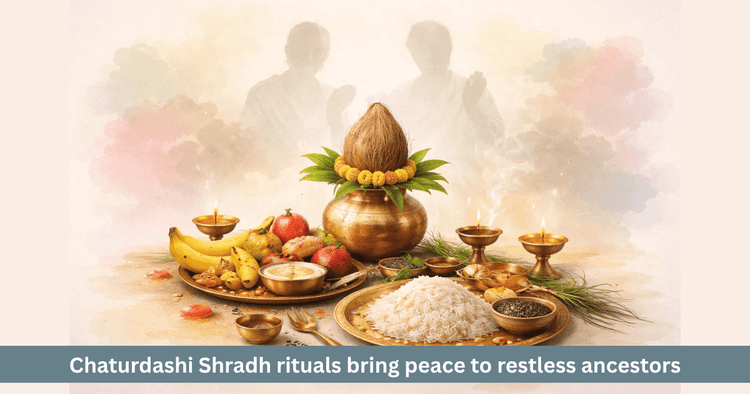
Table of Contents
Within the entire fortnight of Pitru Paksha, there are certain days that carry not only ritual importance but also touch the deep layers of grief, remembrance and compassion within a family. Chaturdashi Shradh, also known as Ghata Chaturdashi, Ghayala Chaturdashi and in many places Chaudas Shradh, is one such highly significant observance. In the year 2026, Chaturdashi Shradh will be observed on Friday, October 9, 2026. The important timings for Shradh on this day are Kutup Muhurat approximately from 11:36 AM to 12:24 PM, Rohina Muhurat approximately from 12:24 PM to 1:12 PM and after that the wider Aparahna Kala, meaning the afternoon ritual period, is especially accepted. This is the second last Shradh day of Pitru Paksha, coming just before Sarva Pitru Amavasya. For that reason, its feeling is not only one of remembrance but also of gently releasing restless souls toward peace.
What is Chaturdashi Shradh
Chaturdashi means the fourteenth lunar day. Every month contains a Shukla Chaturdashi and a Krishna Chaturdashi, yet the Ashwin Krishna Chaturdashi of Pitru Paksha is regarded as especially distinctive. This is the day on which Shradh is performed for those souls whose death took place through akal mrityu, meaning untimely death or through unnatural circumstances.
In most Shradh observances, the general rule is that the rite is performed on the same tithi on which the ancestor departed. Yet Chaturdashi Shradh is not limited only to that tithi based rule. Its purpose is to reach those souls whose death came suddenly, violently or through shock. Because of this, it is regarded as one of the most compassionate and healing observances within Pitru Paksha.
Why is it called Ghata Chaturdashi or Ghayala Chaturdashi
The name Ghata Chaturdashi points to those souls who died through a blow, injury, accident or violence. In Sanskrit and in traditional usage, ghata carries the sense of being struck down or killed. This is how the observance came to be known by this name.
In some regions, it is also called Ghayala Chaturdashi, which makes the meaning even more direct, indicating those who suffered physical or emotional trauma before death. Chaudas Shradh is the popular regional form of the same observance, where chaudas simply means the fourteenth day.
For whom is Chaturdashi Shradh performed
Chaturdashi Shradh is specifically meant for families whose loved one or ancestor died under circumstances such as the following:
| Circumstance of death | Why Chaturdashi Shradh is performed |
|---|---|
| Death by accident | For peace after sudden death |
| Death by violence or murder | For healing after traumatic death |
| Death by weapon or war | For those slain through direct force |
| Suicide | For compassion, forgiveness and peace |
| Sudden unexpected death | Such as cardiac arrest or other abrupt passing |
| Death in childbirth | In some traditions this is also included among untimely deaths |
This observance is meant for souls whose death did not come after a calm and complete life but in a sudden, painful or premature manner. Tradition creates a separate sacred place for such souls and that place is Chaturdashi Shradh.
If the exact death tithi is known, can Chaturdashi Shradh still be performed
In the Dharmashastra tradition, an important principle is accepted. If a person died through untimely or violent means and the family also knows the original tithi of death, then both forms of Shradh may be performed. For example, if a person died in an accident on Panchami Tithi, then Panchami Shradh may be performed for the tithi connection and Chaturdashi Shradh may also be performed for the condition of akal mrityu.
This is because one Shradh honours the original tithi and the other addresses the special condition of traumatic death through prayer and release.
If a family has no such death, should a separate Chaturdashi Shradh still be performed
In some traditions, it is held that families who have no ancestor in the category of untimely or violent death do not need to perform a separate Chaturdashi Shradh. For such families, the ancestors are understood to be included within Sarva Pitru Amavasya. therefore the special observance of Chaturdashi is mainly reserved for those souls whose passing was sudden, traumatic or unnatural.
Date and muhurat of Chaturdashi Shradh 2026
In the year 2026, Pitru Paksha runs from September 26 to October 10. Within this sequence, Chaturdashi Shradh will fall on Friday, October 9, 2026. The very next day is Sarva Pitru Amavasya, so this day is regarded as one of the most serious and emotionally significant phases of the fortnight.
The main timings for the Shradh are as follows:
| Details | Time |
|---|---|
| Date of Chaturdashi Shradh | October 9, 2026, Friday |
| Kutup Muhurat | Approximately 11:36 AM to 12:24 PM |
| Rohina Muhurat | Approximately 12:24 PM to 1:12 PM |
| Main ritual period | Aparahna Kala |
It is especially said for Chaturdashi Shradh that tarpan and the entire observance should be performed in a state of inner peace, restraint and compassion. On this day, it is not enough only to remain in grief. The deeper purpose is to transform grief into prayer, release and peace.
Who can perform Chaturdashi Shradh
The order of performers generally follows the same traditional pattern as in other Shradh rites. The eldest son is usually considered the first performer. In his absence, other sons, brothers, brother’s sons, daughters, daughter’s sons, spouses or other close relatives may also perform the Shradh.
If the deceased died by suicide, violence or sudden misfortune, then the living husband or wife, siblings or another close relative may also perform the observance. Here eligibility is not merely formal. It is deeply connected with love, shraddha, meaning reverent faith and inner responsibility.
How is Chaturdashi Shradh performed
The method of Chaturdashi Shradh follows the general Pitru Paksha framework but certain special emotional and ritual features are included because it is meant for souls who died through untimely or traumatic means.
Morning preparation
The day begins with a morning bath. White or light coloured clean clothing is worn. It is considered proper on this day to avoid unnecessary talking, anger, entertainment and worldly distraction. The departed person is remembered inwardly and the feeling is held that the day’s observance is for their peace and liberation.
Sankalpa
In the Sankalpa, meaning the sacred declaration of intent, the performer states their own name, gotra and the name of the departed soul for whom Ghata Chaturdashi Shradh is being performed. If there are several such ancestors who died through unnatural causes, their names may be included in one sankalpa. It is explicitly stated that this Shradh is being offered for the peace of a soul who died through akal mrityu, meaning untimely death.
Pinda Daan
Pinda Daan, meaning the offering of ritual food balls, is performed in the usual manner. Pindas made of rice or barley are prepared with black sesame seeds, ghee and honey. Yet in Chaturdashi Shradh, the offering is made with a special prayer for peace and liberation. The feeling is that a soul left unsettled through trauma or sudden loss may receive rest and stillness through this offering.
Tarpan
In Tarpan, meaning the sacred water offering, water is offered with black sesame seeds, Kusha grass and in some traditions barley as well. Some pandits also advise adding a single drop of milk to the water in Chaturdashi Shradh, as a symbol of nourishment, comfort and healing. While offering the water, the performer keeps the name of the departed and the nature of the loss in mind.
Special Shanti Havan
Some families also arrange a small Shanti Havan, meaning a peace fire ritual, along with Chaturdashi Shradh. In this, the Maha Mrityunjaya Mantra is especially recited:
Om Tryambakam Yajamahe Sugandhim Pushtivardhanam
Urvarukamiva Bandhanan Mrityor Mukshiya Mamritat
This mantra is connected with Lord Shiva in the form of Mrityunjaya, meaning the conqueror of death and is regarded as especially calming for souls who passed through sudden or painful death.
Brahmin bhojan and dakshina
After the Shradh, a worthy Brahmin is offered a sattvic meal. On this day, some families also include sattvic foods that were dear to the departed person, so that the offering becomes not only scriptural but also deeply personal. After the meal, dakshina is given with reverence.
What inner state matters most in Chaturdashi Shradh
During Chaturdashi Shradh, it is considered especially important that the performer remain free from anger, blame or the burden of unresolved conflict. If grief, guilt or deep emotional pain remains in the heart, this day invites that pain to be transformed into forgiveness, compassion and release.
Especially for those who died by suicide or under profoundly painful circumstances, it is often advised that two prayers be held in the heart. First, from the living toward the departed, a prayer of compassion and forgiveness. Second, from the departed toward the living, a prayer for peace and the blessing to move forward.
What is the scriptural basis of Chaturdashi Shradh
In Puranic and Dharmashastra understanding, souls who die through untimely or violent means may remain in a more agitated, traumatized or unsettled state than those who die in natural peace. In the Garuda Purana, one finds the idea that suddenly departed souls may continue to remain attached to the body that was taken from them too abruptly.
The Dharmashastra tradition also states that such ancestors should especially be remembered on Chaturdashi. That is why this observance is regarded as distinct and separate from the general tithi based system.
Chaturdashi is also linked with Lord Shiva. The Krishna Chaturdashi of every month bears the significance of Shivaratri. Because of Shiva in the forms of Mahakala, meaning the great lord of time and Mrityunjaya, Chaturdashi is regarded as especially powerful for the peace of souls caught in difficult transitional conditions.
What should be done on the day of Chaturdashi Shradh
| What should be done | Why it should be done |
|---|---|
| Keep the mind peaceful and compassionate | This is a Shradh of healing and release |
| Recite the Maha Mrityunjaya Mantra | It is regarded as calming for souls who died through trauma |
| Mention Ghata Chaturdashi and untimely death in the sankalpa | It directs the Shradh to the intended soul |
| Perform tarpan in flowing water | Continuous flow symbolizes peace and onward movement |
| Feed a Brahmin | It is essential for the completion of Shradh |
| Light a ghee lamp in the evening | It adds the feeling of offering light to the departed soul |
What should be avoided on the day of Chaturdashi Shradh
| What should be avoided | Why it should be avoided |
|---|---|
| Do not perform Shradh in a state of anger or blame | The day is meant for peace and release |
| Do not consume non vegetarian or tamasic food | Sattvic purity is required |
| Do not perform Shradh after sunset | The proper Shradh period is accepted only until afternoon |
| Do not use iron vessels | Copper and other pure ritual metals are preferred |
| Do not speak harshly about the circumstances of death | This is a day for healing, not for reopening conflict |
The deepest message of Chaturdashi Shradh
Chaturdashi Shradh teaches that not every soul is remembered only by the date of death. Some souls leave behind a wound so deep that the family carries it for years. For such souls, this day creates a compassionate sacred place. It says that the soul who left suddenly has not been forgotten, for them too there is a tithi, a prayer and a light.
This Shradh is not only for the liberation of the ancestor. It is also for the healing of the living heart of the family. When a family performs Ghata Chaturdashi with love, forgiveness and peace, it does not merely bid farewell to a soul. It also allows the hardened weight of grief within itself to begin softening.
FAQs
When is Chaturdashi Shradh 2026
Chaturdashi Shradh in the year 2026 will be observed on Friday, October 9.
For whom is Ghata Chaturdashi performed
It is performed for souls who died through untimely, violent, accidental or other unnatural circumstances.
Is Chaturdashi Shradh also performed for death by suicide
Yes, tradition regards Chaturdashi Shradh as a compassionate and appropriate observance for such souls as well.
If the exact death tithi is known, can Chaturdashi Shradh still be performed
Yes, if the death was untimely or traumatic, both the original tithi Shradh and Chaturdashi Shradh may be performed.
Which mantra is especially important on Chaturdashi Shradh
The Maha Mrityunjaya Mantra is regarded as especially calming and liberating on this day.
Get your accurate Kundali
Generate KundaliDid you like it?
Author

Pt. Nilesh Sharma (63)
Experience: 20
Consults About: Family Planning, Career
Clients In: Punjab, Haryana, Delhi
Share this article with friends and family
About ZODIAQ
ZODIAQ is an online Vedic Astrology platform. It connects clients seeking astrological advice to experienced astrologers with deep knowledge. Our users also generate kundali and perform kundali milan for free. ZODIAQ also offers services to the Astrologers. Astrologers utilize various offerings by ZODIAQ to serve their clients effectively.
If you are a User
Consult with experienced astrologers and seek their guidance. You can also order handwritten Janm Patrika report with life prediction prepared by experienced astrologers. Generate accurate Kundali, perform Kundali Matching and check horoscope and muhurat. Utilize our online library for all the necessary astrological and spiritual information.
If you are an Astrologer
Create accurate kundali for your clients and perform Kundali Matching for up to 5 people at a time. Write comprehensive Janm Patrika report for your clients with ZODIAQ. Check client details anytime by saving it in client directory. Become more productive by tracking how many clients you guide every day.
WELCOME TO
ZODIAQ
Right Decisions at the right time with ZODIAQ
