Chaturthi Shradh 2026: Date, Significance and Complete Rituals
By Aparna Patni
Importance of Chaturthi Shradh, Date, and Pinda Daan Rituals
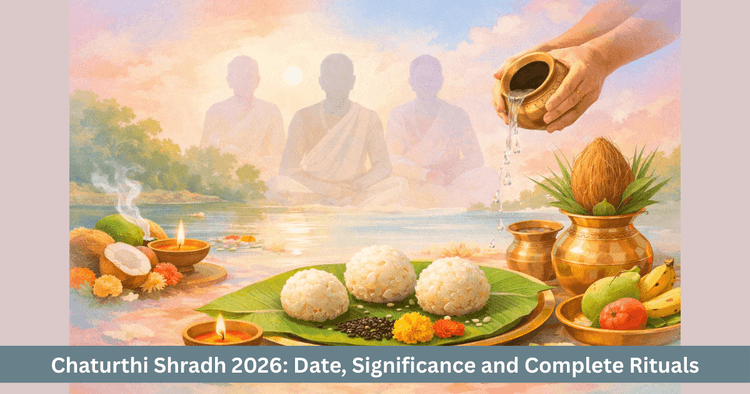
Table of Contents
Chaturthi Shradh is the day in Pitru Paksha that is devoted to those ancestors who passed away on the Chaturthi tithi. On this day Shradh, Pind daan and Tarpan are performed with devotion so that the forefathers are pleased and bestow their blessings upon the family. Like the other Pitru Paksha observances, Chaturthi Shradh can become a profound spiritual experience for the entire household when performed with correct method and sincere feeling.
In the year 2026 Chaturthi Shradh will be observed on Wednesday, 30 September 2026. This will be the fourth day of Pitru Paksha and on this date the Bhadrapada Krishna Chaturthi tithi will hold. The Chaturthi tithi will begin on 29 September 2026 at 05:09 PM and will continue until 30 September 2026 at 02:55 PM. For Shradh, the midday portion of the day is considered best. Accordingly, the Kutup muhurat is approximately from 11:02 AM to 11:50 AM, the Rohina muhurat from 11:50 AM to 12:38 PM and the Aparahna kala from 12:38 PM to 03:02 PM. Completing the Shradh rites within these windows is regarded as highly auspicious.
Chaturthi Shradh 2026 date and muhurat overview
The main details of Chaturthi Shradh can be seen clearly in the following table.
| Detail | Date and time |
|---|---|
| Chaturthi Shradh day | Wednesday, 30 September 2026 |
| Lunar tithi | Bhadrapada Krishna Chaturthi |
| Tithi begins | 29 September 2026, 05:09 PM |
| Tithi ends | 30 September 2026, 02:55 PM |
| Kutup muhurat | Approximately 11:02 AM to 11:50 AM |
| Rohina muhurat | Approximately 11:50 AM to 12:38 PM |
| Aparahna kala | Approximately 12:38 PM to 03:02 PM |
It is advisable to complete all major Shradh rituals, including sankalpa, Pind daan, Tarpan and Brahmin feeding, before the end of the Aparahna kala. The tradition of avoiding Shradh after sunset is based on the understanding that the subtle efficacy of Pitru rites is strongly linked to the position of the midday and afternoon sun.
What is Chaturthi Shradh and why is it called Chauth Shradh
Chaturthi Shradh is the special Shradh performed on the Chaturthi tithi, the fourth day in Pitru Paksha, for those ancestors whose death occurred on a Chaturthi date. This applies whether their passing was on a Shukla Chaturthi or a Krishna Chaturthi. Performing their Shradh on the Chaturthi of Pitru Paksha is considered the most appropriate and fruitful.
It is also known as Chauth Shradh in common speech. The word Chauth is the everyday form of Chaturthi. From the perspective of Dharma texts, each tithi has its own quality and potency. When Shradh is performed on the same tithi on which the ancestor left the body, it is believed to become especially effective for that soul. For this reason Chaturthi Shradh holds a distinct importance for Chaturthi tithi ancestors.
When the exact death tithi of a forefather is known, priority should be given to Shradh on that same tithi. If the real tithi is completely unknown, then a general Shradh on Sarva Pitru Amavasya is recommended. Where traditional family memory preserves the association with Chaturthi, however Shradh on Chaturthi itself is regarded as particularly beneficial.
For which ancestors is Chaturthi Shradh performed in 2026
In practice Chaturthi Shradh is recommended mainly for two categories of forefathers.
- Ancestors whose death took place on Chaturthi tithi, whether in Shukla Paksha or Krishna Paksha.
- Ancestors for whom Chauth Shradh has been observed by family tradition, even when the exact date is now remembered only approximately.
In addition, some households use a tithi specific Shradh such as Chaturthi to make up for a Shradh that was missed in an earlier year, by taking a clear sankalpa for the omitted year. In this way Chaturthi Shradh does not only serve one single ancestor but can also contribute to the overall peace and stability of the lineage.
Spiritual benefits of Chaturthi Shradh
According to Dharma texts, Shradh performed on a specific tithi brings deep satisfaction to the forefathers. Works such as Manusmriti, Yama Smriti, Grihya Sutras and Nirnaya Sindhu mention that tithi based Shradh supports happiness, peace, prosperity and the healthy growth of descendants in the family.
In the case of Chaturthi Shradh it is described as especially favourable for childbirth, household welfare, health and longevity. Families that observe tithi based Shradh regularly often notice that unexplained disturbances, frequent illness or instability gradually diminish over time. The effect unfolds quietly as a steady inner peace rather than a sudden change. Chaturthi Shradh can become a significant foundation for such balance, particularly when performed year after year with faith.
Parvana Shradh rules during Pitru Paksha
The Shradhs of Pitru Paksha are generally known as Parvana Shradh. In Parvana Shradh the rites are aligned with specific tithis and the middle portion of the day is given prominence.
During Parvana Shradh
- The Kutup muhurat is considered the highest quality Shradh muhurat.
- The Rohina muhurat is also viewed as very favourable.
- When it is not possible to complete all rites within these two, the broader Aparahna period remains valid for Shradh.
Other times, such as very early morning or after sunset, are not preferred for Pitru rites. therefore on Chaturthi Shradh the day’s schedule should be arranged so that the core rituals fall within these midday periods.
How to perform the main rituals of Chaturthi Shradh
The method of Chaturthi Shradh follows the general Shradh pattern, with particular mention of Chaturthi tithi ancestors in the sankalpa.
1. Morning bath and purification
The day begins with a bath taken in the early morning. Where possible one may bathe in a river or sacred water body, otherwise a careful bath at home is taken, ideally with a few drops of Ganga jal added to the water. After the bath, clean, simple and light coloured clothes are worn.
The home or ritual place is cleaned. It is resolved that only sattvic food will be cooked on that day. This prepares a quiet, pure atmosphere for the Shradh.
2. Sankalpa and invocation of ancestors
At the start of the rites, the sankalpa is made. The performer declares name, gotra, place and date and resolves to perform Shradh on Chaturthi tithi for specific ancestors.
- The names and relationships of those who died on Chaturthi tithi are spoken.
- Where names are partly forgotten, the ancestors of Chaturthi tithi are invoked more generally with gotra and relation.
After the sankalpa, a sacred seat for the pitrus is prepared using kusa grass or a clean mat. The ancestors are invited inwardly to accept the pindas, Tarpan and food offerings that will follow.
3. Tarpan as the central offering of water
In the middle of the Shradh comes Tarpan, the ritual offering of water. For Tarpan, water is commonly mixed with black sesame seeds, barley and kusa grass.
- Water is poured slowly from the cupped right hand while remembering the ancestors by name.
- Special Tarpan is offered specifically for those who passed on Chaturthi tithi.
- At the end a collective Tarpan may be offered for all forefathers of the lineage, extending the benefit beyond a single group.
The inner attitude is that this water is not only a material offering but also a stream of gratitude and remembrance reaching the Pitru realm.
4. Pind daan and respectful offering of food essence
Pind daan is the most sensitive part of Shradh. Round pindas are formed from rice, sesame, ghee and honey.
- Generally three pindas are prepared but more may be made according to family tradition and need.
- The pindas are placed in order on a bed of kusa grass and offered with the names of the ancestors.
- With each pinda the performer prays that this subtle food may reach the forefathers and grant them peace and contentment.
The effect of Pind daan on Chaturthi Shradh is believed to extend into the whole year, touching the subtle environment of the home and family.
5. Brahmin feeding and final Tarpan
After Shradh offerings, Brahmin feeding is carried out. A priest is seated respectfully and served a meal which typically consists of rice, dal, vegetables, roti or puri and a sweet dish such as kheer or halwa.
After the meal, the Brahmin receives dakshina and, according to capacity, cloth or other useful items. At the very end a brief Tarpan is performed again for Devas, Rishis and Pitrs. With this, the main body of Chaturthi Shradh is regarded as complete.
Chaturthi Shradh, Pitru Dosha relief and family growth
Scriptural teachings indicate that Shradh performed on a specific tithi helps to calm particular forms of Pitru Dosha, ancestral affliction. Chaturthi Shradh is described as especially helpful for matters of offspring, household welfare, health and long life.
In families that keep tithi aligned Shradh, subtle issues such as recurring ill health, frequent disturbances or emotional restlessness often soften over time. The change is generally gradual, reflecting as a more settled inner climate rather than outward drama. Regular observance of Chaturthi Shradh can become one of the foundations of this gradual healing, especially when accompanied by a sincere heart.
Common questions about Chaturthi Shradh 2026
On which date will Chaturthi Shradh be observed in 2026 and what are the main timings?
In 2026 Chaturthi Shradh will be observed on Wednesday, 30 September. The Bhadrapada Krishna Chaturthi tithi will run until 02:55 PM and the main muhurats for Shradh are Kutup, Rohina and the wider Aparahna period.
For which ancestors is Chaturthi Shradh considered essential?
It is especially meant for ancestors whose death occurred on a Chaturthi tithi, whether in Shukla or Krishna Paksha and for those whose connection with Chaturthi has been preserved in family tradition through Chauth Shradh.
If the exact date of an ancestor’s passing is unknown, can Chaturthi Shradh still be performed?
If the tithi is completely unknown, Shradh on Sarva Pitru Amavasya is the safe choice. Where there is a strong traditional indication that the death was linked with Chaturthi, Shradh on Chaturthi may also be performed with a clear sankalpa.
Which part of the day should be avoided for Chaturthi Shradh?
Shradh rites should not be performed after sunset or at night. For Chaturthi Shradh, the midday Kutup and Rohina muhurats and the Aparahna kala are to be used instead.
Can Chaturthi Shradh be done at home or must it be at a tirtha?
Chaturthi Shradh may certainly be performed at home with proper method. When travel to a tirtha is possible, Shradh there is considered more meritorious but a Shradh carried out at home with purity and devotion also reaches the ancestors fully.
Get your accurate Kundali
Generate KundaliDid you like it?
Author

Aparna Patni (63)
Experience: 20
Consults About: Family Planning, Career
Clients In: Punjab, Haryana, Delhi
Share this article with friends and family
About ZODIAQ
ZODIAQ is an online Vedic Astrology platform. It connects clients seeking astrological advice to experienced astrologers with deep knowledge. Our users also generate kundali and perform kundali milan for free. ZODIAQ also offers services to the Astrologers. Astrologers utilize various offerings by ZODIAQ to serve their clients effectively.
If you are a User
Consult with experienced astrologers and seek their guidance. You can also order handwritten Janm Patrika report with life prediction prepared by experienced astrologers. Generate accurate Kundali, perform Kundali Matching and check horoscope and muhurat. Utilize our online library for all the necessary astrological and spiritual information.
If you are an Astrologer
Create accurate kundali for your clients and perform Kundali Matching for up to 5 people at a time. Write comprehensive Janm Patrika report for your clients with ZODIAQ. Check client details anytime by saving it in client directory. Become more productive by tracking how many clients you guide every day.
WELCOME TO
ZODIAQ
Right Decisions at the right time with ZODIAQ
