Dahi Handi Festival 2026: Date, Significance, Story and Celebrations
By Pt. Narendra Sharma
Celebrated after Krishna Janmashtami, blending devotion, playfulness and teamwork in the festivities
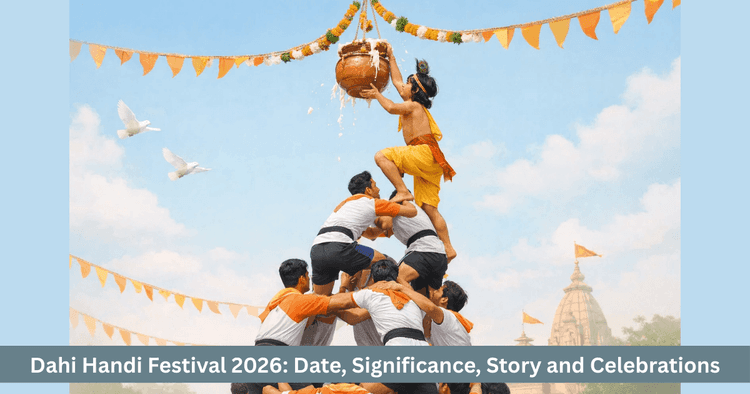
Table of Contents
Among the many vibrant festivals of India, Dahi Handi stands out as a celebration that combines devotion, playfulness and teamwork in a very natural way. This festival is observed on the day following Krishna Janmashtami and keeps alive the childhood pastimes of Lord Krishna as a beloved form of Lord Vishnu.
Dahi Handi 2026 Date and Auspicious Timing
The Dahi Handi festival is traditionally observed on the day after Krishna Janmashtami. According to the Hindu calendar, it is connected with the Krishna Paksha Ashtami of the Bhadrapada month and is treated as an extension of the Janmashtami celebrations.
| Detail | Date and Day | Time / Information |
|---|---|---|
| Dahi Handi 2026 | Saturday, 5 September 2026 | The day after Krishna Janmashtami |
| Ashtami tithi begins | 4 September 2026 | Around 10:48 AM |
| Ashtami tithi ends | 5 September 2026 | Around 11:23 AM |
For a religious event like Dahi Handi, communities often consult local panchanga, especially the choghadiya and other auspicious periods. In many cities the main Dahi Handi events are scheduled in the afternoon or early evening when both practical convenience and favourable timings can be combined.
What Is Dahi Handi and How Is It Linked to Krishna Janmashtami?
Dahi Handi is directly inspired by the childhood pastime of Krishna as Makhan Chor, the butter thief. According to traditional stories, when Krishna lived in Vrindavan, the finest milk products were sent as tax to the cruel king Kansa. This left very little high quality dairy food in the homes of ordinary people. Krishna loved fresh butter, curd and milk, so he would playfully steal these items along with his cowherd friends.
To protect their butter and curd, the village women began hanging their pots at greater heights. Krishna and his companions treated this as a friendly challenge. They would form human pyramids, reach the hanging pots, break them and share the butter with everyone around. Modern Dahi Handi celebrations recreate this spirit of joy after Janmashtami, turning the memory of Krishna’s play into a community festival.
How Is the Muhurat of Dahi Handi 2026 Understood?
Although Dahi Handi is full of energy and activity, it is still considered a religious observance. Organisers therefore give attention to timing.
- The day itself follows directly after the Janmashtami observance that is based on the Ashtami tithi.
- Within that day organisers generally choose auspicious choghadiya periods such as labha, shubha or amrita for breaking the handi.
- On Saturday, 5 September 2026, many neighbourhoods are likely to hold their main Dahi Handi events between midday and sunset.
Local priests and community leaders may fine tune the exact schedule according to the region’s panchanga and practical needs.
What Ingredients Are Placed Inside the Dahi Handi?
The earthen pot used in Dahi Handi is filled with items that Krishna is known to love and that reflect the dairy traditions of the region.
Some common ingredients include the following.
- Curd, which holds a special place among Krishna’s favourite foods.
- Butter or freshly churned makhan, symbolising his childhood name Makhan Chor.
- Ghee, sugar and jaggery, expressing richness and sweetness.
- Dahi poha, a mixture of flattened rice with yoghurt and sweetening agents.
- In some places fruits, dry fruits and a small amount of milk are also added.
The pot is decorated with flowers, coloured cloth and auspicious symbols. Silver coins are often tied along the rope or attached to the handi and later distributed as prizes among the Govinda teams that succeed in reaching and breaking it.
The Story Behind Dahi Handi and Krishna’s Butter Pastimes
In Vrindavan, the gopis sometimes felt both delighted and troubled by Krishna’s constant butter raids.
- They began to hang pots of butter, curd and ghee high on ropes or hooks so that small children would not easily reach them.
- Krishna and his friends accepted this as an invitation to a new game and worked together to climb on one another’s shoulders.
- The child at the top would touch or break the pot and then the group would share the butter that fell.
This pastime is more than simple mischief. It carries an undercurrent of sharing, cooperation and the fearless joy of overcoming obstacles with friends. Dahi Handi keeps this message alive in a form that whole communities can experience.
How Will Dahi Handi 2026 Be Celebrated?
In 2026, Dahi Handi will be especially vibrant in Maharashtra, Mumbai, Thane, Pune, Gujarat and several cities across North India.
- Open squares, crossroads and community grounds are chosen as venues for hanging the handi at a challenging height.
- Teams of participants gather below, preparing to form human pyramids and reach the pot.
- Residents watch from terraces and balconies, calling out Govinda Ala Re and other chants as the climbers attempt to reach the handi.
To support safety, many organisers now use mats or cushioning at the base and coordinate with local authorities to manage crowds and first aid.
Govinda Teams and the Tradition of the Human Pyramid
At the heart of the Dahi Handi celebration are the Govinda teams.
- The base layer of the pyramid is usually formed by the strongest participants, who create a wide and steady foundation.
- The second and third tiers climb up carefully, distributing weight and maintaining balance.
- The youngest or lightest member typically climbs to the top and makes the final attempt to break the handi with the hand or with a coconut.
This entire process is a living exercise in mutual trust and coordination. Each participant depends on the others and success is shared. The achievement belongs to the team rather than to any one individual.
Spiritual and Social Meaning of Dahi Handi
Dahi Handi has both spiritual depth and social relevance.
- Spiritually, it mirrors Krishna’s playful way of drawing hearts closer to the divine through ordinary village life and simple joys.
- Socially, it fosters team spirit, courage, perseverance and leadership among the participants.
- The festival brings together residents, local organisations and families, creating stronger bonds in the community.
In many regions Dahi Handi is also known as Gopal Kala, a reference to the simple yet nourishing prasad made from ingredients like dahi and poha that is shared after the celebrations.
Safety and Balance During Dahi Handi
With growing enthusiasm and crowds, attention to safety has become essential.
- Responsible organisers keep the height of the handi within reasonable limits and encourage use of helmets, belts and protective gear.
- Many city administrations specify guidelines about age, maximum levels for pyramids and the presence of medical teams.
When safety, discipline and devotion come together, Dahi Handi 2026 can remain a genuinely uplifting celebration for everyone present.
Guidance Offered by Dahi Handi 2026
Dahi Handi 2026 offers lessons that extend beyond a single day of excitement.
- The handi suspended high above becomes a symbol of goals that require collective effort rather than solitary struggle.
- The human pyramid reminds that anyone who reaches the top does so with the support of many unseen shoulders.
- The shared distribution of butter and prasad expresses that success feels complete only when it is enjoyed together.
Seen in this way, Dahi Handi becomes a festival of devotion, cooperation and inner balance, echoing the deeper teachings of Lord Krishna.
Frequently Asked Questions
When will Dahi Handi be celebrated in 2026 and how is it connected to Janmashtami?
Dahi Handi in 2026 will be celebrated on Saturday, 5 September. It follows Krishna Janmashtami, which is observed on the Krishna Paksha Ashtami of the Bhadrapada month and continues the celebration of Krishna’s birth and childhood pastimes.
What is the main religious meaning of the Dahi Handi festival?
The festival commemorates Krishna’s playful childhood acts of stealing butter and curd from the homes of Vrindavan. By forming pyramids and breaking the handi, devotees symbolically re enact this pastime and nurture both devotion and team spirit.
Which ingredients are usually placed inside the Dahi Handi pot?
The handi is commonly filled with curd butter, ghee, sugar, jaggery and dahi poha. In some celebrations fruits and dry fruits are also added and the pot is decorated with flowers and sometimes silver coins.
Why is Dahi Handi especially popular in Maharashtra and Gujarat?
In Maharashtra and Gujarat, long standing traditions linked to Krishna’s life and Janmashtami have given Dahi Handi a prominent place in urban as well as rural culture. Over time it has become a major social and devotional event in these regions.
How can safety be maintained during Dahi Handi events?
Safety is supported by controlling the height of the handi, using mats and padding at the base, training participants properly and providing helmets or other gear where possible. Clear guidelines and medical support help ensure that devotion and joy are expressed without unnecessary risk.
Get your accurate Kundali
Generate KundaliDid you like it?
Author
Pt. Narendra Sharma (63)
Experience: 20
Consults About: Family Planning, Career
Clients In: Punjab, Haryana, Delhi
Share this article with friends and family
About ZODIAQ
ZODIAQ is an online Vedic Astrology platform. It connects clients seeking astrological advice to experienced astrologers with deep knowledge. Our users also generate kundali and perform kundali milan for free. ZODIAQ also offers services to the Astrologers. Astrologers utilize various offerings by ZODIAQ to serve their clients effectively.
If you are a User
Consult with experienced astrologers and seek their guidance. You can also order handwritten Janm Patrika report with life prediction prepared by experienced astrologers. Generate accurate Kundali, perform Kundali Matching and check horoscope and muhurat. Utilize our online library for all the necessary astrological and spiritual information.
If you are an Astrologer
Create accurate kundali for your clients and perform Kundali Matching for up to 5 people at a time. Write comprehensive Janm Patrika report for your clients with ZODIAQ. Check client details anytime by saving it in client directory. Become more productive by tracking how many clients you guide every day.
WELCOME TO
ZODIAQ
Right Decisions at the right time with ZODIAQ
