Devshayani Ekadashi 2026: Date, Chaturmas Beginning, Fasting Rules and Sacred Story
By Pt. Abhishek Sharma
Importance of Devshayani Ekadashi and Start of Chaturmas
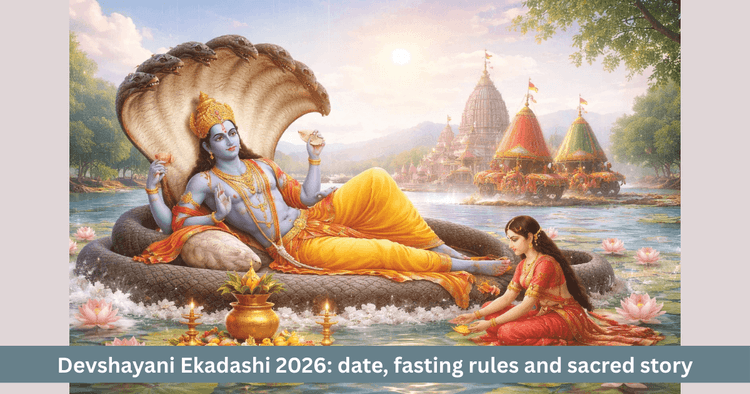
Table of Contents
With the arrival of the monsoon in India a long sequence of fasts and festivals begins. From the months of Ashadha and Shravan, especially around July, this sacred flow becomes very strong and brings together faith, restraint and devotion. Among all these observances Devshayani Ekadashi 2026 is regarded as the first major step into Chaturmas and sets the tone for the spiritual atmosphere of the coming four months.
In 2026 Devshayani Ekadashi will be observed on Saturday, 25 July 2026. This vrata is kept on the Ekadashi tithi of the bright fortnight of Ashadha and is usually close to the time of the Jagannath Rath Yatra festival. Understanding the exact Devshayani Ekadashi date and tithi time makes it easier to observe the fast, follow the puja and respect the rules of Chaturmas.
Devshayani Ekadashi 2026 date and Ekadashi tithi timings
The date of Devshayani Ekadashi is set according to the lunar calendar. The Ekadashi of Ashadha Shukla Paksha is known as Devshayani Ekadashi.
| Devshayani Ekadashi 2026 details | Date and time |
|---|---|
| Main fast and festival date | Saturday, 25 July 2026 |
| Ekadashi tithi begins | 09:25 in the morning on 24 July 2026 |
| Ekadashi tithi ends | 11:40 in the morning on 25 July 2026 |
Because the Ekadashi tithi remains in effect until late morning on 25 July, the main observance and fasting of Devshayani Ekadashi will take place on that day. The sankalpa for the fast is taken based on Ekadashi at sunrise, while the preparatory discipline starts from Dashami.
What is Devshayani Ekadashi and when is it observed
Devshayani Ekadashi falls after about ten days from Ashadha Purnima and is the Ashadha Shukla Ekadashi. This Ekadashi is also known as Ashadhi Ekadashi and Padma Ekadashi.
It is believed that Chaturmas begins from this very Ekadashi. According to tradition, on Devshayani Ekadashi Lord Vishnu enters a state of deep yogic sleep on the serpent bed of Kshira Sagara. For the next four months he is said to remain in this resting state and then awaken on Kartika Shukla Ekadashi, known as Devuthani Ekadashi or Devotthana Gyaras.
From Devshayani to Devuthani these four months see fewer weddings and grand celebrations, while bhakti, japa, austerity and service gain special importance.
What is the significance of Devshayani Ekadashi
Beginning of Chaturmas and pause on major ceremonies
According to Hindu scriptures Chaturmas starts from Devshayani Ekadashi. During these four months, performance of the sixteen samskaras and major auspicious ceremonies is generally put on hold.
Even so, the texts explain that during this period worship, sadhana, recitation, simple house entry after renovation and purchase of vehicles or jewellery can be done but excessive enjoyment and loud celebration are best avoided.
Removal of sins, progress towards liberation and fulfilment of wishes
Padma Purana states that the fast of Devshayani Ekadashi is very powerful in removing sins done knowingly or unknowingly. When worship is performed with proper method, this Ekadashi supports movement towards the path of liberation.
Brahmavaivarta Purana calls this Ekadashi Saubhagyadini Ekadashi. The vrata is believed to help in the fulfilment of sincere desires and in bringing more auspicious circumstances into one’s life.
It is also said that after Devshayani, for four months the brightness of the Sun, the Moon and nature itself seems more subdued. This is described as the period of Devshayan, when auspicious powers are comparatively gentle and the fruits of big undertakings are not considered very favourable. Therefore Chaturmas is reserved more for inner refinement than for outward expansion.
Sacred story of Devshayani Ekadashi: King Mandhata and freedom from famine
A well known legend linked to Devshayani Ekadashi speaks of the Suryavanshi emperor King Mandhata.
He was renowned as a righteous, truthful and powerful ruler. His subjects lived in comfort and prosperity and for a long time no misfortune came to his kingdom.
One year the rain did not come. Then another year passed and a third, with no rainfall. A severe famine spread across the land. Fields dried up, food grain diminished, yajnas and sacrificial rituals stopped and people were plunged into sorrow and hunger.
King Mandhata became deeply concerned. Scriptures say that suffering among the subjects often reflects the burden of the ruler’s karma. He followed dharma carefully, so he could not understand why such a calamity had arisen. In search of an answer he set out towards the forest with part of his army.
On his journey he visited many ashrams and finally reached the hermitage of Rishi Angira, considered a son of Brahma. Bowing to the sage he humbly said that despite ruling according to dharma his kingdom was suffering from a long famine and he could not discover the cause.
Rishi Angira listened and then advised the king to observe the fast of Padma Ekadashi in the bright fortnight of Ashadha with full discipline and to inspire his people, servants and ministers also to take this vrata. He explained that this Ekadashi grants siddhi, destroys troubles and brings blessed rain.
The king returned to his capital and, following the sage’s guidance, kept the Devshayani Ekadashi fast properly. He encouraged his people to join in the observance.
According to the story, as the fruit of this fast rain finally came, the famine ended and the kingdom regained its former prosperity and joy.
The message of this story is that when individuals and communities turn towards collective fasting, prayer and remembrance of the divine, change can arise both within the heart and in outer circumstances.
How to prepare for Devshayani Ekadashi fast
The discipline of Devshayani Ekadashi is not limited to a single day. It stretches from Dashami until Dwadashi and covers three days of mindful living.
Rules to follow on Dashami
The practical preparation begins from Dashami tithi.
- On the night of Dashami it is recommended to avoid any tamasic food.
- If possible, salt is also avoided so that the merit of the upcoming fast increases.
- Barley, wheat, meat and moong dal are to be kept away from the plate.
- Sleeping on the ground or on a simple mat is suggested as a gesture of humility and as a way of turning the mind towards restraint.
On both Dashami and Ekadashi, speaking truthfully, avoiding any harm or hurt to others and maintaining maximum self control are important parts of the vrata.
Main preparation on Ekadashi tithi
On Ekadashi one should wake up early, complete daily cleansing and take a bath. Bathing in a sacred river or pilgrimage place is considered especially beneficial, yet if this is not possible a careful bath at home is also acceptable.
During the bath, if the devotee uses earth, sesame and kusha grass along with pure water, the act is considered even more purifying. After bathing, clean clothes are worn and preparations for worship begin.
Devshayani Ekadashi puja vidhi
The centre of Devshayani Ekadashi worship is Lord Vishnu, who is honoured in his form resting on Ananta Shesha in the ocean of milk.
Kalash Sthapana and worship of Vishnu
For the puja a clean seat is chosen and rice is spread to place a kalash. The kalash is tied with red cloth and an image or idol of Lord Vishnu is placed above it. This is known as Kalash Sthapana.
Then
- A lamp is lit and incense is offered.
- Sandalwood paste, akshata, flowers and tulsi leaves are offered at the feet of the Lord.
- Recitation of Vishnu Sahasranama or at least some of the names, is considered very auspicious.
Throughout the day the devotee strives to maintain purity in thought, word and action. Those who can manage a complete or water based fast may do so. Others may observe a fruit based or light sattvic diet while still honouring the spirit of the vrata.
Duration of the fast and breaking it on Dwadashi
The discipline of Devshayani Ekadashi extends from Dashami until the morning of Dwadashi. The fast is ended with parana on Dwadashi tithi at an appropriate time.
Before breaking the fast many devotees offer food to Lord Vishnu, feed a Brahmin or a needy person and only then take food themselves. In this way the vrata is brought to completion in a balanced and respectful manner.
Scientific importance of Devshayani Ekadashi
Devshayani Ekadashi also marks the start of Chaturmas from a practical viewpoint. Around this time the monsoon becomes active over much of India.
Increased humidity in the atmosphere supports the growth of microbes, insects and disease causing organisms, which can affect human health both directly and indirectly. The ancient rishis understood these patterns and wove certain religious disciplines into Chaturmas to protect body and mind.
Avoiding heavy or tamasic food, reducing unnecessary travel, following a restrained lifestyle, eating lightly, fasting on certain days and turning towards meditation and japa all help the body adapt to seasonal changes. In this way Devshayani Ekadashi becomes both a religious and a health conscious landmark in the year.
Astrological importance of Devshayani Ekadashi
From Devshayani Ekadashi until Devuthani Gyaras, for about four months, major auspicious ceremonies are generally avoided. Astrologically this period is seen as one where planetary influences, climatic variations and emotional tides are better managed through serious spiritual practice than through outward celebration.
During this time
- Worship of Lord Vishnu and Lakshmi,
- Tulsi puja,
- Shiva worship,
- bhajans, kirtans and satsangs are highlighted.
Many traditions also encourage wearing rudraksha during Chaturmas. It is believed that
- the ten mukhi rudraksha is associated with Lord Shri Krishna,
- the seven mukhi with Mahalakshmi,
- and the nineteen mukhi with Narayana.
Beginning from Devshayani Ekadashi 2026, wearing such rudrakshas is said to support relief from difficulties, to increase self confidence and to stabilise inward positivity.
For those who combine this period with regular japa, fasting, satsang and discipline, these months can become a special opportunity for spiritual growth and inner purification.
Inner message of Devshayani Ekadashi
The core message of Devshayani Ekadashi is that after many months of outward activity the time has come to turn more inward.
When Lord Vishnu is believed to rest in yoganidra upon the ocean of milk, it signals that the seeker too should allow the mind to rest from outward restlessness and to settle into deeper awareness. Through fasting, japa, service and satsang, those who honour Chaturmas meaningfully often notice gradual clarity in decisions, strength in mind and stability in their spiritual direction.
Frequently asked questions
When is Devshayani Ekadashi in 2026
Devshayani Ekadashi in 2026 will be observed on Saturday, 25 July. Ekadashi tithi begins at 09:25 in the morning on 24 July 2026 and ends at 11:40 in the morning on 25 July 2026.
Why is Devshayani Ekadashi considered so important
This day marks the start of Chaturmas, when Lord Vishnu is believed to enter a resting state in Kshira Sagara. The fast is associated with removal of sins, purification of the mind, fulfilment of wishes and progress towards liberation.
How is the Devshayani Ekadashi fast observed
Preparation starts on Dashami by avoiding tamasic food and salt. On Ekadashi devotees bathe early, perform worship of Vishnu with Kalash Sthapana, light lamp and offer tulsi. The fast continues until Dwadashi when it is broken in a prescribed way.
Which activities are avoided during Chaturmas
During Chaturmas weddings, large celebrations and major house ceremonies are generally postponed. Devotees instead focus on devotion, japa, charity, sadhana and may still undertake limited actions like buying vehicles or jewellery.
What message does the story of King Mandhata give
The story shows that collective vrata and devotion can help remove even severe calamities like famine. When rulers and people together turn to dharma, fasting and remembrance of the Lord, peace, rainfall and prosperity can return.
Get your accurate Kundali
Generate KundaliDid you like it?
Author
Pt. Abhishek Sharma (63)
Experience: 20
Consults About: Family Planning, Career
Clients In: Punjab, Haryana, Delhi
Share this article with friends and family
About ZODIAQ
ZODIAQ is an online Vedic Astrology platform. It connects clients seeking astrological advice to experienced astrologers with deep knowledge. Our users also generate kundali and perform kundali milan for free. ZODIAQ also offers services to the Astrologers. Astrologers utilize various offerings by ZODIAQ to serve their clients effectively.
If you are a User
Consult with experienced astrologers and seek their guidance. You can also order handwritten Janm Patrika report with life prediction prepared by experienced astrologers. Generate accurate Kundali, perform Kundali Matching and check horoscope and muhurat. Utilize our online library for all the necessary astrological and spiritual information.
If you are an Astrologer
Create accurate kundali for your clients and perform Kundali Matching for up to 5 people at a time. Write comprehensive Janm Patrika report for your clients with ZODIAQ. Check client details anytime by saving it in client directory. Become more productive by tracking how many clients you guide every day.
WELCOME TO
ZODIAQ
Right Decisions at the right time with ZODIAQ
