Dwadashi Shradh 2026: Date, Muhurat, Rituals and Significance
By Pt. Amitabh Sharma
Special Shradh performed on Dwadashi Tithi in Pitru Paksha
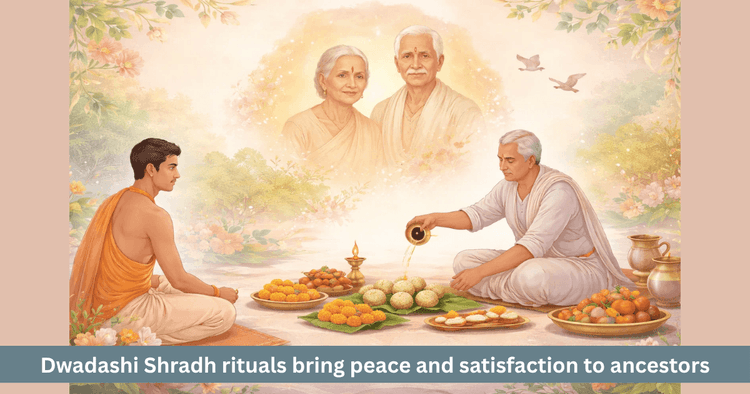
Table of Contents
Within Pitru Paksha, Dwadashi Shradh, also popularly known in many regions as Baras Shradh, is performed for those ancestors who departed on Dwadashi Tithi, meaning the twelfth lunar day. In the year 2026, Dwadashi Shradh will be observed on Wednesday, October 7, 2026. The importance of this day becomes even greater because Magha Nakshatra will also be present during Aparahna Kala on the same date. Among the accepted sacred timings for Shradh on this day are Kutup Muhurat approximately from 11:36 AM to 12:24 PM, Rohina Muhurat approximately from 12:24 PM to 1:12 PM and after that the wider Aparahna Kala, meaning the afternoon ritual period, is considered especially valid. It is within this span that tarpan, pinda daan and Brahmin bhojan are regarded as most appropriate.
What is Dwadashi Shradh
In Hindu ancestral tradition, every Shradh observance is linked to the lunar day on which a family member departed from this world. It is believed that the departed soul remains attuned to the subtle energy of that tithi. Because of this, Shradh performed on that same tithi creates a powerful alignment between the living and the departed, ensuring that tarpan, pinda daan and prayer reach the intended soul in the most effective manner.
Dwadashi Tithi is traditionally associated with Lord Vishnu. Ekadashi is regarded as the day of fasting dedicated to Vishnu and the following Dwadashi is understood as the day of completion through parana, offering and grace. For this reason, when a person passes away on Dwadashi Tithi, their Shradh on Dwadashi during Pitru Paksha is regarded not merely as a family duty but as an observance connected with the aspiration for moksha, meaning liberation.
Why is it called Baras Shradh
In many regions including Uttar Pradesh, Bihar and Madhya Pradesh, Dwadashi Shradh is commonly called Baras Shradh. Here the word Baras is used in the sense of the number twelve. This is a regional name but its religious meaning remains the same, the Shradh performed for those who departed on the twelfth lunar day.
Date and muhurat of Dwadashi Shradh 2026
In the year 2026, Pitru Paksha begins on Saturday, September 26 and continues until Saturday, October 10. Within this sacred period, Dwadashi Shradh falls on Wednesday, October 7, 2026. An additional point of importance is that Magha Nakshatra will also prevail during Aparahna Kala on this day, making it significant for two ancestral observances at once.
The timings can be viewed simply below:
| Details | Time |
|---|---|
| Date of Dwadashi Shradh | October 7, 2026, Wednesday |
| Kutup Muhurat | Approximately 11:36 AM to 12:24 PM |
| Rohina Muhurat | Approximately 12:24 PM to 1:12 PM |
| Main Shradh period | Aparahna Kala |
In Dwadashi Shradh, it is regarded as proper to complete the ritual within Aparahna Kala. If a family also needs to perform Magha Shradh on the same day, a qualified pandit may sequence both rites within the available time.
Who should perform Dwadashi Shradh
Dwadashi Shradh should be performed by any family whose ancestor departed on Dwadashi Tithi, whether that was Shukla Paksha Dwadashi or Krishna Paksha Dwadashi. If the family has preserved proper death records, a Panchang can confirm whether the departed person’s tithi was Dwadashi.
In addition, there are certain special categories for whom Dwadashi Shradh is also regarded as appropriate:
| For whom | Reason |
|---|---|
| Ancestors who died on Dwadashi Tithi | This is their designated tithi Shradh |
| Sanyasins | After renunciation they are regarded as beyond ordinary householder rules |
| Vrat nishtha individuals | Those who remained deeply committed to sacred vows |
| In some traditions, those who died on Ekadashi | If Ekadashi Shradh could not be performed, Dwadashi may serve as an alternate day |
Why does Dwadashi Shradh hold special importance for sanyasins
One special aspect of Dwadashi Shradh is that it is also regarded as the appropriate Shradh day for sanyasins, meaning renunciants. A person who has formally taken sanyasa diksha, meaning initiation into renunciation, is considered spiritually distinct from the ordinary householder order. Their Dwadashi Shradh is performed with the understanding that they had already moved beyond the usual social boundaries of family life and embraced the path of spiritual renunciation.
In a similar way, some traditions also include those who remained deeply dedicated to Ekadashi Dwadashi observance throughout life or those who passed away while maintaining a sacred vow.
Who is eligible to perform Dwadashi Shradh
Traditionally, the first responsibility belongs to the eldest son. Yet in his absence, other eligible persons may perform the rite. These include a grandson, daughter’s son, brother, brother’s son or another close relative. In modern Dharmashastra interpretations and in many present family traditions, a daughter is also recognized as an eligible performer, especially where no male heir is available.
If the death tithi of an ancestor is not known, then performing Shradh on Sarva Pitru Amavasya is considered more appropriate.
How is Dwadashi Shradh performed
The method of Dwadashi Shradh follows the standard Pitru Paksha sequence but its sankalpa is directed specifically toward the ancestor who departed on Dwadashi or toward the sanyasin being honoured.
Pre ritual purification
The day begins with bathing before sunrise or in the early morning hours. Clean white or light coloured clothing is worn. Attention is given to the purity of both body and mind. From the previous day onward, sattvic food, restraint and calm conduct are regarded as important.
Preparation of the ritual space
If the Shradh is performed at a riverbank or confluence, a clean place is chosen there. If it is performed at home, the ground or seat is purified and Kusha grass is spread. A copper or bronze vessel is kept ready with water. Ritual materials generally include black sesame seeds, barley, Kusha grass, flowers, incense and the prepared pindas.
Sankalpa
In the Sankalpa, meaning the sacred declaration of intent, the performer states their own name, the father’s name, gotra and the names of the ancestors for whom the Shradh is being performed. If the rite is being performed for a sanyasin, then the renunciant status is also specifically mentioned. This sankalpa directs the ritual toward the intended ancestor.
Pinda Daan
In Pinda Daan, meaning the offering of ritual food balls, pindas are usually prepared from cooked rice or barley. They are mixed with black sesame seeds, honey and ghee. Three pindas are usually considered the minimum, symbolizing the departed, their father and their grandfather. At a confluence or riverside, these pindas are offered with mantra recitation and then consigned to the sacred waters.
Tarpan
In Tarpan, meaning the offering of water, water is mixed with black sesame seeds, barley and Kusha grass and then offered through the right hand in a steady stream. With each offering, the name and gotra of the ancestor are recited. After pinda daan, the tarpan may be extended to paternal and maternal generations, especially for those ancestors whose exact tithi is not clearly known.
Brahmin Bhojan
Brahmin Bhojan, meaning feeding a worthy Brahmin, is regarded as essential for the completion of Dwadashi Shradh. At least one qualified Brahmin is offered a sattvic meal. Reverence, service and humility are central to this act. Tradition holds that in this ritual the Brahmin is honoured as a living representative of the ancestral realm. After the meal, dakshina is respectfully offered.
Panch Bali
Before the family partakes of food, portions are set aside for the cow, crow, dog, ants and other beings. Feeding the crow is regarded as especially auspicious because it is traditionally seen as a messenger of Pitru Loka, meaning the ancestral realm.
A special note for Sanyasi Shradh
If Dwadashi Shradh is being performed for a sanyasin, the sankalpa should clearly state that the departed had received sanyasa diksha. In some traditions, the food offerings are also adjusted according to the renunciant discipline of the deceased. For example, if they had personally given up certain foods, those should not be included in the offering. In such cases, some mantras may differ slightly from ordinary householder Shradh, which is why the guidance of a qualified pandit is considered best.
Scriptural significance of Dwadashi Shradh
The connection of Dwadashi Tithi with Lord Vishnu gives Dwadashi Shradh a distinctive tone among Pitru Paksha observances. In the Garuda Purana, one finds the idea that souls who departed on Vishnu related tithis may find their path toward liberation especially strengthened by Shradh on the corresponding day.
The Vishnu Purana tradition regards Dwadashi as a tithi in which Vishnu’s grace is especially accessible. For ancestors who lived with Vaishnava devotion or who departed on Dwadashi, Shradh on this day becomes both an act of gratitude and an act of spiritual nourishment.
In traditions such as the Dharmasindhu, Dwadashi is also considered especially appropriate for sanyasins. In one sense, this tithi represents the movement from tapas, meaning austerity, toward prasada, meaning grace. This symbolism aligns deeply with the spiritual completion associated with a renunciant’s life.
What should be done on Dwadashi Shradh day
| What should be done | Why it should be done |
|---|---|
| Perform the Shradh during Kutup or Rohina Muhurat | These are considered the most auspicious times within Aparahna |
| Use black sesame seeds in tarpan | They are regarded as essential in ancestral offerings |
| Clearly mention the Dwadashi or sanyasa connection in the sankalpa | It directs the offering with clarity |
| Prepare sattvic food | It preserves the ritual purity of the observance |
| Feed Brahmins, crows, cows and other beings | This is part of the completion of Shradh |
| If possible, perform tarpan at a river or sacred water body | Flowing water is regarded as more effective for the rite |
| Light a sesame oil lamp in the evening | It adds the feeling of offering light to the departed |
What should be avoided on Dwadashi Shradh day
| What should be avoided | Why it should be avoided |
|---|---|
| Do not consume onion, garlic, meat, fish or eggs | Sattvic purity is the basic rule of Shradh |
| Do not perform Shradh after sunset | The proper period of Shradh is accepted only until afternoon |
| Do not use iron vessels | Copper or bronze are considered more suitable |
| Do not display excessive grief or lose composure | The atmosphere should remain peaceful and restrained |
| Do not omit Brahmin Bhojan | Without it, the Shradh is regarded as incomplete |
Why is the 2026 combination of Dwadashi Shradh and Magha Nakshatra important
The day of October 7, 2026 is particularly noteworthy because on this date Dwadashi Shradh and Magha Nakshatra come together. Magha Nakshatra is itself associated with the Pitru Devas, meaning the ancestral divine beings. For this reason, the day becomes even more powerful for families who may need to perform both Dwadashi Shradh and Magha Shradh.
This is not merely a calendrical detail. It also deepens the spiritual gravity of the day. therefore on this date, special care should be taken regarding sankalpa, muhurat and the order of the ritual sequence.
The deeper message of Dwadashi Shradh
Dwadashi Shradh teaches that remembrance is not only the observance of a date. It is also a form of spiritual responsibility. For those who departed on this tithi or for those who lived their life in vow, renunciation and discipline, Shradh performed on Dwadashi also connects the family with a deeper humility.
This day also reminds us that ancestral rites are not only for the past. They bring balance to the present, reconnect the family to its roots and form a quiet foundation of blessing for the future.
FAQs
When is Dwadashi Shradh 2026
Dwadashi Shradh in the year 2026 will be observed on Wednesday, October 7.
What is Baras Shradh
Baras Shradh is the popular regional name for Dwadashi Shradh.
For whom is Dwadashi Shradh performed
It is performed for ancestors who died on Dwadashi Tithi, for sanyasins and in some traditions for those devoted to sacred vows.
Do Dwadashi Shradh and Magha Shradh fall on the same day in 2026
Yes, in the year 2026 both fall on October 7.
What should be done if the death tithi is not known
In that situation, Shradh on Sarva Pitru Amavasya is regarded as the appropriate choice.
Get your accurate Kundali
Generate KundaliDid you like it?
Author
Pt. Amitabh Sharma (56 Years)
Experience: 20
Consults About: Family Planning, Career
Clients In: Punjab, Haryana, Delhi
Share this article with friends and family
About ZODIAQ
ZODIAQ is an online Vedic Astrology platform. It connects clients seeking astrological advice to experienced astrologers with deep knowledge. Our users also generate kundali and perform kundali milan for free. ZODIAQ also offers services to the Astrologers. Astrologers utilize various offerings by ZODIAQ to serve their clients effectively.
If you are a User
Consult with experienced astrologers and seek their guidance. You can also order handwritten Janm Patrika report with life prediction prepared by experienced astrologers. Generate accurate Kundali, perform Kundali Matching and check horoscope and muhurat. Utilize our online library for all the necessary astrological and spiritual information.
If you are an Astrologer
Create accurate kundali for your clients and perform Kundali Matching for up to 5 people at a time. Write comprehensive Janm Patrika report for your clients with ZODIAQ. Check client details anytime by saving it in client directory. Become more productive by tracking how many clients you guide every day.
WELCOME TO
ZODIAQ
Right Decisions at the right time with ZODIAQ
