Dwitiya Shradh 2026: Date, Significance and Complete Rituals
By Pt. Sanjeev Sharma
Importance of Dwitiya Shradh, Date, and Pinda Daan Rituals
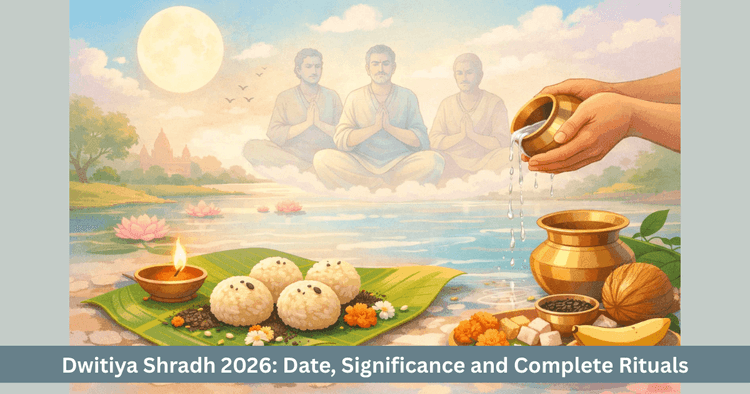
Table of Contents
Dwitiya Shradh 2026 is the second day of Pitru Paksha and is especially dedicated to remembering those male ancestors who acted as protectors and pillars of the family. On this day Shradh, Tarpan and Pind daan are performed for all forefathers who passed away on any Dwitiya tithi in any month. In 2026 Dwitiya Shradh will be observed on Monday 28 September 2026 and because it falls on a Monday, the day of Chandra, its spiritual influence for ancestral rites becomes even more pronounced.
Ashwina Krishna Dwitiya is regarded as the second day of the Pitru fortnight. In 2026 this Dwitiya tithi coincides with Monday, the day ruled by the Moon, which in Vedic astrology is considered a key significator for Pitru Loka, the ancestral realm. For North India the approximate auspicious periods are as follows. The Kutup muhurat is from about 11:44 AM to 12:31 PM, Rohina muhurat from 12:31 PM to 1:17 PM and the Aparahna kala from 1:17 PM to 3:36 PM. Morning hours are well suited for bathing, purification and preparation, while the central acts of Tarpan, Pind daan and Brahmin feeding gain full fruit when performed in these afternoon windows.
What is Dwitiya Shradh
Dwitiya is the second lunar day of each fortnight. The Dwitiya Shradh of Pitru Paksha is offered for all ancestors who left the body on either Shukla Dwitiya or Krishna Dwitiya of any month. In popular speech it is often called Dooj Shradh, a name that echoes the Kartika festival of Bhai Dooj, which also celebrates a sacred bond on Dwitiya tithi.
From the Vedic perspective Dwitiya carries a strong association with relationships and protection. Texts such as Matsya Purana suggest that Dwitiya Shradh is especially fruitful for ancestors who were elder brothers, paternal uncles or guardians of the family and who left a strong protective energy behind. Those who died young or in the prime of life and longed to see the family prosper are also regarded as particularly benefited by Shradh on this day.
Dwitiya Shradh 2026: date and muhurat
The main timings of Dwitiya Shradh 2026 can be viewed together for clarity.
| Detail | Date and time |
|---|---|
| Second day of Pitru Paksha | Monday, 28 September 2026 |
| Lunar tithi | Ashwina Krishna Dwitiya |
| Suitable Shradh date | 28 September 2026 |
| Kutup muhurat | Approximately 11:44 AM to 12:31 PM |
| Rohina muhurat | Approximately 12:31 PM to 1:17 PM |
| Aparahna kala | Approximately 1:17 PM to 3:36 PM |
Dwitiya tithi comes into effect after Pratipada ends on the morning of 28 September and continues through the afternoon, which is why this date is prescribed for Shradh within the Aparahna period. Monday as the weekday adds further auspiciousness, because the gentle and sensitive nature of the Moon supports the inner work of remembering and honouring the ancestors.
For whom is Dwitiya Shradh especially performed
According to traditional guidelines Dwitiya Shradh holds special importance for certain categories of ancestors and situations.
- Ancestors who passed away on a Dwitiya tithi, whether in Shukla or Krishna Paksha.
- Elder brothers, paternal uncles and other male relatives who acted as guardians and protectors of the family.
- Forefathers who died in youth or middle age.
- Step relatives such as step parents, half siblings or adopted members with whom there was a meaningful bond.
- Families where several male ancestors such as grandfathers, great uncles and elder brothers have passed away and a collective remembrance is desired.
In families where Pitru Paksha Shradh is being arranged for the first time and exact tithis for some ancestors are not known, a knowledgeable priest may guide the family to treat Dwitiya Shradh as a broader remembrance day for the brotherly and collateral line of the clan.
Morning preparations for Dwitiya Shradh
From the beginning of the day the effort is to keep the atmosphere sattvic and calm.
- The performer rises before or around sunrise and bathes.
- Where possible a few drops of Ganga jal are added to the bathwater.
- Clean white or light coloured clothing is worn.
- The home or ritual place is swept and sprinkled with Ganga jal or water mixed with cow products for purification.
A small altar is arranged in the home or at the chosen site with a sacred seat, photograph or symbolic item for the ancestor being remembered. In the kitchen preparations begin using rice, lentils, urad dal, sesame, ghee, jaggery and seasonal vegetables, all kept strictly sattvic for the day.
Sankalpa on Dwitiya Shradh
The heart of the Shradh is the sankalpa, the conscious vow that sets the direction of the rite. On Dwitiya Shradh the sankalpa explicitly includes the fraternal and protective male ancestors of the family.
During the sankalpa
- The performer states name, gotra, residence and date.
- The names, relationships and, if known, death tithis of the ancestors are pronounced.
- A clear intention is expressed that this Dwitiya Shradh is being offered for the peace of elder brothers, uncles and male relatives who supported the family and for the upliftment of the entire lineage.
In this way the sankalpa itself becomes a concise lineage map placed before the sacred fire and the ancestral realm.
Tarpan procedure on Dwitiya Shradh
Shradh is incomplete without Tarpan, the offering of water. When performed at a sacred river or confluence its merit is enhanced, though it may also be done reverently at home.
- Water is mixed with black sesame and kusa grass.
- Using the right hand, water is poured out in controlled streams while remembering forefathers by name.
- In the Dwitiya sequence particular attention is given to elder brothers, uncles and young male ancestors, who are invoked separately in addition to the main paternal line.
With each libation a prayer for satisfaction and peace is offered, trusting that the mixture of water, sesame and heartfelt remembrance reaches the ancestors as a subtle nourishment.
Pind daan features on Dwitiya Shradh
A distinguishing feature of Dwitiya Shradh is the frequent use of multiple pindas. Each pinda may be dedicated to one specific ancestor.
- Pindas are prepared from cooked rice, barley flour, black sesame, ghee and honey.
- As many pindas are formed as there are ancestors to be individually remembered.
- Each pinda is taken in the hands while reciting the name, gotra and relationship of the ancestor, then placed respectfully on a kusa spread.
When the name or tithi of a particular forefather is not known, a combined pinda may be offered for all such unknown souls. Wherever details are known, however separate pindas help focus the remembrance and are considered especially proper on this day. Through these offerings the protective and brotherly ancestors are honoured in a direct and personal way.
Brahmin bhoj and daan on Dwitiya Shradh
After Shradh offerings comes the important act of Brahmin feeding. On Dwitiya Shradh the meal typically includes
- Rice, dal and seasonal vegetables.
- A preparation made from urad dal.
- Kheer or another sweet dish.
- Roti or puri.
In many traditions urad dal is mentioned as particularly pleasing to those who departed on Dwitiya tithi. Brahmins are seated with respect and served with humility and their blessings are accepted at the end of the meal.
This is followed by daan, where grains, sesame, jaggery and according to means, clothes or other useful items are gifted. If the ancestor being remembered had a specific profession or study, a symbolic gift related to that field, such as books for a scholar or seeds for a farmer, creates a very touching and meaningful remembrance.
Conduct guidelines for Dwitiya Shradh
The day of Shradh is shaped as much by behaviour as by formal rites, so certain guidelines are followed.
Practices to follow
- Maintain gentle speech and a composed mind throughout the day.
- Offer water to a Peepal tree if possible, as this tree is traditionally linked with Pitru energies.
- After Shradh, seek the blessings of elderly family members, seeing their grace as a reflection of ancestral blessings.
- Light two lamps, one for the direct lineage and one for the collateral line of brothers and extended family.
Things to avoid
- Performing the rites in haste, since Dwitiya Shradh often involves multiple pindas and a detailed sankalpa.
- Creating or escalating conflicts, loud arguments or harsh speech that disturb the subtle atmosphere.
- Eating before a crow has been offered food, because the acceptance of food by a crow is considered a sign of Pitru satisfaction.
- Starting new disputes, legal actions or contentious matters within the family on this day.
These disciplines are intended to keep the mind and home aligned with the spirit of gratitude and reconciliation that Dwitiya Shradh embodies.
Spiritual benefits of Dwitiya Shradh
When a family performs Dwitiya Shradh with sincerity they do more than complete an annual duty. They consciously reconnect with those ancestors who stood as elder brothers, guides and shields in earlier generations.
Souls who passed in youth or middle age and who carried a strong emotional bond to the family receive reassurance that they have not been forgotten. This often reflects in the subtle easing of long standing tensions, inexplicable fears or repetitive obstacles within the household.
Dwitiya Shradh silently teaches each generation that gratitude is owed not only to parents and grandparents but also to all who guarded and strengthened the family line. Over time this awareness becomes a source of inner stability, shaping a family culture of mutual care and remembrance.
Common questions about Dwitiya Shradh 2026
On which date and weekday will Dwitiya Shradh be observed in 2026?
Dwitiya Shradh 2026 will be observed on Monday 28 September and will mark the second day of Pitru Paksha.
For which ancestors is Dwitiya Shradh particularly recommended?
It is especially meant for ancestors who passed on a Dwitiya tithi, for elder brothers, paternal uncles and other protective male relatives and for forefathers who died young.
Can multiple pindas be offered on Dwitiya Shradh?
Yes. It is good to prepare a separate pinda for each ancestor when names and relationships are known. A combined pinda is used only when details are completely unknown.
What is the main time window for performing Dwitiya Shradh?
The primary window is during Kutup and Rohina muhurats and within the broader Aparahna kala when Tarpan, Pind daan and Brahmin feeding are best performed.
If visiting a tirtha is not possible, can Dwitiya Shradh be done at home?
Yes. One may perform bathing, sankalpa, Tarpan, Pind daan and Brahmin bhoj at home or near a clean local water body, relying on sincere intention as the true strength of Dwitiya Shradh.
Get your accurate Kundali
Generate KundaliDid you like it?
Author
Pt. Sanjeev Sharma (63)
Experience: 20
Consults About: Family Planning, Career
Clients In: Punjab, Haryana, Delhi
Share this article with friends and family
About ZODIAQ
ZODIAQ is an online Vedic Astrology platform. It connects clients seeking astrological advice to experienced astrologers with deep knowledge. Our users also generate kundali and perform kundali milan for free. ZODIAQ also offers services to the Astrologers. Astrologers utilize various offerings by ZODIAQ to serve their clients effectively.
If you are a User
Consult with experienced astrologers and seek their guidance. You can also order handwritten Janm Patrika report with life prediction prepared by experienced astrologers. Generate accurate Kundali, perform Kundali Matching and check horoscope and muhurat. Utilize our online library for all the necessary astrological and spiritual information.
If you are an Astrologer
Create accurate kundali for your clients and perform Kundali Matching for up to 5 people at a time. Write comprehensive Janm Patrika report for your clients with ZODIAQ. Check client details anytime by saving it in client directory. Become more productive by tracking how many clients you guide every day.
WELCOME TO
ZODIAQ
Right Decisions at the right time with ZODIAQ
