Jyeshtha Purnima 2026: Sacred Bath, Vat Puja and Blessings for Married Life
By Pt. Sanjeev Sharma
Jyeshtha Purnima 2026 offers spiritual benefits for married life, family prosperity, and protection through banyan tree and Vishnu worship
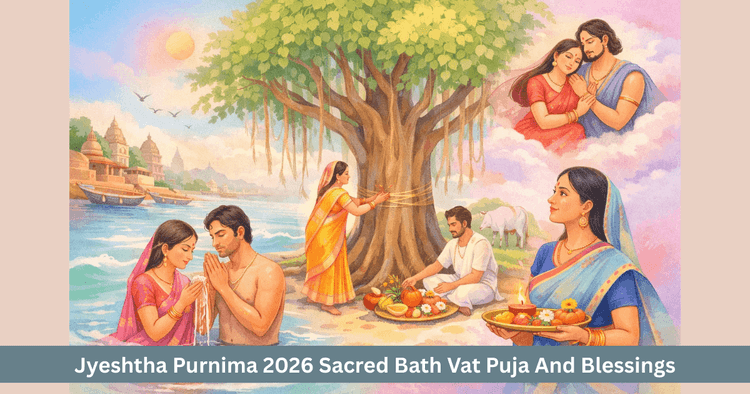
Table of Contents
Jyeshtha Purnima 2026 brings a special opportunity to strengthen family life through sacred bath, vrat and worship of the banyan tree and Lord Vishnu on the full moon of the Jyeshtha month. In the intense heat of summer, this festival is seen as a day of cooling grace, when the remembrance of Ganga’s descent, the steadfast love of Savitri for Satyavan and the vows taken by married women for the long life of their husbands all come together. When the date, puja muhurta and rituals of Jyeshtha Purnima 2026 are understood clearly and followed with sincerity, this day can become a foundation of protection and prosperity for the whole year.
Date Tithi And Puja Muhurta For Jyeshtha Purnima 2026
In the traditional calendar, Jyeshtha is counted as the third month of the year and usually falls in the peak summer period of May and June. When the Sun is placed in Vrishabha, the month of Jyeshtha unfolds its full influence and the full moon during this period is known as Jyeshtha Purnima. In 2026 this festival will be observed in the last week of June.
The main date and timing details for Jyeshtha Purnima 2026 are as follows
Jyeshtha Purnima 2026 date
Monday 29 June 2026
Beginning of Purnima tithi
29 June 2026
03 06 AM
End of Purnima tithi
30 June 2026
05 26 AM
For worship, both morning and evening are considered favourable. According to general tradition
- In the morning, the time from sunrise until about 10 00 AM is especially suitable for bathing, taking the vrat and performing the main puja.
- In the evening, the Pradosh Kaal, that is the period just before and after sunset, is recommended for listening to the vrat katha and renewing one’s sankalpa.
The key timings of Jyeshtha Purnima 2026 can be summarised in this table.
| Detail | Date and time |
|---|---|
| Jyeshtha Purnima date | Monday 29 June 2026 |
| Purnima tithi begins | 29 June 2026 03 06 AM |
| Purnima tithi ends | 30 June 2026 05 26 AM |
| Best time for puja | Morning before about 10 00 AM or evening during Pradosh Kaal |
What Is Jyeshtha Purnima And What Is The Inner Meaning Of Jyeshtha
The word Jyeshtha means senior most, foremost and ancient. In Indian thought, the month of Jyeshtha is seen as a period of intense heat, calling for patience, endurance and inner steadiness. The full moon of this month, Jyeshtha Purnima, is therefore treated as a time to cool and purify the inner life through devotion and restraint.
On Jyeshtha Purnima, Lord Vishnu is specially worshipped. In the ancient hymn Vishnu Sahasranama Stotram, one of the verses describes Lord Vishnu as Jyeshtha Shreshtha Prajapita, meaning the greatest, the best and the progenitor of all beings. Because of this connection, worship of Vishnu on this full moon is held in high regard and the day is known as Jyeshtha Purnima.
From an astrological perspective this period brings together the strong presence of the Sun with the fullness of the Moon. Practices of fasting, bathing and prayer help to maintain emotional balance and mental calm when such forces are at their peak.
Historical And Traditional Background Of Jyeshtha Purnima
Several inspiring narratives and traditions are associated with Jyeshtha Purnima, which deepen the meaning of the day. Two of the most prominent are remembered frequently.
The Blessed Marriage Story Of Savitri And Satyavan
Jyeshtha Purnima is closely linked with Savitri, who is honoured as an ideal of purity, courage and devoted married life.
According to the traditional account, Savitri chose Satyavan as her husband despite knowing that his life would be short. She married him with full awareness and with unwavering faith in dharma and in the power of devotion. When the destined time came, Yama, the Lord of death, arrived to claim Satyavan’s life.
The story narrates that Savitri followed Yama for three days, walking behind him and engaging in humble yet wise conversation. She prayed, reasoned and appealed not only for her husband’s life but also for the upholding of righteousness. Moved by her steadfast devotion and understanding, Yama finally granted Satyavan’s life back to her.
In remembrance of this, Jyeshtha Purnima is a day when Savitri, Satyavan, Yama, Brahma and Narada are worshipped. Savitri is seen as a guiding presence for married women, who listen to her story and keep a vrat on this day seeking long life and harmony in their marriage.
Ganga’s Descent And The Holiness Of The Jyeshtha Month
The month of Jyeshtha is also linked with the descent of the sacred river Ganga to Earth, brought about through the sustained efforts of King Bhagiratha. The coming of Ganga symbolises the lessening of sins, the upliftment of ancestors and the purification of the Earth.
For this reason Jyeshtha and especially Jyeshtha Purnima are considered very suitable for bathing in the Ganga or in other holy rivers. Those who bathe on this day, with prayers for their ancestors and for the welfare of their families, are believed to receive blessings of peace, prosperity and spiritual upliftment.
Why Is Jyeshtha Purnima Also Called Dev Snan Purnima And Vat Purnima
Jyeshtha Purnima is known by several names in different regions and traditions.
- When the emphasis is on ceremonial bathing and anointing of deities, the day is called Dev Snan Purnima. On this day images of deities are bathed and honoured with water, milk or sacred river water, offering them symbolic coolness and respect.
- In some regions, especially in Maharashtra and certain western parts of India, this day is observed as Vat Purnima, when married women keep the Savitri vrat and worship the banyan tree or vat vriksha.
- In many places it is also simply referred to as Pournima or Pournami, the local names for the full moon.
All these names carry one central message. Jyeshtha Purnima honours divine energies, sacred rivers and the life giving power of the banyan tree as sources of longevity, protection and prosperity.
Vrat And Vat Puja Vidhi On Jyeshtha Purnima 2026
On Jyeshtha Purnima, married women primarily observe a vrat for their husband’s long life, for the peace of the home and for the welfare of their children. Worship of the banyan tree along with the Savitri Satyavan katha forms the heart of the observance.
How To Begin The Day
- It is auspicious to rise before or around sunrise on this day.
- After completing daily cleansing, bathing in a holy river, especially the Ganga, is considered highly meritorious. If this is not possible, one can bathe at home with remembrance of the Ganga and a pure intention.
- After bathing, married women wear clean clothes and, where possible, the attire and ornaments associated with their marriage, including sindoor, bangles, toe rings and mangalsutra as symbols of marital auspiciousness.
They then take a sankalpa to observe the vrat with discipline and devotion for the wellbeing of their husband and family.
Method Of Worshipping The Banyan Tree
The central ritual of Jyeshtha Purnima in many regions is the worship of the banyan tree or vat vriksha. This tree is viewed as a symbol of Brahma, Vishnu and Mahesh together.
The general steps of worship are as follows
- Near the tree, a clean space is prepared and a thali is arranged with water, rice, flowers, roli, turmeric, sandalwood and offerings of food.
- The trunk of the tree is anointed with sandalwood paste and turmeric and a mark of vermilion is applied.
- Women circumambulate the tree and during each circumambulation they gently wind a cotton thread or sacred string around the trunk. This thread represents the bond of marriage and the wish for long lasting protection.
- During the puja, Savitri, Brahma, Vishnu, Mahesh, Yama, Narada and Satyavan are remembered and offerings are made in their names.
In some traditions the worship continues for three consecutive days, which is believed to make the fruits of the vrat even more stable and enduring.
The Devotional Reading Of Savitri Satyavan Vrat Katha
A central part of the observance is listening to or reciting the Savitri Satyavan vrat katha.
Through this story, several inner lessons are highlighted
- Savitri does not act only for her husband’s life but also for upholding dharma and truth.
- She maintains composure, humility and clarity of thought even when speaking with Yama, the Lord of death, over three days.
- Yama’s final decision to restore Satyavan’s life shows that when love, righteousness and firm resolve stand together, even severe limitations can be softened.
As the story is heard, women are encouraged to nourish the same qualities of patience, loyalty and inner strength within their own lives and relationships.
Special Disciplines For Married Women On Jyeshtha Purnima 2026
For married women observing the vrat on Jyeshtha Purnima 2026, certain disciplines are given particular emphasis.
- Maintaining a sattvic state of mind, avoiding harsh words, quarrels and negative thinking throughout the day.
- Controlling food intake, with many traditions encouraging fasting or taking only simple fruit based or single sattvic meal during the day.
- Dressing fully in symbols of marital status at the time of puja, to honour the blessings of married life and to reinforce gratitude for the relationship.
In some local customs, a small portion of the banyan tree root is taken as a symbolic intake of strength and longevity. Such practices should always be followed only under proper guidance and in line with local tradition.
Importance Of Bathing Charity And Japa On Jyeshtha Purnima 2026
The observance of Jyeshtha Purnima extends beyond the puja at the banyan tree. It is also a day of sacred bathing, charity and mantra practice.
- Bathing in holy rivers, especially the Ganga, is believed to bring purification of past actions, peace of mind and blessings for ancestors.
- Charity in the form of water, food, clothing and shade giving items, such as umbrellas or plants, is highly recommended on this day.
- Setting aside time for japa and quiet meditation helps to ensure that the vrat transforms inner tendencies and not only outward behaviour.
Devotees often use this day to place specific prayers before the Divine, such as for family harmony, the wellbeing of children, health or mental peace, while remembering that these desires are best fulfilled when aligned with dharma.
Spiritual And Family Benefits Of Jyeshtha Purnima 2026
When Jyeshtha Purnima 2026 is observed with mindful devotion, it can bring many beneficial influences into life.
- It is believed that married women who worship on this day receive blessings for the long life of their husbands, stability in the home and sweetness in marital relationships.
- Bathing in holy waters can ease the burden of past karma, lighten the heart and increase inner clarity.
- The Savitri katha strengthens the values of loyalty, sacrifice and mutual respect within the family, serving as a quiet guide for everyday decisions.
- Through the vrat, energies of wealth, health and emotional balance are invited into the household, touching not only the couple but all family members.
Above all, the day becomes a reminder to honour feminine strength, the sanctity of the Earth and the life giving blessing of water, thereby deepening gratitude for the visible and invisible supports of life.
Common Questions About Jyeshtha Purnima 2026
On which day will Jyeshtha Purnima 2026 fall and what are its tithi timings
Jyeshtha Purnima 2026 will be observed on Monday 29 June 2026. The Purnima tithi begins at 03 06 AM on 29 June and ends at 05 26 AM on 30 June. The morning before about 10 00 AM and the evening Pradosh Kaal are especially suitable for performing the main puja.
Which deities are worshipped on this day
On Jyeshtha Purnima, Lord Vishnu is worshipped as the central deity. Along with Him, Savitri, Satyavan, Yama, Brahma and Narada are remembered. In regions where the day is observed as Vat Purnima, the banyan tree is worshipped as a symbol of the trinity of Brahma, Vishnu and Mahesh.
Why is it important to listen to the Savitri Satyavan story
The story of Savitri and Satyavan offers a living example of courageous devotion, dharma and marital love. Listening to and reflecting on this narrative helps married women strengthen patience, dedication and constructive thought, which in turn supports harmony and resilience within family life.
Must every woman worship at a banyan tree on this day
Where a banyan tree is accessible, worship is ideally done at the tree itself. When this is not possible, a picture, branch or symbolic representation of the banyan may be respectfully placed at home or in a temple and the puja can be performed there. The essential point is the sincerity of the heart, not the outer grandeur of the place.
How can Jyeshtha Purnima 2026 be made practically meaningful in daily life
To make this day truly fruitful, one can combine the formal vrat with small but steady resolutions, such as improving communication and respect in marriage, setting aside regular funds or time for charity, committing to protect trees and water sources or fixing a daily period for japa and quiet reflection. In this way, Jyeshtha Purnima 2026 becomes not only a festival but a guiding influence towards balance and harmony throughout the year.
Get your accurate Kundali
Generate KundaliDid you like it?
Author

Pt. Sanjeev Sharma (63)
Experience: 20
Consults About: Family Planning, Career
Clients In: Punjab, Haryana, Delhi
Share this article with friends and family
About ZODIAQ
ZODIAQ is an online Vedic Astrology platform. It connects clients seeking astrological advice to experienced astrologers with deep knowledge. Our users also generate kundali and perform kundali milan for free. ZODIAQ also offers services to the Astrologers. Astrologers utilize various offerings by ZODIAQ to serve their clients effectively.
If you are a User
Consult with experienced astrologers and seek their guidance. You can also order handwritten Janm Patrika report with life prediction prepared by experienced astrologers. Generate accurate Kundali, perform Kundali Matching and check horoscope and muhurat. Utilize our online library for all the necessary astrological and spiritual information.
If you are an Astrologer
Create accurate kundali for your clients and perform Kundali Matching for up to 5 people at a time. Write comprehensive Janm Patrika report for your clients with ZODIAQ. Check client details anytime by saving it in client directory. Become more productive by tracking how many clients you guide every day.
WELCOME TO
ZODIAQ
Right Decisions at the right time with ZODIAQ
