Karka Sankranti 2026: Date, Muhurat, Significance, Puja Method and Fast Rules
By Pt. Suvrat Sharma
Sun’s Entry into Cancer and Its Religious Significance
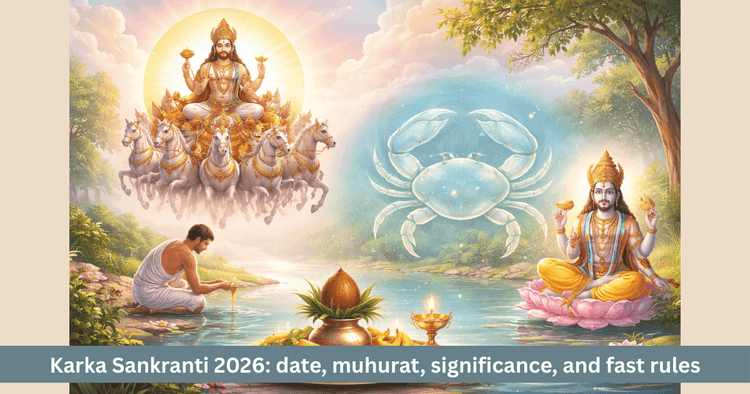
Table of Contents
Karka Sankranti in 2026 will be observed on Thursday, 16 July 2026. On this day Surya Deva moves from Mithuna Rashi to Karka Rashi and from this point the six month period of Dakshinayana is considered to begin. Karka Sankranti is especially important for meritorious acts such as holy bath, charity, pitru tarpan, worship of the Sun and devotion to Lord Vishnu, so understanding the main muhurta and punya period of this day becomes very important.
Karka Sankranti 2026: date and special punya kal timings
On the day of Karka Sankranti the transit of the Sun is not only an astronomical shift but also a deeply auspicious moment from the religious point of view. Acts of bath, charity and worship performed especially during Punya Kaal and Mahapunya Kaal are believed to give quick and multiplied results.
| Karka Sankranti 2026 details | Date and time |
|---|---|
| Karka Sankranti date | Thursday, 16 July 2026 |
| Karka Sankranti Punya Kaal | 12:37 in the afternoon to 07:15 in the evening |
| Karka Sankranti Mahapunya Kaal | 05:15 in the evening to 07:15 in the evening |
Snan, daan, japa, pitru tarpan and offering of arghya to the Sun during these intervals are regarded as more fruitful than on ordinary days. In particular, giving of grains, clothes, sesame and oil during Mahapunya Kaal is looked upon as very auspicious.
What is Karka Sankranti and what is its core meaning
The word Sankranti refers to the movement of the Sun from one zodiac sign to another. When Surya Deva enters Karka Rashi this moment is called Karka Sankranti. From this time his journey of Dakshinayana is taken to begin and is also described as the start of the night time for the devas.
Karka Sankranti is seen as a counterpart to Makar Sankranti. Makar Sankranti marks the start of Uttarayana, while Karka Sankranti marks the beginning of Dakshinayana. The six months of Dakshinayana are considered more favourable for the worship of Lord Vishnu and for rites related to ancestors.
Tradition holds that during this period the devas remain in a more restful state and the presence of pitru energies around the earth becomes stronger. Because of this, the four months from Shravan onwards are also known as Chaturmas, a time in which devotion, vows and restraint receive more emphasis.
Religious and astrological importance of Karka Sankranti
Beginning of Dakshinayana and Devashayana
With Karka Sankranti the Dakshinayana journey of the Sun starts. Around this time the observance of Devshayani Ekadashi also takes place and from that day Lord Vishnu is said to enter a state of yoganidra for four months.
During these four months it is customary to reduce large auspicious events like weddings or grand housewarmings and to give more space to japa, fasting, daan and other forms of bhakti. At the same time, worship and remembrance of Lord Vishnu and Surya during this phase are held to be particularly beneficial.
Monsoon season and agricultural activity
Karka Sankranti also signals the arrival of the monsoon and the active phase of agricultural work. For countless families in India agriculture forms the backbone of income and survival. At this time the fertility of the earth rises, the water element increases and farmers turn towards sowing, planning and nurturing their crops.
Because of this, in many regions worship and charity connected with fields, water bodies and nature are performed around the time of Karka Sankranti as an expression of gratitude.
Karka Sankranti from the astrological viewpoint
Astrology explains that when the Sun moves into Makara Rashi the fire element becomes stronger and the days lengthen. In contrast, when the Sun enters Karka Rashi on Karka Sankranti the water element becomes more dominant.
The predominance of water increases sensitivity, emotional intensity and moisture in the environment. It is believed that negative or asuric tendencies can also become more active in such conditions, which is why many traditions advise avoiding the start of very big or celebratory ventures for four months after Karka Sankranti and instead recommend focusing on japa, meditation, charity and humble service.
Why are Surya and Vishnu worshipped on Karka Sankranti
On Karka Sankranti the combined worship of Surya Deva and Lord Vishnu is emphasised. Surya is seen as the giver of life force, health and visible light. Lord Vishnu is seen as the preserver who brings balance and protection.
By keeping a fast, offering arghya to the Sun and worshipping Vishnu on this day, a devotee invokes light, health and stability in life. Along with pitru tarpan this combined worship is thought to invite both divine and ancestral grace into the home.
Karka Sankranti puja vidhi: how to perform the worship
The method of worship on Karka Sankranti is simple yet filled with meaning. The main spirit is purification, charity, remembrance and inner humility.
Morning bath and preparation
It is advisable to rise early on Karka Sankranti, complete all cleansing routines and wear clean clothes. Ideally one should bathe in a sacred river, pond or reservoir if this is practically possible, though a home bath done with sincere intention is also acceptable.
After bathing, one faces the east and offers arghya to Surya with clean water, sometimes mixed with Ganga water, sesame seeds or flowers. While offering arghya it is beneficial to recite Surya mantras or verses from Aditya Hridaya Stotra.
Surya mantra and recitation of Vishnu Sahasranama
After giving arghya, a devotee may chant a simple Sun mantra such as “Om Ghrini Suryaya Namah”. This supports inner clarity, confidence and vitality.
Next, at the home altar, Lord Vishnu is worshipped. A lamp is lit, incense and flowers are offered and tulsi leaves are placed at his feet. Recitation of Vishnu Sahasranama or at least a portion of it is regarded as a powerful way to invite peace and good fortune.
Charity, service and pitru tarpan
Karka Sankranti is particularly praised as a day for charity and service. The tradition encourages giving of food, clothes, sesame, oil, useful utensils, footwear and other necessities to Brahmins and to the poor and needy. Such acts are believed to yield quick and multiplied merit.
Many people also perform pitru tarpan on this day. Using water and sesame, they remember their ancestors and offer prayers for their peace. Dakshinayana is regarded as a time when the link with pitru loka becomes stronger, so rituals performed around Karka Sankranti are seen as especially effective.
Caution regarding new ventures
A widely held belief regarding Karka Sankranti is that very large new undertakings or major auspicious beginnings are better avoided on this day and in the immediate period that follows. The time is seen more as one for inwardness, austerity, japa and charity than for outward expansion.
At the same time ordinary responsibilities of work, profession and family life continue as usual. The emphasis is simply on avoiding needless display, extravagance and decisions driven by pride and to move forward with greater restraint.
Importance of Karka Sankranti Punya Kaal
On Karka Sankranti Punya Kaal and Mahapunya Kaal are chosen for focused acts of merit. Charity done in these windows is not only a material help to others but also a subtle way of lightening one’s own karmic weight and emotional burdens.
During Punya Kaal, feeding the poor, offering grains, supporting cows, feeding birds, helping the sick and contributing to dharmic institutions are all considered very auspicious. If a devotee uses this interval to give up some harmful habit or pattern and takes a sincere vow, this is also viewed as a powerful step on the spiritual path.
Karka Sankranti, Dakshinayana and the way of sadhana
The four months of Dakshinayana that many traditions call Chaturmas are treated as a deep period for sadhana. Karka Sankranti is like the doorway to this season, inviting a person to adopt a more disciplined, introspective and sattvic way of living.
Those who link this phase with regular japa, meditation, scriptural study, purity in food, charity and service often experience new steadiness, gentleness and inner peace. Karka Sankranti thus becomes a clear reminder that now the emphasis should move from outer expansion to inner strengthening.
Frequently asked questions
What is the main significance of Karka Sankranti
Karka Sankranti marks the entry of the Sun into Cancer and the start of Dakshinayana. From this time greater focus is placed on Devashayana, pitru rites, charity, worship of Vishnu and a more restrained lifestyle.
What will be the Punya Kaal for Karka Sankranti 2026
For Karka Sankranti in 2026 Punya Kaal will be from 12:37 in the afternoon to 07:15 in the evening and Mahapunya Kaal will be from 05:15 to 07:15 in the evening.
Is fasting compulsory on Karka Sankranti
Fasting is not compulsory, though those whose health and circumstances allow can observe light fasting, fruit based diet or strictly sattvic food along with japa, daan and worship to gain greater benefit from the day.
Does one have to avoid all auspicious activities for four months after Karka Sankranti
All activities need not be stopped. Major functions like weddings and large celebrations are often postponed, yet daily duties of job, business and family continue. The key is to increase devotion and restraint rather than completely withdraw from life.
Which deities should be specially worshipped on Karka Sankranti
Offering arghya to Surya and worship of Lord Vishnu with recitation of Vishnu Sahasranama, along with pitru tarpan and charity, are considered the most important practices of this day. Through this a devotee invites both divine support and ancestral blessings.
Get your accurate Kundali
Generate KundaliDid you like it?
Author
Pt. Suvrat Sharma (63)
Experience: 20
Consults About: Family Planning, Career
Clients In: Punjab, Haryana, Delhi
Share this article with friends and family
About ZODIAQ
ZODIAQ is an online Vedic Astrology platform. It connects clients seeking astrological advice to experienced astrologers with deep knowledge. Our users also generate kundali and perform kundali milan for free. ZODIAQ also offers services to the Astrologers. Astrologers utilize various offerings by ZODIAQ to serve their clients effectively.
If you are a User
Consult with experienced astrologers and seek their guidance. You can also order handwritten Janm Patrika report with life prediction prepared by experienced astrologers. Generate accurate Kundali, perform Kundali Matching and check horoscope and muhurat. Utilize our online library for all the necessary astrological and spiritual information.
If you are an Astrologer
Create accurate kundali for your clients and perform Kundali Matching for up to 5 people at a time. Write comprehensive Janm Patrika report for your clients with ZODIAQ. Check client details anytime by saving it in client directory. Become more productive by tracking how many clients you guide every day.
WELCOME TO
ZODIAQ
Right Decisions at the right time with ZODIAQ
