Magha Shradh 2026: Date, Nakshatra Significance and Ritual Method
By Pt. Abhishek Sharma
Special Shradh performed during Magha Nakshatra in Pitru Paksha
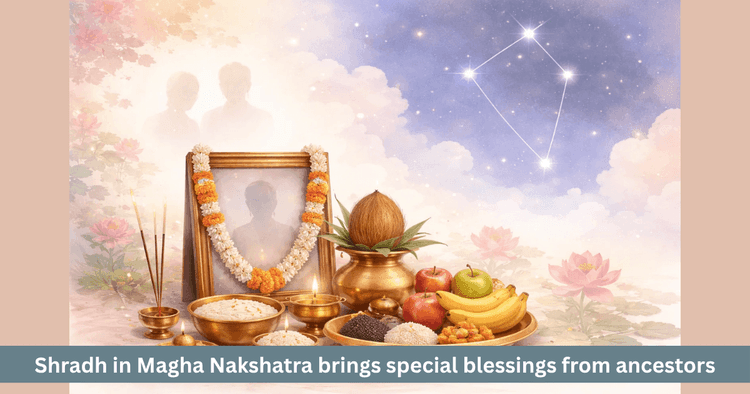
Table of Contents
Within Pitru Paksha, Magha Shradh is regarded as a uniquely special observance because it is not determined only by tithi but by nakshatra, meaning the lunar mansion. In the year 2026, Magha Shradh will be observed on Wednesday, October 7, 2026. On the same day, Dwadashi Shradh will also occur, which makes this date even more significant within the Pitru Paksha fortnight. The main rule of Magha Shradh is that when Magha Nakshatra prevails during Aparahna Kala, meaning the afternoon sacred period, within Pitru Paksha, then Shradh is performed for those ancestors who departed under Magha Nakshatra. The important auspicious periods on this day include Kutup Muhurat approximately from 11:36 AM to 12:24 PM, Rohina Muhurat approximately from 12:24 PM to 1:12 PM and after that the Aparahna period is especially accepted for the rite.
What is Magha Shradh and why is it so different
The Hindu system of sacred time rests on two major foundations, one is tithi, meaning the lunar day and the other is nakshatra, meaning the lunar mansion. Most Shradh observances in Pitru Paksha, such as Pratipada, Dwitiya, Saptami or Dashami Shradh, are performed according to tithi. In contrast, Magha Shradh is among those rare ancestral observances that are nakshatra based.
If an ancestor departed at a time when Magha Nakshatra was active, then during Pitru Paksha their Shradh is performed on the day when Magha Nakshatra again prevails during Aparahna Kala. In this way, Magha Shradh is not only a day of remembrance but also an opportunity to restore that subtle cosmic relationship under whose influence the soul left this world.
What is the connection of Magha Nakshatra with the ancestors
Magha Nakshatra is regarded as the tenth nakshatra among the 27 nakshatras. It is situated in the early degrees of Simha Rashi, meaning Leo. In Sanskrit, Magha conveys the meaning of greatness, dignity and powerful presence. Because of this, the nakshatra is held in high reverence not only in astrology but also in the context of ancestral tradition.
In Dharmashastra, Grihya Sutra and Vedic tradition, Magha Nakshatra is described as the nakshatra of the Pitru Devas, meaning the ancestral divine beings. This is its greatest distinction. Other nakshatras may be associated with other deities or powers but Magha is directly related to the ancestors themselves. therefore when an ancestor departed under Magha Nakshatra, performing their Shradh again under the same nakshatra is seen as the completion of a full spiritual circle.
Date and muhurat of Magha Shradh 2026
In the year 2026, Pitru Paksha begins on Saturday, September 26 and continues until Saturday, October 10. Within this sacred fortnight, Magha Nakshatra will prevail during Aparahna Kala on Wednesday, October 7, 2026. On the same day, Dwadashi Tithi will also be present, so this day becomes important from the perspective of both Magha Shradh and Dwadashi Shradh.
The timings may be viewed simply below:
| Details | Time |
|---|---|
| Date of Magha Shradh | October 7, 2026, Wednesday |
| Kutup Muhurat | Approximately 11:36 AM to 12:24 PM |
| Rohina Muhurat | Approximately 12:24 PM to 1:12 PM |
| Main valid period for Shradh | Presence of Magha Nakshatra during Aparahna Kala |
In Magha Shradh, the most important point is not only the day but the presence of Magha Nakshatra during Aparahna Kala. If it remains present during that period, then the Shradh may be performed in that time even if the nakshatra changes later.
Is there also a Magha Trayodashi Shradh
Tradition mentions a very rare and highly auspicious combination called Magha Trayodashi Shradh. This occurs when Magha Nakshatra and Trayodashi Tithi both prevail together during Aparahna Kala. Such a combination is regarded as exceptionally powerful for ancestral rites.
This combination does not occur in the year 2026, because in this year Magha Nakshatra falls on Dwadashi. Even so, the day remains highly fruitful in its own importance.
Who should perform Magha Shradh
Magha Shradh is performed for those ancestors whose departure took place while Magha Nakshatra was active. To determine this, the date and time of death are usually matched with a Panchang. Knowing only the civil calendar date is not enough, because Magha Nakshatra is determined by the position of the Moon.
Many families remember the death date, yet do not know the nakshatra at the time of death. In such cases, with the help of a learned pandit and older Panchang records, it can be determined which nakshatra was active. If it becomes clear that the departed ancestor left the world under Magha Nakshatra, then Magha Shradh is regarded as the designated observance for them.
If this special Shradh cannot be performed, then Shradh for that ancestor may still be included in Sarva Pitru Amavasya. Yet where the nakshatra is known, Magha Shradh is considered more precise and more subtly aligned.
Who is eligible to perform Magha Shradh
Traditionally, the householder son is regarded as the primary performer of Magha Shradh but in his absence other eligible family members may also carry out the rite. These may include a daughter, daughter’s son, brother, brother’s son, the wife of the deceased and in certain traditions a close disciple as well.
In this rite, outer eligibility alone is not enough. Shraddha, meaning reverent faith and true sincerity are considered equally important. From the scriptural perspective, technical correctness and purity of heart must go together.
How is Magha Shradh performed
The ritual method of Magha Shradh follows the general Shradh procedure of Pitru Paksha but it includes an explicit reference to the nakshatra as a special feature.
Purification and preparation
In the morning, one bathes and wears clean white or light coloured clothing. If possible, bathing in the Ganga or another sacred river is considered best. If the ritual is performed at home, the altar space is cleaned and a pure seat is arranged. From the previous night onward, sattvic discipline, restraint and mental calm are regarded as proper.
Sankalpa with the reference to Magha Nakshatra
The most distinctive part of Magha Shradh is that in the Sankalpa, meaning the sacred declaration of intent, it is explicitly stated that the Shradh is being performed for the ancestor who departed under Magha Nakshatra. The pandit leads the performer in stating the ancestor’s name, gotra and the Magha connection. This makes the observance different from an ordinary tithi based Shradh and directs it more specifically.
Pinda Daan
In Magha Shradh, pindas are prepared from rice or barley. These are usually made with sesame seeds, ghee and honey. Often three pindas are offered for each ancestor, one for the departed soul, one for their father and one for their grandfather. If the ritual is being performed near a sacred river or confluence, the pindas are offered at the water’s edge and then immersed.
Tarpan
In Tarpan, meaning the sacred water offering, water is mixed with black sesame seeds, Kusha grass and barley. The offering is made through the right hand while reciting the ancestor’s name and gotra. Since Magha Nakshatra itself is governed by the Pitru Devas, tarpan on this day is considered especially effective.
Panch Bali
Some traditions also include Panch Bali, meaning the fivefold offering. In this, shares of food are set aside for the cow, crow, dog, the ancestor and other living beings. Feeding the crow on this day is regarded as especially important because the crow is seen as a messenger of the ancestral realm.
Brahmin Bhojan
Brahmin Bhojan, meaning feeding a worthy Brahmin, holds a central place in the completion of Shradh. Offering a sattvic meal to a qualified Brahmin and then respectfully giving dakshina is regarded as one of the principal means of satisfying the ancestors. The feeling is that through the Brahmin, the offering reaches the ancestral plane.
What precaution matters most in Magha Shradh
The greatest precaution in Magha Shradh is to ensure the presence of Magha Nakshatra during Aparahna Kala. It is not enough to look only at Dwadashi Tithi. Since Dwadashi Shradh and Magha Shradh fall on the same day in 2026, it is necessary to understand the operating time of the tithi and the nakshatra separately.
For this reason, the guidance of a qualified pandit is considered especially useful in this Shradh. The wording of the sankalpa, the correct nakshatra timing and the proper period for tarpan must all be observed carefully.
Importance of Magha Nakshatra in Hindu tradition
The ruling planet of Magha Nakshatra is Ketu, which is associated with liberation, detachment, impressions from previous births and ancestral karma. Because of this, Magha Nakshatra does not only symbolize lineage pride and inherited dignity. It also represents both the blessings received from the ancestors and the unfinished karmic thread connected with them.
Traditional astrological texts describe Magha as the nakshatra of royal lineage, ancestral honour and Pitru connection. It is also believed that people born under Magha Nakshatra carry a particularly strong ancestral current within their lives. For that reason, the meeting of Magha Nakshatra and Pitru Paksha carries a very deep spiritual meaning.
What should be done on the day of Magha Shradh
| What should be done | Why it should be done |
|---|---|
| Verify the timing of Magha Nakshatra for October 7, 2026 through a Panchang | This is the principal condition of the rite |
| Mention Magha Nakshatra clearly in the sankalpa | It helps direct the offering to the intended ancestor |
| Use black sesame seeds, Kusha grass and barley | These are considered highly sacred in ancestral rites |
| If possible, perform the ritual at a sacred river or confluence | The merit of the tirtha makes the Shradh more effective |
| Feed the crow, cow and dog | This is part of the broader ancestral offering tradition |
| Feed at least one Brahmin | It is regarded as important for the completion of Shradh |
| Keep the mind calm and devotional throughout the day | The feeling behind the act is as important as the act itself |
What should be avoided on the day of Magha Shradh
| What should be avoided | Why it should be avoided |
|---|---|
| Do not confuse the timing of Magha Nakshatra with the timing of Dwadashi Tithi | They occur on the same day but are based on different principles |
| Do not consume onion, garlic, meat, fish or intoxicants | Sattvic purity is regarded as essential for Shradh |
| Do not perform Shradh after sunset | The proper period of Shradh is accepted only until the afternoon |
| Do not use iron vessels | Copper, bronze or silver are considered more suitable |
| Do not engage in festivity, entertainment or indulgence | This day is meant for ancestral remembrance and restraint |
The deeper message of Magha Shradh
Magha Shradh teaches that the human relationship with the ancestors is not only one of blood but also one of time, samskara, meaning inner inherited impressions and celestial rhythm. Tithi is one layer but nakshatra indicates the even more subtle moment under which the soul departed from the body. Because of this, Magha Shradh becomes more than a religious observance. It becomes a profound discipline of remembrance.
When tarpan, pinda daan and Shradh are offered to the ancestors under the nakshatra governed by the Pitru Devas themselves, lineage, memory and gratitude come together. This is the deepest spiritual beauty of the day.
FAQs
When is Magha Shradh 2026
Magha Shradh in the year 2026 will be observed on Wednesday, October 7.
Is Magha Shradh based on tithi or nakshatra
Magha Shradh is based not on tithi but on Magha Nakshatra.
What should be done if an ancestor died under Magha Nakshatra
For such an ancestor, Shradh should be performed during Pitru Paksha on the day when Magha Nakshatra is present in Aparahna Kala.
Are Magha Shradh and Dwadashi Shradh on the same day in 2026
Yes, in the year 2026 both fall on October 7, which makes the day especially significant.
What is the alternative if Magha Nakshatra Shradh cannot be performed
In such a case, Shradh for that ancestor may be performed on Sarva Pitru Amavasya.
Get your accurate Kundali
Generate KundaliDid you like it?
Author

Pt. Abhishek Sharma (63)
Experience: 20
Consults About: Family Planning, Career
Clients In: Punjab, Haryana, Delhi
Share this article with friends and family
About ZODIAQ
ZODIAQ is an online Vedic Astrology platform. It connects clients seeking astrological advice to experienced astrologers with deep knowledge. Our users also generate kundali and perform kundali milan for free. ZODIAQ also offers services to the Astrologers. Astrologers utilize various offerings by ZODIAQ to serve their clients effectively.
If you are a User
Consult with experienced astrologers and seek their guidance. You can also order handwritten Janm Patrika report with life prediction prepared by experienced astrologers. Generate accurate Kundali, perform Kundali Matching and check horoscope and muhurat. Utilize our online library for all the necessary astrological and spiritual information.
If you are an Astrologer
Create accurate kundali for your clients and perform Kundali Matching for up to 5 people at a time. Write comprehensive Janm Patrika report for your clients with ZODIAQ. Check client details anytime by saving it in client directory. Become more productive by tracking how many clients you guide every day.
WELCOME TO
ZODIAQ
Right Decisions at the right time with ZODIAQ
