Nag Panchami 2026: Date, Puja Muhurat, Story and Rituals
By Pt. Amitabh Sharma
Worship of serpent deities and their significance on the fifth tithi of Shravan month
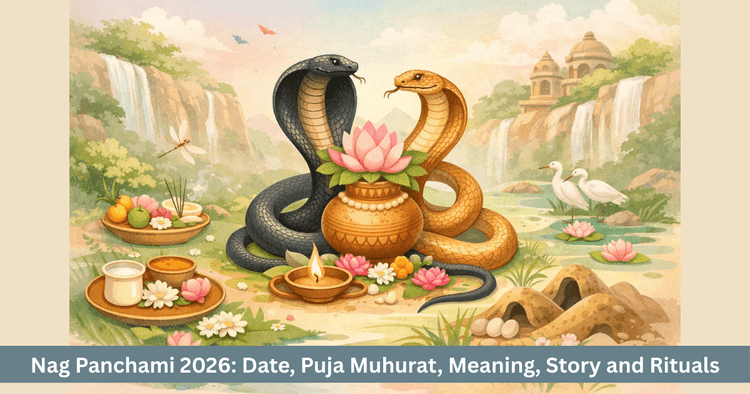
Table of Contents
On the bright fifth tithi of the Shravan month Nag Panchami is observed as a day of reverence for serpents and serpent deities. Across India, Nepal and other regions with Hindu communities, the festival is seen as an occasion to honour snakes, seek protection from harm and remember the deeper bond between human life and the natural world. Through this observance people reaffirm a respectful coexistence with these powerful yet often misunderstood creatures.
Nag Panchami 2026: Date and Puja Muhurat
Since Nag Panchami is linked with the Shravan Shukla Panchami tithi, its date differs each year according to the lunar calendar. For 2026 the main dates and timings become especially important for those who wish to observe the vrat and puja correctly.
Nag Panchami 2026 Dates and Muhurat for North India
| Detail | Date | Time |
|---|---|---|
| Nag Panchami date | Monday, 17 August 2026 | Panchami observance throughout the day |
| Puja muhurat | 17 August 2026 | From 06:00 AM to 08:10 AM |
| Muhurat duration | 17 August 2026 | About 2 hours 10 minutes |
| Panchami tithi begins | 16 August 2026 | At 04:55 PM |
| Panchami tithi ends | 17 August 2026 | Around 05:00 PM |
Thus the Panchami tithi starts on the evening of 16 August but Nag Panchami will be celebrated on Monday, 17 August 2026. The early morning window from 6:00 AM to 8:10 AM is especially suitable for formal worship, sankalp of the fast and offerings to Nag Devata.
Nag Panchami 2026 for Gujarat (Amanta Calendar)
In some regions, especially Gujarat, the Amanta system of lunar months is followed, which slightly shifts the Shravan month.
| Detail | Date |
|---|---|
| Nag Panchami date (Gujarat Amanta) | Tuesday, 1 September 2026 |
therefore in Gujarat and other places that follow the Amanta calendar Nag Panchami will be observed on 1 September 2026, while in the North Indian system it will fall on 17 August 2026.
What Is Nag Panchami and Why Is It Observed in Shravan?
Nag Panchami is a festival of serpent worship observed on the fifth tithi of the bright half of the Shravan month. Shravan is regarded as especially dear to the deities and during the monsoon season the earth remains moist, water bodies are active and snakes move more frequently across fields and dwellings. In this setting Nag Panchami carries a message of caution, respect and gratitude towards snakes.
By worshipping Nag Devata on Shravan Shukla Panchami, devotees seek protection from snake bites and ask for harmony with these beings. Across India, Nepal and other regions, clay or cow dung images of snakes are prepared or images are drawn and these forms become the focus of household or temple worship.
How Is Serpent Worship Performed on Nag Panchami?
On Nag Panchami people fashion snakes from clay, cow dung or other natural materials and decorate them with colours and simple ornaments. These images are placed on a clean platform, wall or doorway and worshipped with devotion. In many homes serpents are drawn on both sides of the main entrance and honoured through a specific form of worship called Bhitti Chitre Nag Puja.
Some of the common practices include the following.
- Placing the clay or symbolic snakes on a low stool or altar and offering turmeric, vermilion, rice, flowers and milk.
- In parts of Maharashtra and Karnataka, permanent temples dedicated to serpent gods perform elaborate poojas and abhisheks.
- In certain regions living snakes are brought safely for darshan and are offered milk, symbolic food and financial support through their handlers.
On this day people who work closely with snakes, such as traditional snake charmers, receive food, respect and monetary offerings. This honours their role and encourages them to handle snakes with care.
Nag Panchami Vrat and the Rituals Mentioned in Garuda Purana
Many devotees observe a fast on Nag Panchami. The vrat is kept on the Shravan Shukla Panchami tithi and is usually accompanied by simple, sattvic conduct. As mentioned in the Garuda Purana, drawing serpent images on both sides of the entrance and worshipping them is considered very auspicious. This is referred to as Bhitti Chitre Nag Puja.
Women often perform puja at home or in temples using images, idols or symbolic forms of Nag Devata. They prepare and offer food such as laddoos and kheer made from rice, milk and sugar. These offerings are shared with Brahmins, family members and, in some places, with snake charmers and those who care for snakes. In this way the ritual brings together devotion, sharing and ecological sensitivity.
Why Is Digging the Earth Avoided on Nag Panchami?
On Nag Panchami digging the earth is strongly discouraged in many traditional communities. During the rainy season snakes often reside in underground burrows or in moist soil. Ploughing fields, digging pits or breaking the ground can harm them or disturb their shelters.
By refraining from such activities on this day people reduce the risk of unintentionally injuring snakes and also lower the chance of provoking snake bites. This practical rule reflects a deeper principle of the tradition, which seeks to align religious observance with genuine care for living beings and their habitats.
Worship of Devi Manasa and Ashta Nag in Bengal
In West Bengal, Nag Panchami is closely associated with the worship of Devi Manasa, regarded as the presiding goddess of snakes. Together with her, the Ashta Nag or eight principal serpents, are invoked and honoured. Devotees place symbolic snake forms near the image or idol of Devi Manasa and offer milk, fruits, sweets and coconut.
This form of worship is not only about protection from snake bites. It also symbolises an effort to calm inner poisons such as anger, jealousy and resentment. Through devotion to Devi Manasa families seek relief from difficulties connected with fear, disease and hidden dangers related to snakes.
The Main Nag Panchami Story and Its Teaching
Several stories accompany the observance of Nag Panchami. One of the most well known tells of a peasant family and a serpent mother. The narrative conveys the power of repentance and compassion in healing the effects of ignorance.
Once a farmer lived with his wife, two sons and one daughter. One day while ploughing the field his plough accidentally crushed three baby snakes hidden in the soil and they died. Their mother, a serpent, witnessed the loss of her offspring and, overcome with grief and anger, resolved to take revenge on the farmer.
That night, while the farmer and his family were sleeping, the serpent entered the house and bit the farmer, his wife and their two sons. All three succumbed to the venom and only the daughter remained alive. The next morning, the serpent returned to kill the daughter as well.
The daughter, however responded with presence of mind and humility. Instead of running away, she respectfully offered the serpent a bowl of milk and folded her hands. She acknowledged the pain of the serpent mother and begged forgiveness for her father’s unknowing act. She welcomed the serpent and requested that her family be spared.
Deeply moved by the girl’s sincerity, the serpent’s anger softened. She restored the farmer, his wife and both sons to life and blessed the family. She further granted a boon that any woman who worships snakes on Shravan Shukla Panchami with devotion would receive protection for her family for seven generations. That day became remembered as Nag Panchami.
The story teaches that even severe consequences born of ignorance can be transformed when met with truthfulness, compassion and a willingness to admit fault.
Nag Panchami, Kaal Sarpa Dosha and Worship of Ashta Nag
In astrology, Nag Panchami is often connected with the discussion of Kaal Sarpa Dosha, a condition where all the planets in a birth chart lie between Rahu and Ketu. People with this combination sometimes experience heightened anxiety about obstacles and ancestral patterns. For such individuals the worship of Nag Devata on Nag Panchami is considered especially meaningful.
On this day many choose to honour the Ashta Nag, including Vasuki, Takshaka, Karkotaka, Padma, Mahapadma, Shankha, Kulika and Ananta. Along with ritual worship, some recite special texts known as Sarpa Sutra and chant the Nag Gayatri to seek release from fear, confusion and the heavy feelings associated with Kaal Sarpa Dosha.
Nag Gayatri Mantra: Meaning and Inner Sense
A well known mantra recited on Nag Panchami is as follows.
॥ Om Navkullaya Vidmahe Vishdantaaye Dhimahi Tanno Sarpah Prachodayat ॥
In Roman transliteration this reads, “Om Navkullaya Vidmahe Vishdantaaye Dhimahi Tanno Sarpah Prachodayat.” In essence it is a prayer to the serpent energy, asking that contemplation on Nag Devata may purify the mind, calm inner toxicity and inspire the devotee towards right thought and action. It is not only a protection from external snakes but also a call for balance in inner emotional patterns.
Why Is Milk So Important on Nag Panchami?
The tradition of offering milk to snakes on Nag Panchami is often explained through a story linked with the Samudra Manthan, the churning of the ocean. During that event many treasures emerged along with a powerful poison called halahala, which threatened to destroy the universe.
To save creation, Lord Shiva drank the poison and held it in his throat, gaining the name Neelkantha, the blue throated one. It is said that a few drops of this poison fell upon the earth and were consumed by snakes. To pacify the burning effect of the poison, the devas performed abhishek with Ganga water and cooling substances over both Shiva and the serpents. The ritual of offering milk to snakes on Nag Panchami symbolically recalls this act of soothing and balancing the energy of poison.
Guidance from Nag Panchami 2026 for Daily Life
Nag Panchami 2026 invites a thoughtful view of the relationship between human beings and the more hidden forms of life around them. Snakes naturally evoke fear, yet tradition encourages a disciplined respect rather than blind aggression. With awareness, people can learn to keep distance where needed, protect themselves wisely and still allow snakes their rightful place in the ecosystem.
Those who approach this day with a feeling of apology for past harm, gratitude for protection and a willingness to live more gently may notice a softening in their own mental patterns as well. Nag Panchami gently shows that cycles of harm born from ignorance are best healed not by further violence but by insight, humility and sincere change of heart.
Frequently Asked Questions
When will Nag Panchami be observed in 2026 and what are the Panchami timings?
In North India Nag Panchami will be celebrated on Monday, 17 August 2026. Panchami tithi begins on 16 August 2026 at 4:55 PM and ends around 5:00 PM on 17 August 2026. In Gujarat and other Amanta regions Nag Panchami will be observed on Tuesday, 1 September 2026.
What is the main significance of Nag Panchami?
The festival is dedicated to serpent deities and seeks protection from snake bites, blessings for family safety across generations and a more harmonious attitude towards nature. It is also regarded as supportive for those concerned about Kaal Sarpa Dosha.
How is Nag Panchami vrat and puja usually performed?
Devotees bathe, draw or mould snake images and worship them with milk, flowers, vermilion and rice. They feed Brahmins and those who work with snakes and often observe a simple fast while maintaining a calm and respectful attitude throughout the day.
Why should digging the earth be avoided on Nag Panchami?
During the rainy season snakes commonly live in underground burrows. Digging or ploughing on this day can injure them or disturb their shelters, so the custom of avoiding such activity protects both snakes and people.
What is the importance of offering milk and reciting the Nag Gayatri mantra?
Milk offerings recall the calming of poison after the Samudra Manthan episode, symbolising the cooling of harmful forces. The Nag Gayatri mantra, “Om Navkullaya Vidmahe Vishdantaaye Dhimahi Tanno Sarpah Prachodayat,” is recited to seek inner purification, courage and guidance from Nag Devata.
Get your accurate Kundali
Generate KundaliDid you like it?
Author

Pt. Amitabh Sharma (56 Years)
Experience: 20
Consults About: Family Planning, Career
Clients In: Punjab, Haryana, Delhi
Share this article with friends and family
About ZODIAQ
ZODIAQ is an online Vedic Astrology platform. It connects clients seeking astrological advice to experienced astrologers with deep knowledge. Our users also generate kundali and perform kundali milan for free. ZODIAQ also offers services to the Astrologers. Astrologers utilize various offerings by ZODIAQ to serve their clients effectively.
If you are a User
Consult with experienced astrologers and seek their guidance. You can also order handwritten Janm Patrika report with life prediction prepared by experienced astrologers. Generate accurate Kundali, perform Kundali Matching and check horoscope and muhurat. Utilize our online library for all the necessary astrological and spiritual information.
If you are an Astrologer
Create accurate kundali for your clients and perform Kundali Matching for up to 5 people at a time. Write comprehensive Janm Patrika report for your clients with ZODIAQ. Check client details anytime by saving it in client directory. Become more productive by tracking how many clients you guide every day.
WELCOME TO
ZODIAQ
Right Decisions at the right time with ZODIAQ
