Narali Purnima 2026: Date, Shravan Full Moon, Meaning, Mantra and Main Rituals
By Pt. Suvrat Sharma
Festival of offering coconuts to Sea God Varuna, seeking safety and expressing gratitude along India’s western coast
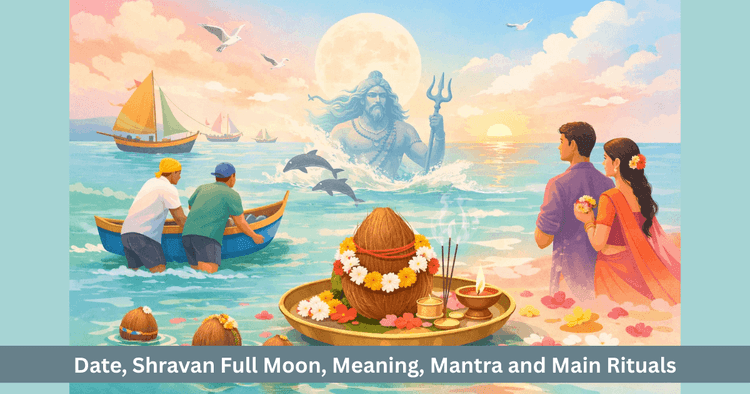
Table of Contents
For communities living along the western coast of India Narali Purnima is not just a festival. It is a heartfelt act of gratitude and a prayer for safety offered to the Sea God Varuna. On the full moon of Shravan, fishermen and coastal families dedicate coconuts to the waves and seek a calm, supportive sea for the season ahead.
Narali Purnima 2026 Date and Shravan Purnima Tithi
Narali Purnima is celebrated on the Purnima or full moon of the Shravan month, which is why it is also called Shravani Purnima. In 2026 this full moon coincides with several important festivals, including Raksha Bandhan.
| Detail | Date | Time / Information |
|---|---|---|
| Narali Purnima 2026 | Friday, 28 August 2026 | Shravan Purnima day |
| Purnima tithi begins | 27 August 2026 | Around 09:18 AM in the morning |
| Purnima tithi ends | 28 August 2026 | Around 09:58 AM in the morning |
Because the tithi spans both dates, the main observances for coastal communities are held on Friday, 28 August. Devotees consider this full moon especially favourable, as after this point winds and sea conditions are believed to become more supportive for fishing and sea trade.
What Is Narali Purnima and Why Is Coconut Central to It?
The word Narali comes from regional usage for the word “coconut” and Purnima denotes the full moon day. On Narali Purnima, coconuts play a central role in worship at the seashore, at harbours and near boat landings.
In Hindu tradition the coconut is regarded as a sacred fruit.
- Its three “eyes” are associated with the three gunas or the three principal deities.
- The pure water inside symbolises clarity, life and emotional purity.
- Breaking and offering the coconut expresses a wish to break the shell of ego and offer a sincere heart to the divine.
When coconuts are offered to the sea on Narali Purnima, fishermen and coastal families symbolically place their livelihood and safety under the care of Lord Varuna and pray for a fruitful year.
Why Is Narali Purnima Important in the Konkan Belt?
In Maharashtra and the neighbouring Konkan belt Narali Purnima is celebrated with lively devotion. It marks several transitions at once.
- The main phase of the monsoon begins to taper.
- The new fishing season prepares to open.
- Sea trade and transport are expected to become smoother.
For the fishing community the sea is not just water. It is a living source of survival and therefore honoured as a deity. On Narali Purnima they bow to the ocean, acknowledging that their daily bread depends on its moods. This awareness encourages respect, discipline and humility in their dealings with nature.
The festival also carries a wider meaning, pointing to a year filled with joy, abundance and harmony. A calm sea and smoothly completed rituals on this day are taken as encouraging signs for the months ahead.
How Are Narali Purnima Rituals Performed?
Preparations gather pace in villages and small ports well before the actual full moon. The change in atmosphere is visible along the waterfronts.
Preparations in the Days Before
- Fishermen repair their older boats, repaint them and, where needed, purchase new ones.
- Nets are examined and mended and fresh nets may be woven.
- Boats are decorated with flower garlands, coloured flags, ribbons and paper streamers.
At the same time homes and temples plan for special coconut based dishes and offerings that will be prepared on the festival day.
Main Religious Observances on Narali Purnima
- On the morning of the festival, communities gather near the sea to worship Lord Varuna.
- The puja generally includes water, vermilion, rice, flowers, lamps, coconuts and sweets.
- After the prayers coconuts are lifted in both hands and gently offered to the waves.
- Many groups also decorate their boats with symbols or flags representing Varuna and perform a separate boat puja.
Honouring the boats in this way expresses gratitude towards the very instruments that carry families to their livelihood.
Traditional Food and Use of Coconut
In Maharashtra, Narali Purnima brings a variety of coconut based dishes to the table.
- Narali bhaat or coconut rice made with rice, jaggery and grated coconut is especially loved.
- Coconut based laddoos, barfi and halwa are also prepared as festive treats and offerings.
Many Brahmins observe Shravani Upakarma on this day and keep a fruit based fast, with coconut as a central part of their simple diet, linking Narali Purnima to spiritual renewal as well.
Boat Processions and Community Joy
After the puja, the beautifully adorned boats sail a short distance into the sea. This ceremonial journey symbolises the auspicious opening of the new fishing season.
On returning, the shore comes alive with
- music and drumming,
- traditional dances,
- community feasts,
- informal games and gatherings.
For the Koli community and other fisherfolk, Narali Purnima becomes a day to affirm cultural identity, strengthen bonds and give thanks together.
Shravan Full Moon, Tides and Planetary Influence
On every full moon the Sun and Moon stand opposite each other in the zodiac. This alignment influences the tides and can lead to stronger movements of the sea. On the Shravan full moon these effects are particularly noted and respected by coastal communities.
On Narali Purnima, therefore fishermen pray to the Sea Lord that even amidst powerful tides their boats remain safe and their journeys steady. The ritual becomes a way to anchor courage and calmness in the face of nature’s vastness.
Subtle Meaning of Offering Coconut to the Sea
In sacred understanding, the sea is regarded as the domain of Lord Varuna, guardian of the western direction and lord of the waters.
On Narali Purnima
- people living near the coast gather to offer coconuts to Varuna.
- the water and tender kernel inside the coconut are seen as symbols of creativity and inner purity.
- casting the coconut into the sea expresses a readiness to release fear and negativity and to welcome fresh beginnings.
Local customs also note that during parts of the monsoon fish breeding is at its peak and sustainable practice discourages heavy fishing in that period. After Narali Purnima, when conditions settle, the renewed activity on sea aligns with both livelihood and respect for marine life.
Varuna Mantra for Narali Purnima
A simple and powerful mantra is recited on Narali Purnima to invite the blessings of Varuna.
॥ Om Vam Varunaya Namah ॥
In this mantra
- Om represents the primal, sacred sound.
- Vam is considered a bija or seed syllable associated with Varuna, water, purification and flow.
- Varunaya Namah expresses salutations to Lord Varuna, asking for balance, safety and prosperity.
Chanting this mantra while offering coconuts or lighting a lamp by the sea helps the mind become steady and respectful towards the great waters that support life.
How Is Narali Purnima Connected with Raksha Bandhan and Kajari Purnima?
Narali Purnima shares its date with other Shravan full moon festivals.
- Raksha Bandhan focuses on the protection of relationships, especially between brothers and sisters.
- Kajari Purnima holds importance for farmers and mothers, linking prayers for crops and children.
Narali Purnima adds the dimension of sea and water. Together, these observances create a threefold remembrance on one full moon day. People give thanks for water, land and human bonds, recognising that all three need care and protection.
Narali Purnima 2026 and Our Relationship with Water
Narali Purnima 2026 arrives at a time when water conservation and ocean health are increasingly important topics. The festival gently reminds everyone that survival depends on how wisely water is used and honoured.
Even those who do not live near the sea can use this day to reflect on the role of water in their lives. Preserving clean rivers and lakes, avoiding waste and feeling gratitude for every drop used are all in harmony with the spirit of Narali Purnima. In that sense, offering a coconut to the sea becomes a symbol for a wider promise to protect the waters of the earth.
Frequently Asked Questions
What is Narali Purnima and when will it be celebrated in 2026?
Narali Purnima, also known as Coconut Day, is a Hindu festival dedicated to the Sea God Varuna and celebrated mainly by fishing communities. In 2026 it will be observed on Friday, 28 August, the full moon day of the Shravan month.
Why are coconuts offered on Narali Purnima?
Coconuts are considered sacred and symbolise purity, creativity and surrender of ego. Offering them to the sea honours Lord Varuna and expresses a prayer for safe journeys, good catches and a prosperous year.
How does the Koli community celebrate Narali Purnima?
The Koli community worships the sea, offers coconuts, decorates boats, performs boat puja and then sails briefly into the sea. Afterwards they return to the shore to celebrate with music, dancing and shared meals, marking the opening of the fishing season.
What main rituals are followed during Narali Purnima?
Devotees repair and decorate boats, prepare coconut based dishes, gather by the sea to perform Varuna puja and offer coconuts with the mantra “Om Vam Varunaya Namah.” Boat processions and community festivities complete the observance.
What are the timing details for Narali Purnima tithi in 2026?
In 2026 the Shravan Purnima tithi begins on 27 August at around 09:18 AM and ends on 28 August at around 09:58 AM. Festivals linked with Narali Purnima are observed mainly on Friday, 28 August within this tithi span.
Get your accurate Kundali
Generate KundaliDid you like it?
Author
Pt. Suvrat Sharma (63)
Experience: 20
Consults About: Family Planning, Career
Clients In: Punjab, Haryana, Delhi
Share this article with friends and family
About ZODIAQ
ZODIAQ is an online Vedic Astrology platform. It connects clients seeking astrological advice to experienced astrologers with deep knowledge. Our users also generate kundali and perform kundali milan for free. ZODIAQ also offers services to the Astrologers. Astrologers utilize various offerings by ZODIAQ to serve their clients effectively.
If you are a User
Consult with experienced astrologers and seek their guidance. You can also order handwritten Janm Patrika report with life prediction prepared by experienced astrologers. Generate accurate Kundali, perform Kundali Matching and check horoscope and muhurat. Utilize our online library for all the necessary astrological and spiritual information.
If you are an Astrologer
Create accurate kundali for your clients and perform Kundali Matching for up to 5 people at a time. Write comprehensive Janm Patrika report for your clients with ZODIAQ. Check client details anytime by saving it in client directory. Become more productive by tracking how many clients you guide every day.
WELCOME TO
ZODIAQ
Right Decisions at the right time with ZODIAQ
