Onam Festival 2026: Thiruvonam Date, Significance, Legend and Main Rituals
By Pt. Narendra Sharma
Celebrate harvest, gratitude and community joy in Kerala during Onam, exploring its cultural and religious significance
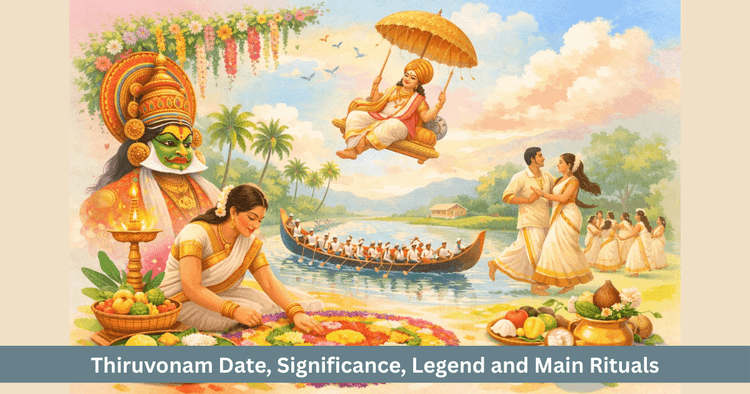
Table of Contents
In the lush landscape of Kerala the Onam festival stands out as a celebration of harvest, gratitude and shared joy. For Malayalees, Onam is more than a festival. It is a season in which families return home, communities gather and a gentle sense of equality and welcome fills homes and streets.
Onam 2026 Date and Thiruvonam Nakshatram
Onam is observed in the Malayalam month of Chingam, which corresponds to August and September in the Gregorian calendar. The ten day long festival reaches its peak on the day of Thiruvonam.
| Detail | Date | Time |
|---|---|---|
| Thiruvonam 2026 | Wednesday, 26 August 2026 | Main festival observances throughout the day |
| Thiruvonam nakshatram begins | 26 August 2026 | At 01:23 AM |
| Thiruvonam nakshatram ends | 27 August 2026 | At 03:20 AM |
During this Thiruvonam period homes, temples and public spaces come alive with decorated floral designs, Onam Sadhya, prayers and cultural programmes.
What Is Onam and Why Is It So Important in Kerala?
Onam is essentially a harvest festival of the Malayali community and is celebrated at the auspicious beginning of the month of Chingam. This month follows Karkidakam, a difficult rainy period, so Onam is welcomed as a time of relief, hope and abundance. References to Onam celebrations can be traced back to the Sangam era and during the rule of the Kulasekhara Perumals it is said that almost the entire month of Chingam was treated as the Onam season.
The festival announces a renewal of energy similar to the arrival of spring in other regions. Temple visits, family reunions, gifting of new clothes called Onakkodi, decorating spaces with flowers and sharing festive meals all form the heart of Onam. One of its strengths is that people from different faiths and backgrounds in Kerala often join in, treating Onam as a cultural celebration that belongs to everyone.
Deeper Meaning of Onam in Daily Life
Although Onam is not defined purely as a Hindu festival, its roots are closely woven with Malayali Hindu folklore and the story of the Vamana avatar of Lord Vishnu. The festival honours King Mahabali, his generosity and his deep commitment to justice. At the same time it reminds people that true prosperity lies in balancing power with humility and duty.
Through Onam, the idea of a just and caring society is remembered, one in which all people live with dignity and fairness. The harvest becomes a symbol of more than grain. It stands for shared wellbeing and the wish that everyone may have enough and live with self respect.
The Story of Onam: Vamana Avatar and King Mahabali
The main legend behind Onam involves the sage Kashyapa, his wives, the conflict between Devas and Asuras and the appearance of the Vamana avatar. Kashyapa had two wives, Diti and Aditi. From Diti were born the Asuras and from Aditi the Devas. Indra became the king of the Devas, while Mahabali rose as a powerful and respected king among the Asuras.
In due course Mahabali, through strength and ability, gained control even over the realm of Indra. When Kashyapa returned from the Himalayas he found Aditi in sorrow over her son’s defeat. With spiritual insight he understood the situation and taught Aditi the Payovrata, a sacred observance beginning on the twelfth day of the bright fortnight of Kartika and ending on the next Dwadasi.
Aditi performed this vrata with a pure and focused heart. Pleased, Lord Narayana assured her that He would take birth in her womb and support Indra. On the twelfth day of the bright half of Bhadrapada, Aditi gave birth to a radiant child who later became known as Vamana, the dwarf Brahmin incarnation.
The Meeting of Mahabali and Vamana
Mahabali, also called Balichakravarthi, was the grandson of Prahlada, the famed devotee of Lord Vishnu. Like Prahlada, he was devoted to the divine and cared deeply for both the spiritual and material welfare of his subjects. At one time he was performing the Vishwajit Yagna and declared that whoever came to the sacrifice with a request would not leave empty handed.
Into this setting walked a young Brahmin boy, Vamana. His radiance caught the attention of the sages present. Mahabali welcomed him with all appropriate honours, offered him a seat and asked what he desired. Vamana replied gently that he did not wish for anything extraordinary, only the amount of land that could be covered by three of his footsteps.
Hearing this, Mahabali’s preceptor Shukracharya understood through foresight that the visitor was none other than Lord Narayana. He warned Mahabali that granting this request would lead to the loss of his possessions and advised him not to make such a promise. Shukracharya argued that Vamana needed nothing, as the Lord already held everything.
Mahabali now faced a serious inner test. On one side stood the counsel of his guru and on the other his own vow never to deny a seeker. Maintaining a calm, respectful tone, Mahabali chose to stand by his word. He said that breaking a promise would be a sin and that he was prepared to accept any consequence rather than withdraw the offer. At this, Shukracharya cursed him that he would be reduced to ashes, yet Mahabali did not turn back from his decision.
The Vast Form of Vamana and Mahabali’s Surrender
After Mahabali confirmed his promise, Vamana began to expand. He assumed a cosmic form and prepared to measure the granted land in three steps. With one foot he covered the entire earth. With the second he spanned the heavens. There remained no space for the third step, as all the worlds had already been measured.
Then Vamana asked Mahabali where he should place his third foot. Mahabali humbly bowed his head and offered it as the place for the final step, declaring that his own ego and pride should also be surrendered at the Lord’s feet. Vamana placed his third step on Mahabali’s head and sent him to Patala, the netherworld, appointing him ruler there.
In doing so Lord Mahavishnu, in the form of Vamana, lifted Mahabali beyond worldly pride and granted him a higher spiritual status. At the same time, delighted with his unshaken loyalty and spirit of sacrifice, the Lord granted him a boon. Mahabali would be allowed to visit his people once every year. The Onam festival in Kerala is celebrated as a welcome to this annual visit of King Mahabali and as a remembrance of Vamana’s appearance.
How Is Onam Celebrated in Kerala?
Onam unfolds over ten days, with each day carrying its own charm and traditions. Together they create an atmosphere in which households, neighbourhoods and temples all participate in shared celebration.
Onam Beginning and the Tradition of Onakkodi
On the opening day, often associated with Attam, family members rise early, bathe and wear new clothes known as Onakkodi. In many homes an image or idol of Thrikkakara Appan, representing Vamana Vishnu, is installed and worshipped. This honours the divine presence that guided King Mahabali and protected dharma.
Pookkalam, Lamps and Onappattukal
In the courtyard, usually on the eastern side of the house, women create intricate Pookkalam, floral designs made from fresh petals. These designs symbolically prepare a path for King Mahabali or Maveli to enter the home. Lamps are lit around the Pookkalam and traditional Onam songs, known as Onappattukal, are sung. This fills the space with colour, fragrance and gentle devotion.
Swings, Songs and Shared Joy
On Thiruvonam and other days swings are hung from high branches of trees. These swings are decorated with flowers. Women and girls take turns swinging while singing melodious songs. The swinging ceremony can be seen as a playful expression of the lightness, renewal and joy that Onam seeks to bring into daily life.
Onam Sadya: The Heart of the Festive Meal
From the third day onwards and especially on Thiruvonam, families arrange the traditional Onam Sadya, a grand vegetarian meal served on banana leaves. The Sadya typically includes a wide variety of dishes, pickles, vegetable preparations, curries, curd and accompaniments, all carefully arranged.
A central place in the Sadya is taken by Payasam, a sweet preparation made using milk, rice, sugar and coconut. The custom of everyone sitting together in rows, sharing the same meal, reinforces the spirit of equality, togetherness and gratitude that defines Onam.
Vallamkali: The Excitement of the Boat Races
In the backwaters and rivers of Kerala, the famous Vallamkali or snake boat races form a major attraction during the Onam period. At places like Alappuzha long, beautifully decorated boats glide through the water, powered by teams of oarsmen rowing in perfect rhythm. Drums beat and songs are chanted to keep the pace.
These races are not only competitive events. They symbolise the power of teamwork, coordination and discipline. Just as the oarsmen must move as one to propel the boat forward, communities too progress when people work together with shared focus and respect.
Onakazhcha and Bonds of Responsibility
On the ninth day, many families observe the custom of Onakazhcha. Dependants, tenants or those associated with the household present items such as vegetables and coconut oil to the eldest male member of the family, known as the Karanavar. This practice has been particularly associated with the Nair community of Kerala.
Through this exchange, relationships of mutual responsibility are affirmed. The Karanavar, in turn, is expected to care for the wellbeing of all those connected with the household. The custom quietly reinforces a sense of social balance, loyalty and shared security.
Temple Festivals, Elephants and Cultural Events
During Onam, temples and sacred places host a variety of programmes. These include devotional singing, classical and folk dances such as Kathakali and Thiruvathira and traditional music. Elephants are adorned with ornaments and taken out in dignified processions, adding to the visual splendour of the festival.
Children participate in traditional games, youth engage in competitions and elders gather in devotional groups or storytelling circles. In all of this the central thread is inclusion. People from diverse backgrounds feel invited to join the celebrations and contribute in their own way.
Inner Message of Onam Festival 2026
Onam 2026 arrives as a reminder that true prosperity must be measured not only in harvest and income but also in justice, kindness and mutual respect. The story of King Mahabali and Vamana shows that greatness lies in keeping one’s word, practising generosity and remaining humble even in positions of power.
Those who use the festival as a time for reflection may ask where more fairness, listening and gratitude are needed in their own lives. In that sense the harvest seen in the fields becomes a mirror for the harvest of qualities in the heart. The core message of Onam is that when the land flourishes, the inner world should also flourish with truth, balance and goodwill.
Frequently Asked Questions
What is the significance of the Onam festival in 2026?
Onam Festival 2026 continues the tradition of Kerala’s main harvest celebration, marking the beginning of the harvest season in Chingam. It honours King Mahabali’s annual visit, the Vamana avatar of Lord Vishnu and the values of generosity, fairness and shared happiness.
When is Thiruvonam in 2026 and what are its timings?
Thiruvonam in 2026 falls on Wednesday, 26 August. The Thiruvonam nakshatram begins at 01:23 AM on 26 August and ends at 03:20 AM on 27 August.
How long does the Onam festival last and in which month is it celebrated?
Onam lasts for ten days and is celebrated in the Malayalam month of Chingam, which corresponds to August and September in the Gregorian calendar.
What are some traditional activities during Onam?
Traditional activities include visiting temples, family gatherings, gifting Onakkodi, creating pookkalam, enjoying swings organising Onam Sadya, witnessing Vallamkali boat races and participating in cultural events and processions.
What is the legend behind Onam and what does it teach?
The legend centres on King Mahabali and the Vamana avatar of Lord Vishnu. Vamana measured the worlds in three steps, sending Mahabali to the netherworld while granting him an annual visit to his people. The story teaches humility, steadfastness in keeping one’s word and the deeper meaning of true kingship.
Get your accurate Kundali
Generate KundaliDid you like it?
Author
Pt. Narendra Sharma (63)
Experience: 20
Consults About: Family Planning, Career
Clients In: Punjab, Haryana, Delhi
Share this article with friends and family
About ZODIAQ
ZODIAQ is an online Vedic Astrology platform. It connects clients seeking astrological advice to experienced astrologers with deep knowledge. Our users also generate kundali and perform kundali milan for free. ZODIAQ also offers services to the Astrologers. Astrologers utilize various offerings by ZODIAQ to serve their clients effectively.
If you are a User
Consult with experienced astrologers and seek their guidance. You can also order handwritten Janm Patrika report with life prediction prepared by experienced astrologers. Generate accurate Kundali, perform Kundali Matching and check horoscope and muhurat. Utilize our online library for all the necessary astrological and spiritual information.
If you are an Astrologer
Create accurate kundali for your clients and perform Kundali Matching for up to 5 people at a time. Write comprehensive Janm Patrika report for your clients with ZODIAQ. Check client details anytime by saving it in client directory. Become more productive by tracking how many clients you guide every day.
WELCOME TO
ZODIAQ
Right Decisions at the right time with ZODIAQ
