Panchami Shradh 2026: Date, Significance and Unmarried Ancestor Rites
By Pt. Abhishek Sharma
Importance of Panchami Shradh, Date, and Pinda Daan for Unmarried Ancestors
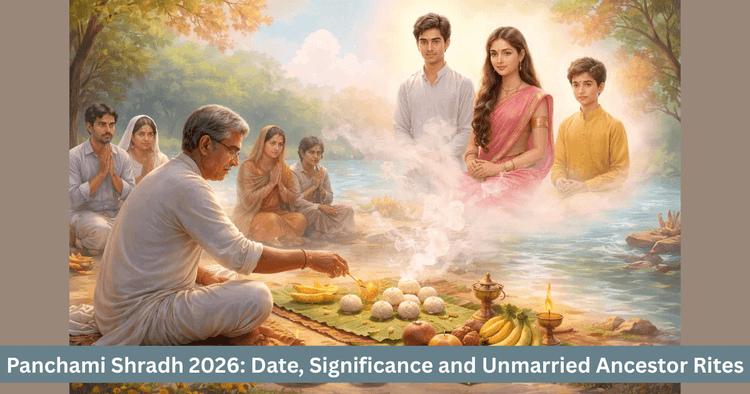
Table of Contents
Panchami Shradh 2026 is a day in Pitru Paksha that is especially dedicated to ancestors who passed away while still unmarried. On this date Shradh is offered not only for those who died on the Panchami tithi but also for sons, daughters, brothers and sisters who left the world before entering the householder stage of life. During Pitru Paksha 2026 Panchami Shradh will fall on Wednesday, 30 September 2026 and on this day the scriptural focus rests on Tarpan, Pind daan and Brahmin feeding for Panchami tithi forefathers and unmarried ancestral souls.
In 2026 Pitru Paksha begins on 26 September with Purnima Shradh and ends on 10 October with Sarva Pitru Amavasya. Within this sixteen day period the fifth tithi, Panchami Shradh, will occur on Wednesday, 30 September. For Shradh the central part of the day is accepted as valid. The Kutup muhurat runs approximately from 11:36 AM to 12:24 PM, Rohina muhurat from 12:24 PM to 1:12 PM and the broader Aparahna kala from about 1:12 PM to 3:36 PM, all of which are considered auspicious for Panchami Shradh. It is not customary to perform Shradh after sunset, because the spiritual effectiveness of Pitru rites is linked to the upward course of the midday sun.
Panchami Shradh 2026 date and timing overview
Seeing all key timings together makes it easier to plan Panchami Shradh and related observances.
| Detail | Date and time |
|---|---|
| Pitru Paksha Panchami Shradh | Wednesday, 30 September 2026 |
| Lunar tithi | Bhadrapada Krishna Panchami |
| Pitru Paksha span | 26 September to 10 October 2026 |
| Kutup muhurat | Approximately 11:36 AM to 12:24 PM |
| Rohina muhurat | Approximately 12:24 PM to 1:12 PM |
| Aparahna kala | Approximately 1:12 PM to 3:36 PM |
| Time not suitable for Shradh | After sunset and during night |
Devotees who wish to observe Panchami Shradh at Prayagraj or other tirtha locations are usually advised to reach one day in advance, on 29 September. This allows a restful night and a calm beginning for the morning preparations and sankalpa on 30 September so that the core rites align smoothly with the midday muhurats.
What is Panchami Shradh and why is it called Kunwara Panchami
The word Shradh comes from the Sanskrit term shraddha, which means faith, devoted sincerity and heartfelt trust. Panchami Shradh is the Shradh performed during Pitru Paksha on the fifth lunar day, the Panchami tithi, for those who passed away on that specific tithi of any month.
In many traditions this day is also known as Kunwara Panchami. The reason is that it holds a special place for ancestors who died while still unmarried. Sons, daughters, brothers, sisters, nephews or other youths who passed away before marriage are remembered on this day with particular tenderness. For them Kunwara Panchami is regarded as an especially compassionate and necessary occasion.
According to Hindu understanding, a soul that departs before reaching the grihastha ashrama, the householder stage of life, often carries an incomplete longing connected with family, partnership and responsibility. The Shradh performed on Kunwara Panchami is believed to address that incompletion and to grant peace and forward movement on the inner journey. Through sincere Pind daan and Tarpan, descendants symbolically complete a portion of what remained unfinished for such ancestors.
Who should observe Shradh on Panchami tithi
The eligibility for Panchami Shradh rests on two main pillars, one based on tithi and the other on the special rule for unmarried ancestors.
- Families whose ancestors passed away on Panchami tithi, whether in Shukla or Krishna Paksha of any month.
- Fathers, mothers, grandfathers, grandmothers and other direct line ancestors whose death occurred on a fifth lunar day.
- Unmarried sons, brothers, uncles, maternal uncles or other male relatives who left the body before marriage.
- Unmarried daughters, sisters or young female relatives who departed before entering a settled householder life.
- Young ancestors for whom the exact date of passing is not known but whose unmarried status at the time of death is certain.
For all these, Panchami Shradh becomes a very important observance. In families where exact death tithis are not known for several forefathers, a practical and traditional approach is to dedicate Panchami to unmarried ancestors and Sarva Pitru Amavasya to all ancestors together, trusting that the intention will reach them correctly.
Emotional significance of Panchami Shradh for unmarried ancestors
Many households carry stories of young members lost unexpectedly in earlier generations. Their names are spoken with a quiet tenderness and their memories remain vivid even decades later. For such souls Panchami Shradh offers a yearly moment of compassion and gratitude.
When a family prepares pindas explicitly in the name of sons, daughters or siblings who never saw their own households, the ritual becomes more than a duty. It becomes a way of saying that their place in the lineage remains intact. This feeling of remembrance is believed to reach the ancestors, making their protective and guiding presence more gentle and available for the living.
Step by step procedure of Panchami Shradh 2026
The ritual sequence of Panchami Shradh closely follows that of other tithi based Shradh days, with an added emphasis on clear remembrance of unmarried ancestors during the sankalpa and offerings.
1. Bathing, purification and sankalpa
The day starts at dawn with a purifying bath. Where possible the performer bathes in a river or sacred water body. Otherwise bathing at home with a small amount of Ganga jal and sesame added to the water is recommended. After bathing, clean and preferably light coloured clothes are worn.
A simple altar is set up in a quiet corner of the home or at the ritual site. A seat of kusa grass or a clean mat is arranged for the ancestors. Tarpan vessels, sesame, barley, ghee, honey, rice and fruits are placed neatly nearby. Then the sankalpa, the formal declaration of intention, is made with the help of a priest or from memory, stating
- The name, gotra and residence of the performer.
- The names of ancestors who died on Panchami tithi.
- The names and relationships of unmarried ancestors such as sons, daughters, brothers, sisters and other youths.
Through this sankalpa the focus of the day is clearly set on both the Panchami tithi souls and the unmarried pitrus.
2. Tarpan, the core water offering
Tarpan is a central act in Panchami Shradh. Water for Tarpan is usually mixed with black sesame seeds, barley and a few blades of kusa grass.
- Water is offered slowly from the cupped right hand.
- With each stream of water a specific ancestor is remembered by name, gotra and relationship.
- Separate Tarpan offerings may be made for Panchami tithi ancestors and for unmarried ancestors, ensuring that both groups receive full attention.
This steady act of pouring water with focused thought is seen as a way of easing thirst, restlessness and waiting in the ancestral realm.
3. Pind daan and offerings
Pind daan on Panchami Shradh carries a special tenderness. Pindas are made from cooked rice, sesame, ghee and honey.
- Each pinda may be dedicated to one particular ancestor, for example one for a father who died on Panchami, another for an unmarried brother, another for an unmarried sister or child.
- When there are many ancestors or limited time, pindas can also be prepared by category, such as one for all unmarried ancestors collectively.
- The pindas are placed on a bed of kusa grass in order and each is offered with the ancestor’s name and relationship spoken aloud.
At tirtha sites this Pind daan is performed on the riverbank or at a sacred platform and the pindas are later consigned to the flowing waters or left at the designated Shradh spot according to local custom.
4. Brahmin feeding and dakshina
After the offerings to the ancestors, Brahmin feeding forms a vital part of the Shradh.
A qualified Brahmin, well versed in Pitru rites, is invited to sit and eat. The meal generally includes rice, dal, vegetables, roti or puri and a simple sweet such as kheer or halwa, all prepared in a sattvic manner. In remembrance of unmarried ancestors some traditions also invite a young Brahmin or celibate student, expressing an additional gesture of care toward youthful energy.
At the end of the meal the Brahmin is given dakshina and, according to means, cloth or other useful items. This act is viewed as a sacrifice made in the name of the ancestors, whose satisfaction is mirrored through the contentment of the guest.
5. Feeding cow, dog and crow
As with other Pitru Paksha days, offering food to a cow, a dog and especially a crow is considered very important on Panchami Shradh.
- Feeding a cow expresses respect for dharma and abundance.
- Giving food to a dog symbolises protection, loyalty and the guarding of the household.
- Placing food for a crow represents a direct link to the ancestors and when a crow accepts the offering it is taken as an encouraging sign of ancestral satisfaction.
Only after these offerings and the completion of Brahmin feeding does the family eat, maintaining the sense that the first right to food belongs to the divine and to the pitrus.
Panchami Shradh in the light of scriptural teachings
Classical texts such as Garuda Purana and Matsya Purana describe the tithi based structure of Shradh. The fifth lunar day, Panchami, is linked with the planet Mercury, Budha, which governs thought, communication and transitions. For young souls whose lives were cut short, Panchami Shradh becomes a means to support their transition from incomplete earthly roles toward a clearer spiritual path.
Dharmashastra teachings also warn that when families forget or ignore the Shradh of unmarried ancestors, subtle Pitru Dosha can arise. This may reflect as repeated delays in marriage, obstacles in conceiving children or recurring emotional turmoil among the younger generation. Observing Panchami Shradh with sincerity and correct method is regarded as an important step toward easing these ancestral imbalances.
Recommended practices on Panchami Shradh
- Rise early, bathe carefully and maintain physical and mental cleanliness throughout the day.
- Use black sesame seeds in the main offerings, since these are foundational for Shradh rites.
- Try to perform the crucial acts of Pind daan, Tarpan and Brahmin feeding during Kutup or Rohina muhurat or at least within the Aparahna period.
- Remember the wider ancestral line, even while giving special focus to the Panchami tithi and unmarried ancestors.
- Maintain a compassionate, prayerful mood, allowing the day to be quiet and reflective rather than crowded with mundane tasks.
Things to avoid on Panchami Shradh
- Avoid meat, alcohol, onion and garlic on this day.
- Refrain from arguments, harsh speech and any act of physical or verbal harm.
- Do not schedule Shradh rites after sunset, because the spiritual opening for Pitru rites is considered closed by then.
- Postpone beginning new ventures, making major purchases or attending celebrations to another day.
- Avoid using iron utensils for the core rites. Prefer copper, brass, silver or clay vessels.
- Do not wear torn, dirty or flashy clothing. Choose simple, clean garments instead.
These careful observances help make Panchami Shradh 2026 a day of focused ancestral service, offering peace to Panchami tithi forefathers and especially to the unmarried sons and daughters of the lineage whose stories still live in family memory.
Common Questions Related to Panchami Shraddh 2026
On which date and day will Panchami Shraddh 2026 be observed? Panchami Shraddh 2026 will be observed on Wednesday, 30th September 2026, during the Pitru Paksha, and it will fall on the Bhadrapada Krishna Panchami tithi.
For which ancestors is Kumbhara Panchami considered special? Kumbhara Panchami is considered special for sons, daughters, brothers, sisters who passed away in an unmarried state, and for those youths who left their body before entering the Grihastha ashram. Additionally, this day is important for all ancestors who passed away on the Panchami tithi.
If the death date of an unmarried ancestor is unknown, what can be done? In such a case, during the Panchami Shraddh ritual, their name and relation can be taken, and a separate pind and tarpana can be offered for the unmarried ancestors with unknown dates, ensuring they also receive the benefits of the Shraddh.
Is Panchami Shraddh performed only for unmarried ancestors? No, Panchami Shraddh is primarily for all ancestors who passed away on the Panchami tithi. However, the tradition of making special resolutions and offering pind for unmarried ancestors makes it distinct as Kumbhara Panchami.
Can Panchami Shraddh be performed at home, or is it necessary to perform it at a pilgrimage site? Panchami Shraddh can be performed at home with complete rituals. However, performing Shraddh at pilgrimage sites like Sangam or other sacred places is considered more fruitful. Where visiting such places is difficult, Shraddh performed at home with devotion and pure intentions also reaches the ancestors.
Get your accurate Kundali
Generate KundaliDid you like it?
Author
Pt. Abhishek Sharma (63)
Experience: 20
Consults About: Family Planning, Career
Clients In: Punjab, Haryana, Delhi
Share this article with friends and family
About ZODIAQ
ZODIAQ is an online Vedic Astrology platform. It connects clients seeking astrological advice to experienced astrologers with deep knowledge. Our users also generate kundali and perform kundali milan for free. ZODIAQ also offers services to the Astrologers. Astrologers utilize various offerings by ZODIAQ to serve their clients effectively.
If you are a User
Consult with experienced astrologers and seek their guidance. You can also order handwritten Janm Patrika report with life prediction prepared by experienced astrologers. Generate accurate Kundali, perform Kundali Matching and check horoscope and muhurat. Utilize our online library for all the necessary astrological and spiritual information.
If you are an Astrologer
Create accurate kundali for your clients and perform Kundali Matching for up to 5 people at a time. Write comprehensive Janm Patrika report for your clients with ZODIAQ. Check client details anytime by saving it in client directory. Become more productive by tracking how many clients you guide every day.
WELCOME TO
ZODIAQ
Right Decisions at the right time with ZODIAQ
