Poila Baisakh 2026: Date, Significance and Rituals
By Pt. Suvrat Sharma
Bengali New Year and New Beginnings with Sun’s Entry into Aries
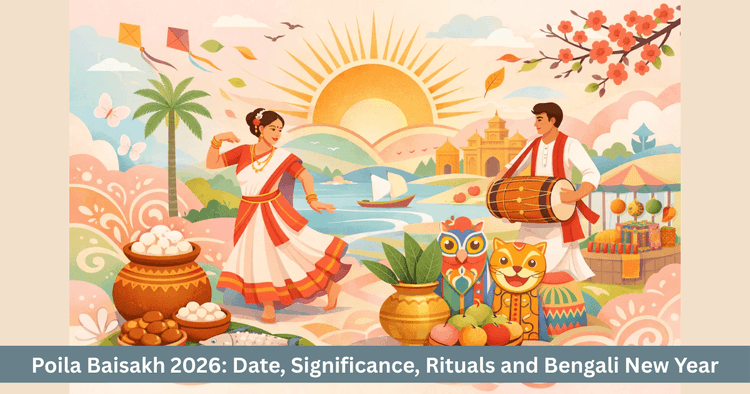
Table of Contents
In Bengali culture the New Year is not seen merely as a change of calendar, it is treated as a chance to look at life with a renewed mindset. Poila Baisakh, also known as Noboborsho or Pohela Boishakh, is the festival that carries this spirit. Celebrated on the first day of the month of Baisakh in the Bengali calendar, it ushers in a year filled with renewal, prosperity and cultural pride.
In 2026 Poila Baisakh will arrive on the day when the Sun enters Aries and marks the beginning of a new solar cycle. This movement of the Sun is regarded as a sign of strength, vitality and fresh beginnings, which makes the religious and social observances of the day especially auspicious.
Poila Baisakh 2026 date and solar transition
The key timing points related to Poila Baisakh 2026 are summarised in the table below.
| Detail | Date | Weekday | Note |
|---|---|---|---|
| Poila Baisakh 2026 date | 14 April 2026 | Tuesday | Bengali New Year, Noboborsho celebration |
| First day of Baisakh month | 14 April 2026 | Tuesday | Opening of the Bengali year |
| Sun’s entry into Aries | 14 April 2026 | Tuesday | Mesha Sankranti, start of a new solar cycle |
Poila Baisakh will be celebrated on Tuesday 14 April 2026. This is the first day of Baisakh in the Bengali calendar and the Sun’s movement into Mesha Rashi on this day adds the flavour of a solar New Year. Through this conjunction the day acquires spiritual, astrological and cultural depth at the same time.
What is Poila Baisakh and why is it celebrated
The term Poila Baisakh simply means the first day of Baisakh. For the Bengali community it marks the beginning of the New Year when people honour the memory of the past year and step into the new one with fresh intentions.
- The day is welcomed as Noboborsho, the auspicious start of a new year.
- It symbolises the opening of new ventures, new accounts, new relationships and new ideas.
- Poila Baisakh is treated as a festival of renewal, prosperity and cultural unity.
The spirit of the day encourages individuals to take meaningful steps towards new goals in personal, family and professional life.
Historical background of Poila Baisakh
The shape of the Bengali calendar evolved over time. A significant phase of this evolution came during the Mughal period when a better alignment was needed between agriculture and tax collection.
Tradition holds that during the reign of Emperor Akbar, a modified calendar was introduced. It combined elements of the Islamic lunar calendar and the Hindu solar calendar to create a system more suitable for collecting taxes according to harvest seasons. This adjustment helped farmers pay taxes in harmony with crop cycles rather than strictly by lunar months.
Gradually this practical reform took on a cultural life of its own. Poila Baisakh grew beyond an economic marker and became a vibrant celebration of Bengali identity, literature, music and community life.
Spiritual and astrological meaning of Poila Baisakh
Poila Baisakh aligns with Mesha Sankranti, the time when the Sun enters Aries and reaches exaltation.
From an astrological perspective this moment signifies several important tendencies.
- A rise in confidence and sense of authority.
- Renewal of energy, ambition and the desire to move forward.
- Activation of leadership qualities and decision making capacity.
- A favourable window for beginning new ventures, projects and financial plans.
The Sun represents the soul, vitality and governance. Its entry into Aries is therefore seen as a symbol of bold beginnings and determined effort at the threshold of the New Year.
Main rituals of Poila Baisakh 2026
On Poila Baisakh 2026 many traditional observances will shape the day in Bengal and among Bengalis elsewhere.
Morning preparations and worship
- People wake early, take a ritual bath and wear fresh traditional clothes.
- Many visit temples to seek blessings for health, success and well being in the year ahead.
- Families often perform simple worship at home with lamps, incense and offerings.
The morning hours are treated as the right time to welcome the New Year both outwardly and inwardly.
What is the Hal Khata ceremony
One of the most distinctive customs of Poila Baisakh is Hal Khata, especially important for traders, shopkeepers and business owners.
- Old account books are formally closed and new ledgers are opened.
- Customers are invited, sweets or prasad are distributed and goodwill is renewed.
- Prayers are offered for growth in business and for honest prosperity.
Hal Khata is more than a bookkeeping ritual. It symbolises the decision to leave behind old entanglements and negativity and to begin commercial life with a fresh intention and cleaner mind.
Cultural festivities and public events
Across West Bengal and Bangladesh Poila Baisakh is marked by rich cultural activities.
- Colourful processions and rallies take place in many towns.
- Folk music and traditional instruments create a characteristic festive sound.
- Programmes of Rabindra Sangeet and dance pay tribute to Bengali literary and artistic heritage.
- Neighbours and communities gather for greetings, cultural performances and shared celebration.
Through these events Poila Baisakh becomes not only a personal New Year but a collective expression of identity and joy.
Traditional food on Poila Baisakh
Food plays a central role in the New Year celebrations. Families prepare a range of dishes that carry both taste and cultural memory.
Some frequently prepared items include the following.
- Panta Bhat, a traditional dish made from soaked rice.
- Hilsa fish or Ilish, which holds a special place in Bengali cuisine.
- A variety of mishti and sweet preparations.
- Classical Bengali vegetable and lentil dishes.
Sharing this food among family and guests becomes a living symbol of unity, affection and prosperity.
Symbolism of the festival
Poila Baisakh is rich with symbolic themes at many levels.
- Closing old account books and opening new ledgers points beyond finance to the inner work of releasing old burdens and starting afresh.
- The New Year inspires new aims, new ambitions and new plans grounded in clarity.
- At the social level the festival nurtures cultural unity, language and tradition as sources of inner strength.
Acts of worship, charity, music and fellowship on this day gently shape the tone for the months that follow.
Reflecting on Poila Baisakh 2026
As Poila Baisakh 2026 arrives with the Sun’s transit into Aries, the day carries both festive joy and an invitation to reflection.
- It encourages people to consider which new steps they are ready to take in personal and professional life.
- It supports planning balanced financial strategies, savings and investments for the year.
- It invites fresh effort to strengthen family communication, cooperation and emotional bonds.
- It reminds that goals should be shaped not only by profit but by ethics and social responsibility.
The underlying message is that prosperity grows where discipline, gratitude and well directed effort are present together.
Deeper cultural meaning of the Bengali New Year
Poila Baisakh is also a celebration of Bengali cultural identity.
- It is a day for honouring language, literature, art and music.
- The legacy of Rabindranath Tagore and many other poets and artists comes alive in songs and recitations.
- People collectively recognise that culture gives stability and meaning, especially in challenging times.
Poila Baisakh 2026 can thus serve as a reminder that by staying rooted in tradition one gains the strength to embrace change in a balanced way.
Life guidance from Poila Baisakh 2026
Poila Baisakh 2026 is a New Year festival but beyond that it is an invitation to change perspective.
The day raises a few quiet questions.
- Which habits, grievances or confusions of the last year are ready to be left behind.
- Which goals truly deserve priority in the coming months.
- How can economic growth be combined with human sensitivity, family closeness and social participation.
When the Sun enters Aries and sends its message of strength and clarity, Noboborsho can become more than a greeting. It can mark the beginning of genuine inner discipline, renewed resolve and constructive change.
Frequently asked questions about Poila Baisakh 2026
On which day will Poila Baisakh 2026 be celebrated
Poila Baisakh 2026 will be celebrated on Tuesday 14 April 2026, the first day of Baisakh in the Bengali calendar and the start of the Bengali New Year.
How is Poila Baisakh related to Mesha Sankranti
On this day the Sun enters Aries, marking a new solar cycle. This Mesha Sankranti forms the astrological foundation for Poila Baisakh and strengthens its meaning as a powerful New Year point.
What is the deeper meaning of the Hal Khata tradition
Hal Khata is not only a business practice of closing old accounts and opening new ones. It also symbolises leaving behind old debts in thought and emotion and beginning work with renewed intention and clarity.
Are New Year rituals on Poila Baisakh meant only for traders
No, while Hal Khata is central for business owners, Poila Baisakh is for everyone. People from all walks of life observe the day through bathing, worship, new clothes, greetings, cultural events and family meals.
What core lesson can an individual take from Poila Baisakh 2026
The core lesson is that the New Year truly begins when one releases old mental burdens and chooses new goals with prosperity, discipline, gratitude and cultural rootedness. In that spirit Noboborsho can genuinely redirect the course of life.
Get your accurate Kundali
Generate KundaliDid you like it?
Author

Pt. Suvrat Sharma (63)
Experience: 20
Consults About: Family Planning, Career
Clients In: Punjab, Haryana, Delhi
Share this article with friends and family
About ZODIAQ
ZODIAQ is an online Vedic Astrology platform. It connects clients seeking astrological advice to experienced astrologers with deep knowledge. Our users also generate kundali and perform kundali milan for free. ZODIAQ also offers services to the Astrologers. Astrologers utilize various offerings by ZODIAQ to serve their clients effectively.
If you are a User
Consult with experienced astrologers and seek their guidance. You can also order handwritten Janm Patrika report with life prediction prepared by experienced astrologers. Generate accurate Kundali, perform Kundali Matching and check horoscope and muhurat. Utilize our online library for all the necessary astrological and spiritual information.
If you are an Astrologer
Create accurate kundali for your clients and perform Kundali Matching for up to 5 people at a time. Write comprehensive Janm Patrika report for your clients with ZODIAQ. Check client details anytime by saving it in client directory. Become more productive by tracking how many clients you guide every day.
WELCOME TO
ZODIAQ
Right Decisions at the right time with ZODIAQ
