Raksha Bandhan 2026: Date, Shravan Purnima, Legends and Rituals
By Pt. Nilesh Sharma
Celebrating the bond of protection, love, and responsibility between siblings on Shravan Purnima
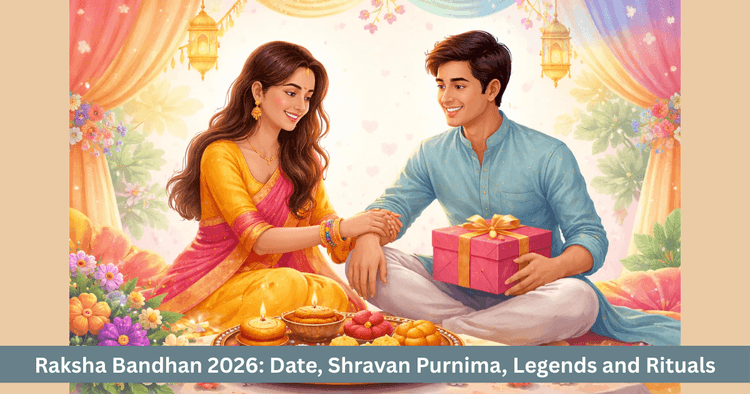
Table of Contents
The festival of Raksha Bandhan celebrated on the full moon of the Shravan month honours the deep bond of affection, responsibility and protection between siblings. It reaches beyond blood ties and includes any relationship in which trust and care are central. In 2026 Raksha Bandhan will once again bring families together across India, as the monsoon rains refresh the land and the Rakhi thread refreshes ties of the heart.
When Is Raksha Bandhan 2026 and How Is the Date Decided?
The date of Raksha Bandhan changes every year because it is based on the lunar calendar. It is always observed on the full moon day of the Shravan month. The civil date shifts between July and August, yet the principle remains constant.
| Detail | Date | Information |
|---|---|---|
| Raksha Bandhan / Rakhi 2026 | Friday, 28 August 2026 | Celebrated on Shravan Purnima |
| Festival basis | Shravan Purnima | As per the Hindu lunar calendar |
| Method of deciding date | Full moon of Shravan | Rakhi is tied in an auspicious, Bhadra free period |
Every year priests and almanac experts calculate the exact time of the Shravan full moon, the duration of Bhadra and the favourable period for tying Rakhi. The general guideline is to avoid Bhadra and to perform the main rituals during a Shubh Muhurat in the daytime.
What Is the Significance of Raksha Bandhan?
Raksha Bandhan is an ancient Hindu festival centred on the sacred relationship between brother and sister, yet its meaning has widened over time. A woman who feels sisterly affection, whether she is a cousin, a neighbour or a friend, can tie a Rakhi. A man who accepts the role of a protective brother can receive it with sincerity.
In states such as Uttar Pradesh, Gujarat, Rajasthan, Madhya Pradesh and Haryana, Raksha Bandhan 2026 is recognised as a public holiday, though the festival is celebrated throughout the country regardless of official status. The Rakhi thread becomes a symbol of love, duty and trust, offering an opportunity for relatives to renew their commitment to one another.
Raksha Bandhan is also counted among the monsoon festivals. The rains wash away dust and heaviness from the earth and bring new greenery. In a similar way the festival invites brothers and sisters to release old resentments and begin again with a clearer, kinder outlook.
Stories and Cultural Background of Raksha Bandhan
Many stories from tradition are linked with Raksha Bandhan. Each one shows that the protective thread can connect gods, kings, teachers, friends and grandchildren, not just biological siblings.
Indra and Indrani
One tale tells of Indra, king of the Devas, engaged in a fierce battle with the Asura king Bali. During this crisis Indra’s wife Sachi, also called Indrani, tied a sacred thread on his wrist and prayed for his safety and victory. The thread symbolised a spiritual armour. This suggests that in ancient times protective threads were tied before battle and the practice was broader than the modern brother sister ritual alone.
Lord Vishnu, Goddess Lakshmi and King Bali
In narratives from the Bhagavata Purana and Vishnu Purana, after Lord Vishnu, in the form of Vamana, defeats King Bali and gains control of the three worlds, Bali requests that Vishnu reside in his palace. The Lord agrees. Goddess Lakshmi feels uneasy about this arrangement because it separates her from Vaikuntha.
On Shravan Purnima she visits Bali and ties a Rakhi on his wrist, accepting him as her brother. Deeply touched, Bali asks what gift she desires. Lakshmi asks that Vishnu return with her. In honour of the bond created by the Rakhi, Bali agrees. From this story comes the understanding that the protective knot can establish chosen sibling bonds, not only those of birth.
Ganesh, Shubh, Labh and Santoshi Maa
Another legend recounts that on Raksha Bandhan, Devi Manasa, considered a sister to Ganesh in some traditions, visits him and ties a Rakhi. Ganesh’s sons, Shubh and Labh, observe this and long for a sister of their own to share the festival. They request their father to bless them with a sister and it is said that Santoshi Maa appears in response. From then the three siblings celebrate Raksha Bandhan together, reinforcing the idea that the presence of a sister brings balance and contentment into a family.
Krishna and Draupadi
The bond between Krishna and Draupadi is also remembered in connection with Raksha Bandhan. In one incident Krishna’s finger is injured and begins to bleed. Draupadi quickly tears a piece from her sari and wraps it around his finger. Moved by her spontaneous care, Krishna vows to stand by her whenever she needs protection. Later, during critical moments of her life, he fulfils this promise.
In the Mahabharata it is also described that Draupadi ties a Rakhi to Krishna before he sets out for the great war and that Kunti ties a protective thread to her grandson Abhimanyu before his own battle. These episodes show that Raksha Bandhan is fundamentally about honouring bonds of protection, trust and gratitude beyond narrow definitions.
Why Is Raksha Bandhan Important for Farmers?
For many farming communities the Shravan Purnima connected with Raksha Bandhan holds a special place. A good harvest depends on sufficient and timely rainfall. The monsoon months nourish the soil, fill rivers and ponds and prepare the fields for sowing and growth. In states such as Bihar, Madhya Pradesh and Jharkhand, farmers express reverence for the earth and pray for fertile soil on this day.
The festival reminds them that prosperity is rooted in a respectful relationship with land and water. In Raksha Bandhan 2026, Shravan rituals will again encourage gratitude for the soil that supports every grain eaten by the family.
Importance of Raksha Bandhan for Fishing Communities
For fishing communities, especially along the western coast, Raksha Bandhan overlaps with a period that carries its own meaning. In Maharashtra, Karnataka, Gujarat and Goa the Shravan full moon is celebrated as Narali Purnima. On this day coconuts are offered to Varuna, the deity of waters, in gratitude and as a prayer for protection at sea.
After the intense phase of the monsoon, when the sea begins to calm, fishers symbolically mark a fresh start to their season. For them the full moon of Rakhi Purnima represents the bond between human life and the ocean and a request that the waters remain kind and supportive.
Upakarma: A Parallel Observance on Rakhi Purnima
In regions such as Odisha, Kerala andhra Pradesh and Tamil Nadu, many Brahmins observe Upakarma on Shravan Purnima. On this day they renew their commitment to study, perform rituals connected with Vedic learning and often change their sacred thread. It is seen as a time for spiritual resetting and a fresh start in disciplined living.
Thus Shravan Purnima carries three parallel streams. It honours knowledge through Upakarma, relationships through Raksha Bandhan and nature through the monsoon related observances. The protective thread here symbolises a pledge to safeguard dharma, learning and ethical conduct, not only family ties.
How to Perform Raksha Bandhan Puja and Rituals?
The pooja vidhi of Raksha Bandhan is simple yet rich in feeling. It serves as a structured way to bring affection, blessings and promises into clear focus for both siblings.
Preparing the Puja Thali
Before tying the Rakhi the sister prepares a small puja thali.
- The thali usually contains a small diya or oil lamp, roli or vermilion, a few grains of rice, the Rakhi, flowers and sweets.
- In some homes a small kalash, coconut or an image of Lord Ganesha is also placed on the altar.
- The sister quietly sets an intention for her brother’s health, protection and progress in life.
Step by Step Rakhi Ritual
- Brother and sister sit facing each other or the brother sits at the household shrine.
- The sister first applies a tilak of roli on her brother’s forehead and places rice grains as a sacred mark.
- She then performs aarti, moving the lamp in gentle circles before him, invoking light and blessing around his life.
- After this she ties the Rakhi on his wrist with care, praying inwardly that he remain safe, guided and steadfast in dharma.
- Finally she offers sweets and in many families the younger one touches the feet of elders for blessings.
The brother expresses his affection through gifts and, more importantly, through a sincere promise to respect, support and protect his sister in appropriate ways.
Regional Traditions and Lumba Rakhi
Different parts of India add their own shades of meaning to Raksha Bandhan.
- In Rajasthani and Marwari families the custom of Lumba Rakhi is well known. Here the sister ties one Rakhi to the brother’s wrist and another decorative Rakhi to the bangle of his wife. The belief is that the wife is the partner in all aspects of life, so the ritual remains incomplete without her. She shares the responsibility of caring for the sister along with her husband.
- In many households sisters also tie a Rakhi to their brother in law, strengthening the circle of trust and mutual care.
- Today the Rakhi often travels further. People tie Rakhis to teachers, close friends or mentors, acknowledging those who offer guidance and support like elder siblings.
How Is the Date of Raksha Bandhan Calculated Each Year?
Raksha Bandhan follows the Hindu lunar calendar, not the purely solar Gregorian calendar. The festival is always linked to Shravan Purnima.
Key points in deciding the date include the following.
- Determining which civil day carries the full moon of the Shravan month.
- Checking the presence and duration of Bhadra, an inauspicious period on that day.
- Selecting a Bhadra free window as the Shubh Muhurat for tying Rakhi.
In 2026, based on these calculations, Raksha Bandhan falls on Friday, 28 August 2026.
Rakhi Purnima and the Message of Change
The monsoon season signifies both creation and clearing. Old leaves fall, rivers shift their flow and many unnecessary elements are washed away. This opens space for new life. Rakhi Purnima can be seen as a mirror of this process in human relationships.
Siblings who may have drifted apart because of distance or misunderstanding are given a natural occasion to reconnect. Small complaints can be gently released. The simple act of tying a thread, sharing a sweet and exchanging a few honest words often softens the heart and restores understanding.
Meaningful Directions from Raksha Bandhan 2026
Raksha Bandhan 2026 comes at a time when families and societies continue to search for deeper trust and clearer communication. On this day, beyond the exchange of gifts, brothers can reflect on what genuine protection means in the present time. It may include supporting a sister’s education, respecting her choices and standing up for her dignity in family and society.
Sisters, in turn, can consider how to encourage responsibility, integrity and emotional strength in their brothers. In this sense Raksha Bandhan becomes more than a custom. It becomes a yearly point of renewal, reminding everyone involved that true protection is grounded in empathy, fairness and honest care.
Frequently Asked Questions
When will Raksha Bandhan be celebrated in 2026 and on which date does it fall?
Raksha Bandhan in 2026 will be celebrated on the full moon of the Shravan month, which corresponds to Friday, 28 August 2026 in the Gregorian calendar. This is the main day for tying Rakhi and performing the associated rituals.
Is Raksha Bandhan only for real brothers and sisters?
No, Raksha Bandhan is not restricted to blood siblings. Cousins, close friends, neighbours, mentors and others who share a protective and loving bond may also take part in the Rakhi ceremony.
What items are traditionally placed in the Raksha Bandhan puja thali?
A typical thali contains an oil lamp, roli or vermilion, grains of rice, one or more Rakhis, flowers and sweets. Some families also include a kalash, coconut or the image of a deity according to their tradition.
Why is Rakhi usually not tied at night?
Rakhi is generally not tied during the Bhadra period or late at night, because many traditions advise against beginning auspicious rituals after sunset. The preferred time is a Bhadra free, well lit part of the day.
Is Raksha Bandhan celebrated outside India as well?
Yes, wherever Indian communities live across the world, Raksha Bandhan is observed. Sisters send Rakhis by post or through friends and brothers respond with messages, blessings and gifts, keeping the bond alive across distances.
Get your accurate Kundali
Generate KundaliDid you like it?
Author

Pt. Nilesh Sharma (63)
Experience: 20
Consults About: Family Planning, Career
Clients In: Punjab, Haryana, Delhi
Share this article with friends and family
About ZODIAQ
ZODIAQ is an online Vedic Astrology platform. It connects clients seeking astrological advice to experienced astrologers with deep knowledge. Our users also generate kundali and perform kundali milan for free. ZODIAQ also offers services to the Astrologers. Astrologers utilize various offerings by ZODIAQ to serve their clients effectively.
If you are a User
Consult with experienced astrologers and seek their guidance. You can also order handwritten Janm Patrika report with life prediction prepared by experienced astrologers. Generate accurate Kundali, perform Kundali Matching and check horoscope and muhurat. Utilize our online library for all the necessary astrological and spiritual information.
If you are an Astrologer
Create accurate kundali for your clients and perform Kundali Matching for up to 5 people at a time. Write comprehensive Janm Patrika report for your clients with ZODIAQ. Check client details anytime by saving it in client directory. Become more productive by tracking how many clients you guide every day.
WELCOME TO
ZODIAQ
Right Decisions at the right time with ZODIAQ
