Raksha Bandhan 2026: Date, Muhurat, Mantra, Legends and Shravan Purnima Festivals
By Pt. Sanjeev Sharma
Learn the significance, Rakhi thread, mantras and traditional celebrations of Raksha Bandhan on Shravan Purnima
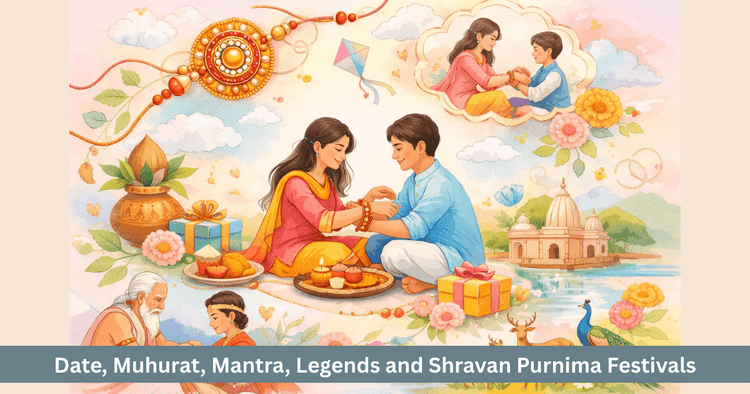
Table of Contents
The auspicious full moon of the Shravan month is celebrated as Raksha Bandhan, a festival that honours the thread of protection binding affection, responsibility and trust between hearts. One simple Rakhi becomes a bridge of faith that links families, teachers, rulers and devotees across generations.
Raksha Bandhan 2026 Date and Auspicious Time to Tie Rakhi
Raksha Bandhan follows the Shravan Purnima tithi each year, therefore its civil date changes according to the lunar calendar. In 2026 the festival will fall in the gentle atmosphere of the monsoon, when rains cool the air and nature appears freshly washed.
| Detail | Date | Time / Information |
|---|---|---|
| Raksha Bandhan 2026 | Friday, 28 August 2026 | Shravan Purnima |
| Rakhi thread ceremony time | 06:40 AM to 09:40 AM | Approximate duration 3 hours |
| Bhadra status | Bhadra is over before sunrise | The day remains free for auspicious tying of Rakhi |
| Purnima tithi begins | 09:18 AM on 27 August 2026 | Beginning of Shravan full moon |
| Purnima tithi ends | Around 09:00 AM on 28 August 2026 | After this the next lunar month begins |
Traditionally the Aparahna or late afternoon is preferred for tying Rakhi, yet when Bhadra occupies that phase, the morning becomes especially important. In 2026 Bhadra is considered to be over before sunrise, therefore the window from 06:40 AM to 09:40 AM is highlighted as a clear and favourable time for the main Rakhi ceremony. Once Bhadra has passed, the rest of the day also remains suitable for family level rituals.
Why Is Raksha Bandhan Spiritually Significant?
In ordinary social thinking physical strength is often associated more with men, yet Raksha Bandhan turns the focus towards the protective power of prayer and heartfelt intention. On this day the sister ties the raksha sutra on her brother’s wrist and sincerely prays for his wellbeing, clarity and righteousness. The festival quietly teaches that inner blessings can be as powerful as outer strength.
Raksha Bandhan extends beyond the household in several ways.
- Priests tie sacred threads on the wrists of their yajman, the ritual patrons, invoking blessings and protection.
- Subjects used to tie Rakhi on the wrist of their king, reminding him of his duty to protect and care for them.
- Close friends, neighbours and mentors may also exchange Rakhis where there is a genuine bond of support.
In this way Raksha Bandhan becomes a social celebration of shared responsibility and mutual guardianship.
Why Does Raksha Bandhan 2026 Emphasise Bhadra and Muhurat?
The Hindu almanac describes Bhadra as an inauspicious period in which starting auspicious tasks is usually avoided. This includes vows and rituals linked with protection. For this reason, care is taken each year to know when Bhadra begins and ends on Shravan Purnima.
In 2026 Bhadra is believed to end before sunrise on Raksha Bandhan day, which opens the way for morning rituals to proceed without hindrance. The specific time between 06:40 AM and 09:40 AM is suggested as ideal for the thread ceremony. After this, families may continue their observances at a convenient hour during the day, while still respecting local guidance about eclipses or other special combinations.
Historical Roots and the Mahabharata Episode
The tradition of Raksha Bandhan draws from both historical and epic sources. One well known episode from the Mahabharata highlights the deep bond between Krishna and Draupadi.
The story tells that on one occasion Krishna injured his finger with a sharp weapon and blood began to flow. Draupadi, moved by concern, immediately tore a strip from her sari and wrapped it around his wrist. Krishna accepted this as a raksha sutra, not merely as a bandage.
Later, in the court of Duryodhana, when Dushasana attempted to strip Draupadi of her clothing, Krishna responded to that earlier gesture of love. He protected her honour by providing an unending flow of cloth. Through this event Raksha Bandhan becomes a reminder that a moment of selfless care can create a lasting bond of protection.
Rani Karnavati and Emperor Humayun
A famous example from the Mughal period illustrates the political and social power of the Rakhi. Rani Karnavati, mother of Maharana Vikramaditya of Mewar, faced the threat of attack from the rulers of Malwa and Gujarat. She sent a Rakhi to Emperor Humayun, symbolically accepting him as a brother and requesting his protection.
Humayun is said to have honoured this Rakhi by marching to her aid and defeating the attackers, thereby safeguarding Mewar. The episode shows that Rakhi can transform a formal relationship into one of moral commitment and defence.
There is also a noted incident from Rajasthan in which two principalities remained in conflict. When the Mughal army moved against one of them, the second king prepared to support the Mughals. At that point the first king sent him a Rakhi. Recognising the bond it represented, the second ruler turned his forces against the Mughal army instead. Together both kingdoms repelled the invaders and maintained unity thereafter. Here Rakhi worked as a thread that turned rivalry into alliance.
Devas, Asuras and the Story of Indra’s Protection
Purana literature also preserves stories linked with Raksha Bandhan. One important tale speaks of a long war between the Devas and Asuras which lasted for twelve years. The Asuras seized control of the heavenly realms and the defeated gods wandered in distress. Indra, their king, approached the guru Brihaspati, describing their suffering and asking for guidance.
Indra’s wife Indrani or Shachi heard this conversation on the day of Shravan Purnima. In the early morning she prepared a sacred thread, empowered it with Vedic mantras and tied it around Indra’s right wrist. She instructed him to go forth into battle with faith in this spiritual protection.
Since the thread had been sanctified through mantra, it acted as a powerful shield. The gods gained strength and ultimately overcame the Asuras. This story lies behind the tradition of chanting a specific Raksha Bandhan mantra while tying the thread.
Raksha Bandhan Mantra and Its Inner Meaning
The classical mantra recited at Raksha Bandhan is as follows.
Yena baddho baliraja danavendro mahabalah।
Tena tvam prati baddhnami rakse machala machalah।।
The sense of this Vedic verse is that
the same protective thread by which the mighty king of the Asuras, Bali, was bound is now being tied on this wrist. May that raksha remain steady and unmoving, guarding the wearer from all harm.
When priests tie the Rakhi on a devotee or a sister ties it on her brother, this mantra expresses the wish that the thread represent divine grace, ethical strength and the resolve to stand by one another in times of difficulty.
Household Preparations and Family Rituals
In the days leading up to Raksha Bandhan many households enter a gentle festive mode.
- Homes are cleaned carefully, with special attention to the kitchen and hearth.
- Traditional sweets such as ladoo, barfi or peda are prepared.
- Flowers, incense, rice, coconuts and other items for worship are kept ready.
On Shravan Purnima morning or during the selected muhurat, family members assemble. Many families worship Lord Hanuman, their Kuladevata or Ishta Devata. Simple offerings are made to ancestors through prayers or traditional rites. After this the main Rakhi ceremony between siblings begins.
Jhulan Utsav, Amarnath Yatra and Other Shravan Purnima Traditions
Shravan Purnima carries several regional festivities alongside Raksha Bandhan, which deepen the spiritual flavour of the day.
Jhulan Utsav in Bengal
In Bengal and some neighbouring regions the Jhulan Utsav begins five days before the full moon and culminates on Shravan Purnima. Images of Radha and Krishna are placed on beautifully decorated swings. Women sing devotional songs describing their divine love. On the full moon evening the festival reaches its climax, blending the sentiment of Raksha Bandhan with devotion and joy.
Amarnath Pilgrimage and the Tale of the White Pigeons
At the Amarnath cave in the Himalayas a natural ice formation, the Shivalinga, is believed to reach its full form during the Shravan period. A legend tells that when Lord Shiva narrated the secret of immortality to Parvati in this cave, she grew drowsy and did not hear the complete teaching. A pair of white pigeons, however listened to the full discourse. From that time they are said to appear before devoted pilgrims and are considered symbols of that timeless blessing.
On Shravan Purnima, which coincides with Raksha Bandhan, many sadhus and pilgrims offer sacred sticks and worship materials to Lord Amarnath. These are ritually prepared in Srinagar and then carried with reverence to the cave. Thus Raksha Bandhan shares its date with a powerful reminder of spiritual endurance and grace.
Other Festivals Observed on Shravan Purnima
Across India the full moon of Shravan is known by several names and associated with different customs. Raksha Bandhan stands among these observances rather than alone.
Narali Purnima
In coastal regions this day is celebrated as Narali Purnima. Fishing communities, whose livelihood depends on the sea and the monsoon, worship Varuna, the deity of waters. They offer coconuts to the sea, seeking protection for their boats and a fruitful season ahead.
Yajnopavita and Upakarma
In southern states such as Andhra Pradesh, Tamil Nadu and Kerala and in Odisha, Shravan Purnima is observed as Avani Avittam. In Karnataka many Yajurveda followers mark it as Upakarma. On this day they
- renew their dedication to Vedic study,
- change their yajnopavita or sacred thread,
- and perform rituals to refresh their spiritual discipline.
While changing the thread, the following mantra is recited.
Om yajnopavitam paramam pavitram prajapater yat sahajam purastat।
Ayushyam agryam pratimumcha shubhram yajnopavitam balam astu tejah।।
This mantra praises the sacred thread as supremely pure, life giving and a source of strength and radiance.
Kajari Purnima
In some northern regions Kajari Purnima is observed on this day. Farmers and mothers of sons perform special rituals, praying both for healthy crops and for the wellbeing of their children.
Pavitropana in Gujarat
In many parts of Gujarat the day is called Pavitropana. Devotees perform special pujas to Lord Shiva, offer water and sacred threads and pray for the forgiveness of past errors. In this way Shravan Purnima weaves together water worship, learning, family protection and inner purification.
Deeper Reflections from Raksha Bandhan 2026
Raksha Bandhan 2026 invites people to reflect on what protection truly means in the present age. For a sister it may mean supporting her brother’s inner growth, steadiness and ethical choices. For a brother it can mean standing for his sister’s safety, education and dignity, both within the home and in the wider world.
When the Rakhi is tied with such awareness, the festival becomes more than a yearly custom. It becomes a shared commitment to live with greater empathy and responsibility. The Shravan full moon then lights not only the sky but also the path of relationships, reminding everyone that genuine protection is always bound to truth and care.
Frequently Asked Questions
When will Raksha Bandhan be celebrated in 2026 and what is the main time to tie Rakhi?
Raksha Bandhan 2026 will be celebrated on Friday, 28 August, the full moon of Shravan. The highlighted thread ceremony time is from 06:40 AM to 09:40 AM, when Bhadra has already ended and the day is clear for auspicious rituals.
Why should rituals not be performed during Bhadra on Raksha Bandhan?
Bhadra is regarded as an inauspicious period for beginning sacred or festive actions, especially those involving vows of protection. Therefore Rakhi is tied only after Bhadra is over, so that the sankalpa associated with the thread remains undisturbed and harmonious.
Which Mahabharata incident is especially connected with the origin of Raksha Bandhan?
The episode in which Draupadi tears a strip from her sari to bind Krishna’s wounded finger is closely linked with Raksha Bandhan. Krishna accepts this as a protective thread and later safeguards her honour in the royal court, embodying the promise contained in the Rakhi.
How did Raksha Bandhan play a role in Rajasthan during the Mughal period?
Rani Karnavati’s Rakhi to Emperor Humayun and his response in defending Mewar is one example. Another describes a king sending a Rakhi to a former rival who was about to support the Mughals. The rival then chose to fight alongside him instead and together they defeated the Mughal forces, showing the Rakhi’s power to build unity.
What other important festivals are observed on Shravan Purnima along with Raksha Bandhan?
On the same full moon Narali Purnima, Upakarma or Avani Avittam, Kajari Purnima and Pavitropana are also celebrated in different regions. These observances involve sea worship, sacred thread renewal, prayers for crops and children and special Shiva pujas, making Shravan Purnima a richly layered spiritual day.
Get your accurate Kundali
Generate KundaliDid you like it?
Author
Pt. Sanjeev Sharma (63)
Experience: 20
Consults About: Family Planning, Career
Clients In: Punjab, Haryana, Delhi
Share this article with friends and family
About ZODIAQ
ZODIAQ is an online Vedic Astrology platform. It connects clients seeking astrological advice to experienced astrologers with deep knowledge. Our users also generate kundali and perform kundali milan for free. ZODIAQ also offers services to the Astrologers. Astrologers utilize various offerings by ZODIAQ to serve their clients effectively.
If you are a User
Consult with experienced astrologers and seek their guidance. You can also order handwritten Janm Patrika report with life prediction prepared by experienced astrologers. Generate accurate Kundali, perform Kundali Matching and check horoscope and muhurat. Utilize our online library for all the necessary astrological and spiritual information.
If you are an Astrologer
Create accurate kundali for your clients and perform Kundali Matching for up to 5 people at a time. Write comprehensive Janm Patrika report for your clients with ZODIAQ. Check client details anytime by saving it in client directory. Become more productive by tracking how many clients you guide every day.
WELCOME TO
ZODIAQ
Right Decisions at the right time with ZODIAQ
