Shardiya Navratri 2026: Dates, Worship of Nine Goddesses and Spiritual Meaning
By Pt. Suvrat Sharma
Nine-day worship of Goddess Durga from Ghatasthapana to Vijayadashami in autumn season
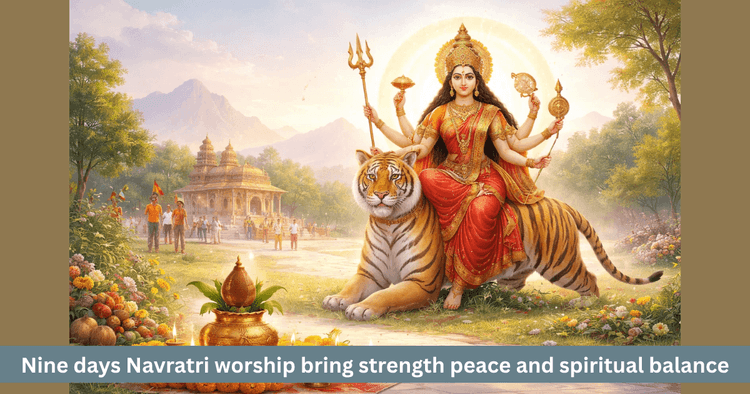
Table of Contents
There are certain seasons in the year when devotion seems to awaken on its own. It feels as though the earth itself is remembering an ancient rhythm. In India, the season of autumn is regarded as one such sacred phase. The rains gradually withdraw, the sky becomes clear and a deep stillness settles into the atmosphere. It is in this time that Shardiya Navratri arrives. In the year 2026, Shardiya Navratri will begin on Sunday, October 11, 2026 with Ghatasthapana and conclude on Tuesday, October 20, 2026 with Vijayadashami. Across these nine days, homes, temples, villages and cities are filled with the atmosphere of Devi worship, yet beneath the outer celebration lies a profound spiritual journey.
What is the meaning of Shardiya Navratri
The word Navratri literally means nine nights. During these nine nights, devotees worship the divine power that is known in Indian philosophy as Shakti, meaning the divine feminine energy. Shakti is not merely one goddess among many. She is regarded as the force behind creation, movement, nourishment and transformation in the universe.
Everything that moves, grows, changes and renews itself is understood to arise through her power. That is why Navratri is not only a religious festival but also a remembrance of the deepest source of life. It celebrates the divine feminine force that overcomes ignorance, imbalance and disorder.
Why is it called Shardiya Navratri
Navratri is observed at different points in the year but the most widely celebrated one is Shardiya Navratri, which falls in Sharad Ritu, meaning the autumn season. The term Shardiya comes from Sharad, which refers to the clear and luminous season that follows the rains.
At this time, the sky becomes transparent after the monsoon. This is not only a seasonal change but also a spiritual symbol. Just as the clouds disperse from the sky, the practice of Navratri aims to disperse confusion, heaviness and inner restlessness from the mind.
Is Shardiya Navratri only a festival or also an inner journey
Outwardly, Navratri is full of lamps, mantras, flowers, devotional songs and sacred gatherings. But its deepest meaning goes beyond celebration. Navratri may also be understood as nine stages of inner transformation.
The first day brings awakening. The middle days bring discipline, struggle, purification and courage. The final days bring compassion, illumination, spiritual fulfilment and victory. In this way, Navratri is not only an outer act of worship but also an inner spiritual pilgrimage.
What is the importance of Ghatasthapana
Shardiya Navratri begins with Ghatasthapana, which is also known as the installation of the sacred Kalasha, meaning ritual vessel. In this rite, a holy pot is established and filled with water. Mango leaves and a coconut are placed upon it. Around the Kalasha, barley seeds are often sown, symbolising fertility, growth and new life.
This ritual is not merely the formal beginning of the festival. Its deeper meaning is that the devotee invokes the presence of the Goddess into the home, the altar and the inner heart. In this way, Ghatasthapana becomes a sign of awakened divine consciousness.
Who are the Navadurga
The nine days of Navratri are dedicated to the nine forms of Goddess Durga, known as the Navadurga. These nine forms may also be understood as a progression in spiritual evolution.
The nine forms are as follows:
| Order | Name of the Goddess | Spiritual indication |
|---|---|---|
| 1 | Shailputri | Stability and sacred beginning |
| 2 | Brahmacharini | Austerity, discipline and devotion |
| 3 | Chandraghanta | Courage and protection |
| 4 | Kushmanda | Creation and divine radiance |
| 5 | Skandamata | Compassion and motherhood |
| 6 | Katyayani | Righteous strength and resolve |
| 7 | Kalaratri | Destruction of fear and ignorance |
| 8 | Mahagauri | Purity and compassion |
| 9 | Siddhidatri | Fulfilment, perfection and grace |
If these nine forms are observed carefully, they appear not only as different expressions of the Goddess but also as symbols of the inward journey of the seeker.
Shardiya Navratri 2026 dates, day wise Devi worship and colours
The sequence of Shardiya Navratri in the year 2026 will be as follows:
| Day | Date | Weekday | Worship | Colour of the day |
|---|---|---|---|---|
| First day | October 11, 2026 | Sunday | Maa Shailputri | Orange |
| Second day | October 12, 2026 | Monday | Maa Brahmacharini | White |
| Third day | October 13, 2026 | Tuesday | Maa Chandraghanta | Red |
| Fourth day | October 14, 2026 | Wednesday | Maa Kushmanda | Royal Blue |
| Fifth day | October 15, 2026 | Thursday | Maa Skandamata | Yellow |
| Sixth day | October 16, 2026 | Friday | Maa Katyayani | Green |
| Seventh day | October 17, 2026 | Saturday | Maa Kalaratri | Grey |
| Eighth day | October 18, 2026 | Sunday | Maa Mahagauri | Purple |
| Ninth day | October 19, 2026 | Monday | Durga Ashtami and Maha Navami | Peacock Green |
| Tenth day | October 20, 2026 | Tuesday | Vijayadashami | Victory and righteousness |
The first day, Maa Shailputri and the colour orange
On October 11, 2026, Sunday, the first day of Navratri will be dedicated to Maa Shailputri. She is regarded as the daughter of the Himalayas and represents grounding, steadiness and the awakening of spiritual consciousness. The first step in spiritual life is to become rooted and Shailputri embodies that foundation.
The colour of this day is orange. Orange symbolises energy, enthusiasm, aspiration and sacred courage. It reminds the seeker that the spiritual journey begins with awakened determination.
The second day, Maa Brahmacharini and the colour white
On October 12, 2026, Monday, the second day belongs to Maa Brahmacharini. This form represents tapas, meaning spiritual austerity, self discipline and unwavering devotion. Brahmacharini teaches the power of walking steadily on the path without turning away from the goal.
The colour of the day is white. White signifies purity, serenity and inward calm. It reflects the peace that arises when the mind withdraws from agitation and moves toward stillness.
The third day, Maa Chandraghanta and the colour red
On October 13, 2026, Tuesday, the third day is dedicated to Maa Chandraghanta. She is a warrior form of Durga who protects the devotee and removes fear. The crescent moon on her forehead gives her this name.
The colour of the day is red. Red symbolises power, courage, strength and active divine force. It teaches that spiritual life is not only quiet contemplation but also the courage to confront darkness.
The fourth day, Maa Kushmanda and the colour Royal Blue
On October 14, 2026, Wednesday, the fourth day is dedicated to Maa Kushmanda. She is revered as the cosmic creator who brought the universe into being through her divine smile. This form signifies creation, radiance and universal consciousness.
The colour of the day is Royal Blue. This colour symbolises depth, wisdom and vastness. It reminds the devotee that the Goddess is not confined to personal life alone but pervades the entire universe.
The fifth day, Maa Skandamata and the colour yellow
On October 15, 2026, Thursday, the fifth day is dedicated to Maa Skandamata. She is the mother of Lord Kartikeya and represents maternal care, compassion, grace and protective love.
The colour of the day is yellow. Yellow signifies wisdom, auspiciousness, illumination and divine warmth. It reflects the grace through which knowledge and compassion are held together.
The sixth day, Maa Katyayani and the colour green
On October 16, 2026, Friday, the sixth day is dedicated to Maa Katyayani. She is the fierce form of the Goddess who destroyed Mahishasura. She represents righteous courage, action aligned with dharma and unwavering resolve.
The colour of the day is green. Green symbolises renewal, balance, growth and harmony. It shows that spiritual courage and inner balance may exist together.
The seventh day, Maa Kalaratri and the colour grey
On October 17, 2026, Saturday, the seventh day belongs to Maa Kalaratri. She is among the most powerful forms of Durga. Her presence destroys ignorance, fear and dark forces.
The colour of the day is grey. Grey signifies neutrality, inward steadiness and composure. It teaches that one needs calm strength to face darkness without collapse.
The eighth day, Maa Mahagauri and the colour purple
On October 18, 2026, Sunday, the eighth day is dedicated to Maa Mahagauri. She is regarded as the embodiment of purity, forgiveness, gentleness and compassionate grace. After the fierce power of Kalaratri, Mahagauri reveals the peace that follows purification.
The colour of the day is purple. Purple signifies spirituality, subtle transformation and higher awareness. It directs the seeker toward inner wisdom.
The ninth day, Durga Ashtami, Maha Navami and Peacock Green
On October 19, 2026, Monday, the sacred day of Durga Ashtami and Maha Navami arrives. In many traditions, this day is especially revered because of the powerful transition between these phases. During this period, Sandhi Puja, meaning the worship performed in the sacred junction, is observed.
The Sandhi Puja timing, according to New Delhi, is 10:27 AM to 11:15 AM. This is regarded as a subtle period in which one divine phase transforms into another.
The colour of the day is Peacock Green. This colour symbolises prosperity, beauty, balance and divine grace.
The tenth day and the message of Vijayadashami
On October 20, 2026, Shardiya Navratri concludes with Vijayadashami. This day symbolises the victory of righteousness over unrighteousness, truth over falsehood and light over darkness.
Two great memories are associated with this day. One is Lord Rama’s victory over Ravana. The other is Goddess Durga’s victory over Mahishasura. Because of this, Vijayadashami is not merely a festival but a declaration of the triumph of dharma.
In many regions, Ayudha Puja, meaning the worship of tools and instruments, is also performed on this day. Tools, books, musical instruments and implements of work are worshipped as reminders that knowledge, labour and skill are also sacred gifts.
What is the spiritual meaning of the Navratri colours
The colours of Navratri are not only decorative traditions. They also reflect the stages of the inner path.
| Colour | Spiritual indication |
|---|---|
| Orange | Beginning, aspiration and sacred enthusiasm |
| White | Purification and peace |
| Red | Strength and courage |
| Royal Blue | Depth and cosmic awareness |
| Yellow | Wisdom and auspiciousness |
| Green | Balance and renewal |
| Grey | Neutrality and inner steadiness |
| Purple | Spiritual transformation |
| Peacock Green | Beauty, abundance and divine grace |
When these colours are seen together as a sequence, they begin to resemble the gradual unfolding of consciousness within the seeker.
Why does Shardiya Navratri still matter so deeply today
Modern life moves quickly. Daily routine often becomes scattered, tense and absorbed in outer activity. In such a time, Navratri offers a sacred pause. For nine days, prayer, mantra, aarti and family participation slow the rhythm of life and give the mind a chance to return inward.
The light of temples, the adornment of homes, the evening worship and the music of devotion are all beautiful from the outside. Yet the most meaningful part of Navratri is the subtle transformation that takes place within. It reminds a person that Shakti is not only to be worshipped outside but also awakened within.
A quiet remembrance beneath the autumn sky
If one stands beneath the open sky during the nights of Navratri, the beauty of autumn begins to reveal itself. The clear post monsoon sky, the deepening blue of the day and the shining stars of the night make the atmosphere of devotion even more moving.
In such moments, Navratri no longer remains only a celebration of the Goddess. It becomes a remembrance that the same divine force worshipped outside also lives silently within. These nine nights are an invitation to become stronger, wiser and more compassionate.
And perhaps by the time the lamps of Vijayadashami are lit on the tenth day, the victory being celebrated outside has already begun softly within.
FAQs
When does Shardiya Navratri 2026 begin and end
Shardiya Navratri 2026 will begin on Sunday, October 11, 2026 and conclude on Tuesday, October 20, 2026.
What is the importance of Ghatasthapana
Ghatasthapana is the opening ritual of Navratri and symbolises the invocation of the Goddess into the home and the heart.
Which goddesses are worshipped during the nine days of Navratri
The nine days are dedicated to Shailputri, Brahmacharini, Chandraghanta, Kushmanda, Skandamata, Katyayani, Kalaratri, Mahagauri and Siddhidatri.
What is the main message of Vijayadashami
Vijayadashami symbolises the triumph of dharma, truth and light over adharma, falsehood and darkness.
What is the significance of the colours of Navratri
The colours of Navratri symbolise different stages of the spiritual path, including purity, strength, wisdom, balance and inner transformation.
Get your accurate Kundali
Generate KundaliDid you like it?
Author

Pt. Suvrat Sharma (63)
Experience: 20
Consults About: Family Planning, Career
Clients In: Punjab, Haryana, Delhi
Share this article with friends and family
About ZODIAQ
ZODIAQ is an online Vedic Astrology platform. It connects clients seeking astrological advice to experienced astrologers with deep knowledge. Our users also generate kundali and perform kundali milan for free. ZODIAQ also offers services to the Astrologers. Astrologers utilize various offerings by ZODIAQ to serve their clients effectively.
If you are a User
Consult with experienced astrologers and seek their guidance. You can also order handwritten Janm Patrika report with life prediction prepared by experienced astrologers. Generate accurate Kundali, perform Kundali Matching and check horoscope and muhurat. Utilize our online library for all the necessary astrological and spiritual information.
If you are an Astrologer
Create accurate kundali for your clients and perform Kundali Matching for up to 5 people at a time. Write comprehensive Janm Patrika report for your clients with ZODIAQ. Check client details anytime by saving it in client directory. Become more productive by tracking how many clients you guide every day.
WELCOME TO
ZODIAQ
Right Decisions at the right time with ZODIAQ
